Lanai slab or open patio: what a Bridgewater backyard slab may carry later
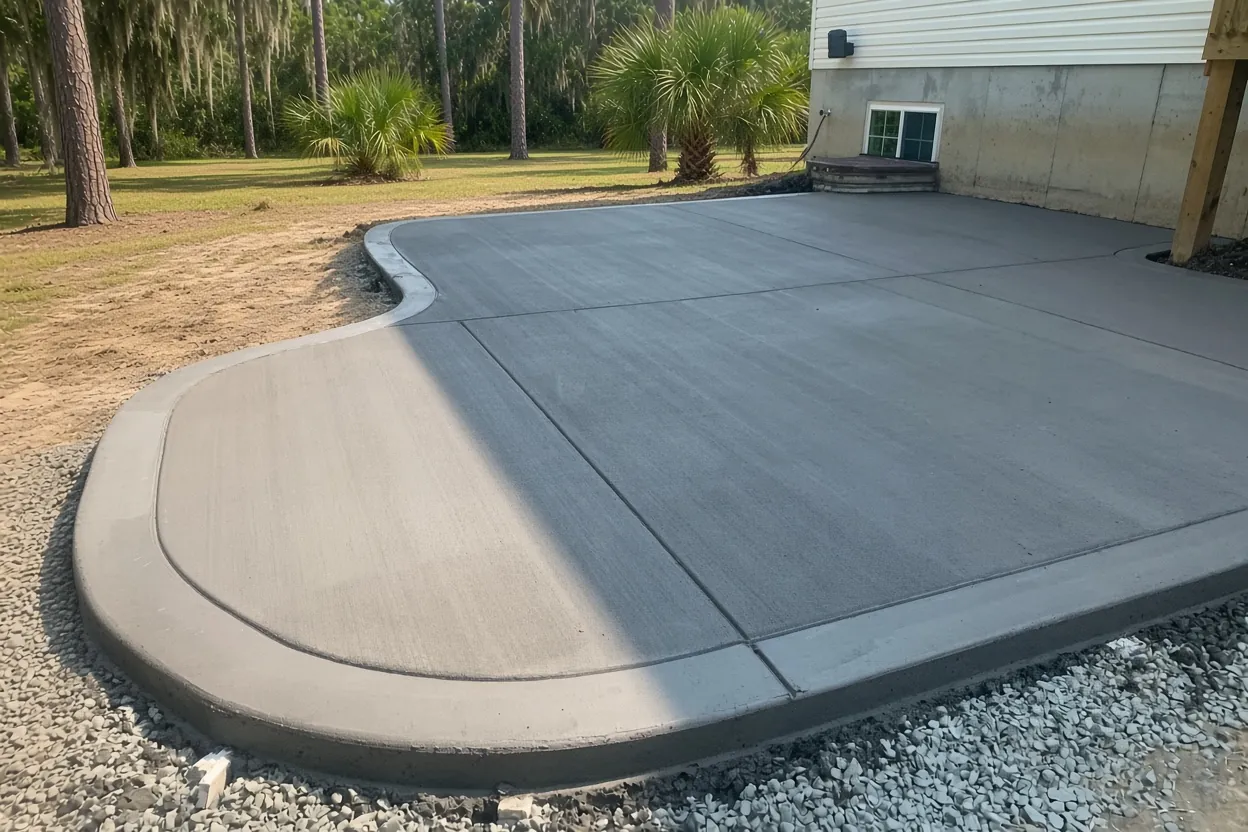
Might a screen room or a solid roof go over the slab someday? Tell us early, because it changes what goes under the concrete. The Florida Residential Code, in R506.2.3, calls for a 6-mil polyethylene vapor retarder between a slab and its base, but it exempts patios and other flatwork that aren't likely to be enclosed and heated later. An open backyard patio skips the sheet. A slab that could turn into a heated room is another story.
The sheet isn't free of trade-offs, either. NRMCA's guide to vapor retarders says they're mainly for interior slabs under moisture-sensitive floors, and that concrete placed right on one carries more risk of plastic shrinkage cracks and finishing delays. Tree cover averages about 8 percent here, so a patio pour is likely to happen in open sun. That's exactly when those precautions matter. Our concrete patios page covers lanai and screen-room slabs across the city.
Lake lots, ponds and Bridgewater's place off the protected-lakeshore list
National Wetlands Inventory mapping, served by Polk County, counts lake across about 26 percent of Bridgewater, freshwater pond across another 10 percent and a sliver of emergent wetland. That's a lot of backyard shoreline for one neighborhood. It's why we start a patio sketch here at the rear of the lot.
Lakeland's Land Development Code, Section 6.4, names eleven protected lakeshores where structures keep a 50 foot landward setback from the ordinary high water line: Beulah, Bonnet, Bonny, Crago, Gibson, Hollingsworth, Holloway, Hunter, Morton, Parker and Wire. Sick Lake, Lake Deeson and Country Oaks Lake, the named lakes closest to Bridgewater, aren't on it. Whether a ground-level patio counts as a structure under that setback is a question for the City, so ask about your lot.
Still, being off the list doesn't clear everything. The City says its own permits are required for shoreline projects on its lakes, other agencies may require theirs, and wetland rules can still reach the water's edge. Before any concrete heads toward the bank, call Lakes and Stormwater. If you're weighing a lot on a listed lake, our Lake Hollingsworth patio page shows how that setback plays out.
What It Costs
Patio prices in Bridgewater follow our standard ranges. What changes the figure is base repair on fill, the distance from the street to the backyard and any slope toward the water.
| Job | Per sq ft | Typical project | What moves the price |
|---|---|---|---|
| Backyard patio, plain or broom finish (about 250 to 450 sq ft) | $8 to $14 | $2,500 to $6,500 | Size, base repair, slope toward the water |
| Patio extension off an existing slab | $8 to $14 | Priced after the site visit | Isolation joint, matching the old finish |
| Lanai slab planned for a future screen room | $8 to $14 | Priced after the site visit | Edge detail, vapor retarder decision |
| Stamped or colored patio | Priced separately | Priced after the site visit | Pattern, color, sealer |
These are ranges, not quotes. Within 48 hours of seeing your yard, we send a free written estimate with base work and permits on their own lines.
Patio budgets under $7,500 and the flood-zone catch
Our typical patio, about 250 to 450 sq ft, runs $2,500 to $6,500. That puts most patios under the $7,500 line in Florida's HB 803, which took effect July 1, 2026 and has local governments exempt qualifying non-structural work on single-family homes from permits. Don't count on it being automatic. You file a written exemption request and get approval before work starts, structural work is excluded, and splitting one project into smaller ones to stay under the cap isn't allowed.
Now the catch: properties in a flood hazard area are left out. FEMA's flood layer puts about 44 percent of the neighborhood in Zone AE and another 1 percent in Zone A, with the rest in Zone X. Most of the AE area is the lakes, but lots along them can be touched by it. Hillsborough County's exempt-work page reads the rule as no exemption if any part of the property sits in a flood hazard area, and the City's building official makes the call on your lot.
Permits aside, Florida's lien law wants a Notice of Commencement recorded with the County Clerk before work starts on a direct contract over $2,500, with a copy to the building department once the contract passes $5,000. Nearly every patio in our range crosses the first line. Our Lakeland patio cost guide breaks the budget down by size.
Mine-spoil sand and fill behind the house: patio base, joints and termite rules
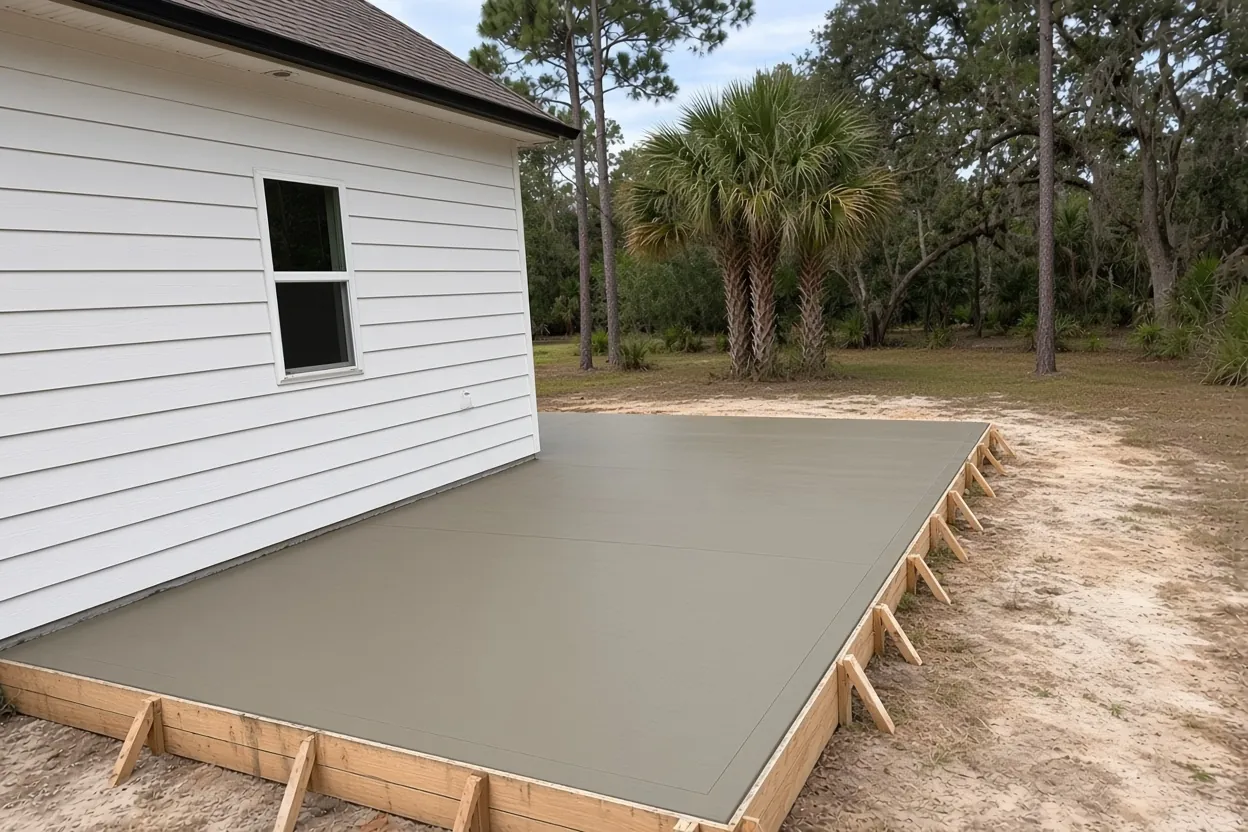
Most of the dry ground in this neighborhood is mapped as Arents, a fill unit, or Neilhurst, an excessively drained sand that formed in spoil from mining. Fill can change from one corner of a yard to the next, so the base can be probed at the house wall, the middle of the slab and the edge nearest the water. Where something soft or organic turns up, it can come out and clean sand can go back in compacted layers, priced on its own line.
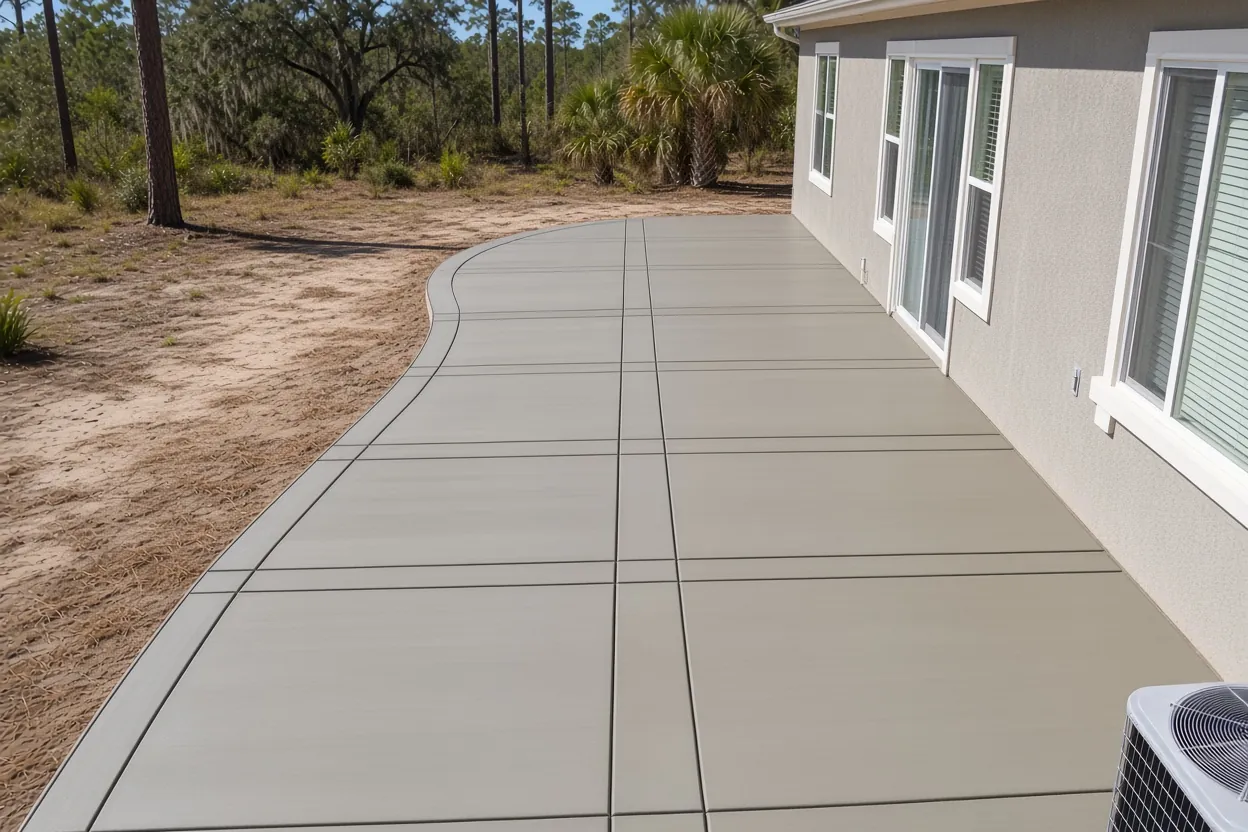
The 3 1/2 inch minimum in R506.1 is written for slab-on-ground floors, not patios, so your written quote states the patio thickness outright. R506 also asks those floor slabs for contraction joints per ACI 332 unless crack control comes from synthetic fibers or 6x6 welded wire in the middle to upper third of the slab. For a 4 inch slab, Concrete Network puts control joints no more than 10 feet apart and a quarter of the slab deep, and the joint layout shows on the quote.
Once a patio butts the house, termite rules come into it. On new construction with soil treatment, Florida's R318.1.6 calls for chemical treatment under exterior concrete within 1 foot of the home's walls. Villages 12 and 13 were platted in 2021, so some homes here are recent. Before the forms go in, ask your pest control company what protection is in place.
How Your Job Goes
Backyard walk
We look up the flood zone and measure to the water, and where the fill looks soft we can probe the base. Then we talk through any future cover.
Written quote
You get size, thickness, joints, base work and paperwork on one page within 48 hours.
Approvals
You check with the CDD and any association; we line up the City permit or exemption request.
Pour and cure
We time the pour around the heat, start curing right away for at least 3 days and leave the yard clean.
Little tree cover: finishes, sealer and shade over a Bridgewater patio
With canopy averaging around 8 percent, a patio here gets sun most of the day unless something is built over it. We won't promise a surface temperature for any finish. Layout is what works: put the seating where the house or a future cover throws shade at the hours you're outside, and leave the sunny side for the grill and the walkway to the lawn.
Finish has more to do with footing than heat. A broom finish leaves texture underfoot instead of a smooth trowel surface. Concrete Network says stamped concrete is often more slip resistant than smooth concrete because of its texture, but it can turn slippery when wet or under a film-forming sealer, and non-skid additives help in busy areas. Stamped work also needs cleaning and resealing about every 2 to 3 years. A Southwest Florida contractor reports that unsealed stamped color fades within one to two seasons of Florida sun, which is one practitioner's view, not a standard.
In open sun, pour timing matters. NRMCA's plastic shrinkage guidance suggests placing concrete in late afternoon or early evening when conditions are harsh, or early morning in very hot, dry weather, with sunshades or fog sprays as options. It also calls for curing to start quickly and run at least 3 days. Got a pool deck on your list too? We can price it at the same visit.
Sizing a patio for a village lot, and who to ask before the pour
Bridgewater counts 779 single-family houses and 120 townhomes, and its village plats under the Villages at Bridgewater master plat were recorded from 2006 to 2021. No two yards are the same, so we size from your survey and your furniture, not a stock number. A 12 by 16 slab is 192 sq ft, which works out to $1,536 to $2,688 at our per-foot rate. A 16 by 20 patio is 320 sq ft, or $2,560 to $4,480. A 20 by 22 slab off a wide lanai is 440 sq ft, or $3,520 to $6,160.
Settle the approvals before you lock in a size. The Bridgewater Community Development District was created by City Ordinance 01-079 in November 2001 and levies assessments for operations and maintenance. Whether it or an association reviews patios is something to confirm directly, so call the district manager and your association, ask whether a new slab or patio extension needs their review, and get the answer in writing. Either way, the City permit is still its own step.
Pour day is short. The prep is the real work. We set forms, place and finish the slab, start curing and leave your yard and the street clean. Planning the front of the house too? Our Bridgewater driveway page covers width and apron rules, and Riverstone and Sandpiper patio pages show how other neighborhoods differ. The neighborhood overview is on our Bridgewater concrete page.
Common Questions
What would a 12x16 slab off a Bridgewater lanai cost?
Can a Bridgewater patio be poured now and screened in later?
How do I keep a patio cool with so little tree shade in Bridgewater?
Does the City's 50 foot lakeshore setback reach a Bridgewater backyard?
My lakefront Bridgewater lot is in Zone AE. Does HB 803 still help?
Does a new patio against a Bridgewater home need termite treatment?
Who should I ask about community approval for a Bridgewater patio?
Sources
- Land Development Code, Sec. 6.4 Lake and Natural Habitat Protection (City of Lakeland (Municode))
- Wetlands NWI (Polk County GIS (U.S. Fish & Wildlife Service National Wetlands Inventory))
- NFHL MapServer: Flood Hazard Zones (FEMA)
- Work Exempt from Permits (Hillsborough County Development Services)
- Lakeshore Residents (City of Lakeland Lakes and Stormwater)
- 2023 Florida Residential Code, Chapter 5 Floors (R506) (UpCodes (Florida Building Commission text))
- CIP 29 - Vapor Retarders Under Slabs on Grade (National Ready Mixed Concrete Association)
- 2023 FBC-Residential Section R318 Protection Against Termites (Charlotte County, FL (reproducing FBC-R 8th Ed.))
- CIP 5 - Plastic Shrinkage Cracking (National Ready Mixed Concrete Association)
- Concrete Driveway Installation: 8 Essentials (Concrete Network)
- Stamped Concrete Basics (Concrete Network)