Shoreline lot or inland yard? Sort that out before sketching
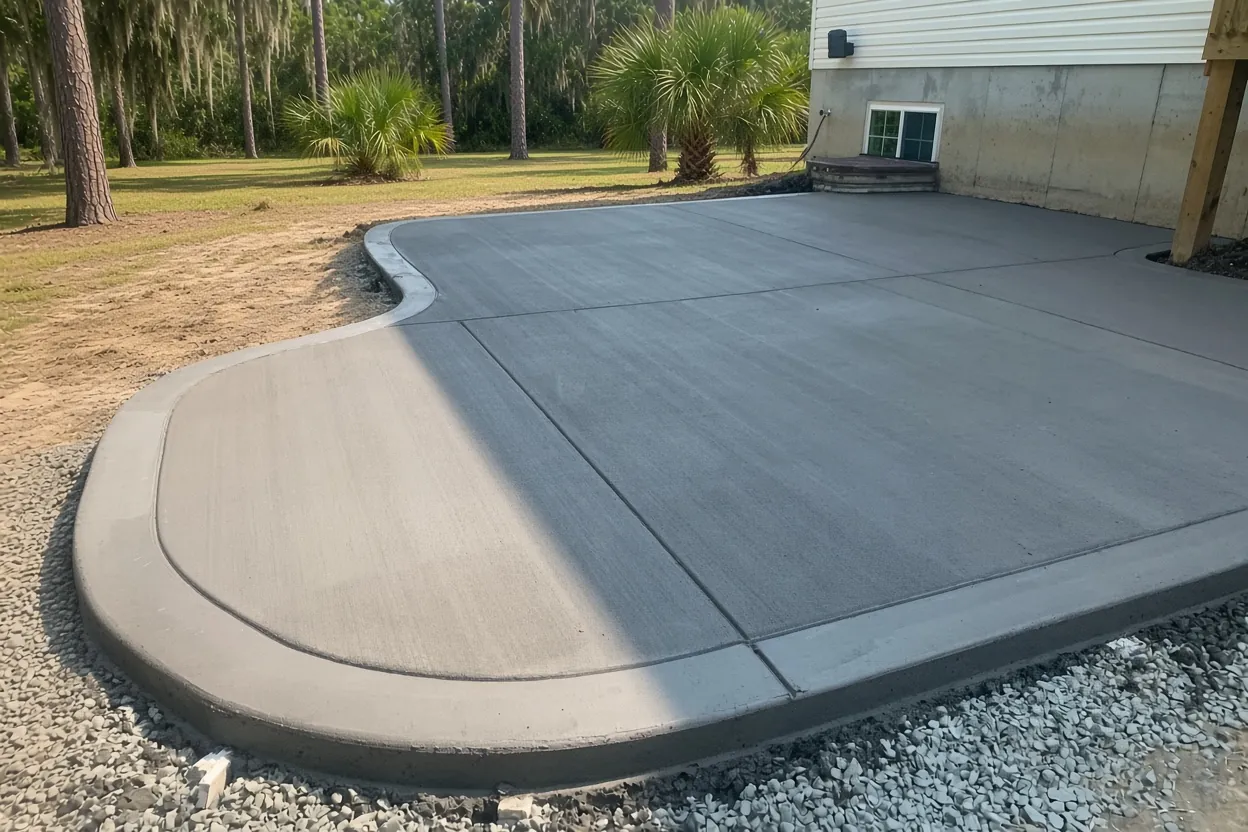
The Lake Hollingsworth neighborhood holds 1,333 single-family homes on the east and south sides of the lake, and only a small share back onto the water. The Polk County Property Appraiser codes 52 of its parcels as residential lakefront, and about 32 of those come within roughly 50 feet of the water. Everyone else has a plain City job on their hands: get the size right, get the slope right and build a solid base.
On a lakefront lot, the patio question starts at the water, not the back door. The City rule that sets that line comes next. Inland, around Cleveland Court Elementary, Horney Park or Handley Park? Skip ahead to soil and shade. Our concrete patios page covers the slab spec for the whole city, and the Lake Hollingsworth neighborhood page covers the rest of our concrete work around the lake.
Sec. 6.4 protected lakeshore: the 50 foot line from high water
Lakeland's Land Development Code names Lake Hollingsworth as one of eleven protected lakeshores. Lake Morton made the list too. Lake Somerset and Lake Bentley didn't. Under Sec. 6.4.3.2, all commercial, residential and industrial structures, main buildings and accessory ones alike, must keep a minimum landward setback of 50 feet from the ordinary high water line.
Here's the gap: the section never says whether a ground-level patio slab counts as a structure. Gravel paths, separate wood steps or platforms, raised boardwalks, docks and boathouses are listed as exempt, but a slab on grade gets no mention at all. So on a lake lot, the first question goes to the City's Lakes and Stormwater office, before any forms go down: does your patio fall under the setback? If it does and you need to come closer, the code lets the Manager of Lakes and Stormwater consider an administrative variance.
Two more lines in that section shape the job. Ground inside the setback has to keep a vegetative cover, and "barren soil shall not be exposed for a period exceeding one day." So any ground disturbed near the water has to be covered again quickly, and the quote lists the sod. The lake is also a parkway lake, with land within 500 feet of the high water mark between the public road and the water designated for parks and parkways. The City's lakeshore residents page says shoreline projects on City lakes need City permits, and other agencies may require their own.
What It Costs
These are our patio ranges for backyards around the lake. Before the number is final, the free visit settles the setback, the soil and the access.
| Patio job | Per sq ft | Typical project | What moves the price here |
|---|---|---|---|
| Backyard patio slab, plain or broom (250 to 450 sq ft) | $8 to $14 | $2,500 to $6,500 | Distance from the street on deep lots, sod in the setback |
| Screen-room or covered patio slab, 16 by 20 (320 sq ft) | $8 to $14 | $2,560 to $4,480 | Thickened edges for posts, retarder if it may be enclosed and heated |
| Patio extension off an old slab | $8 to $14 | Depends on size | Doweling into the old slab, matching height and finish |
| Tear-out of an old patio | adds $2 to $4 | Depends on size | Thickness, roots, haul-off |
Worked numbers are concrete math at our per-foot rate, not a quote. You get a free written estimate after we see the site, within 48 hours of the visit.
Fast-draining ridge sand, with a few slow and mucky pockets
Under the grass in most backyards here is sand. About 85% of the neighborhood maps as Candler or Tavares soil, and the NRCS description of Candler is "excessively drained." That's friendly ground for a patio slab. Water leaves fast, and once compacted it holds.
Patios go wrong in the odd spots. About 4% of the area is Sparr soil, which the NRCS calls somewhat poorly drained and moderately slowly to slowly permeable, so water sits longer after a summer storm. About 2.7% is organic muck, Samsula or Hontoon, the kind NRCS places in swamps and depressions. Organic soil compresses under a slab, so it has to come out. The Florida residential code wants fill under a slab free of vegetation and compacted for uniform support, and that's how we treat it whether the code reaches your patio or not.
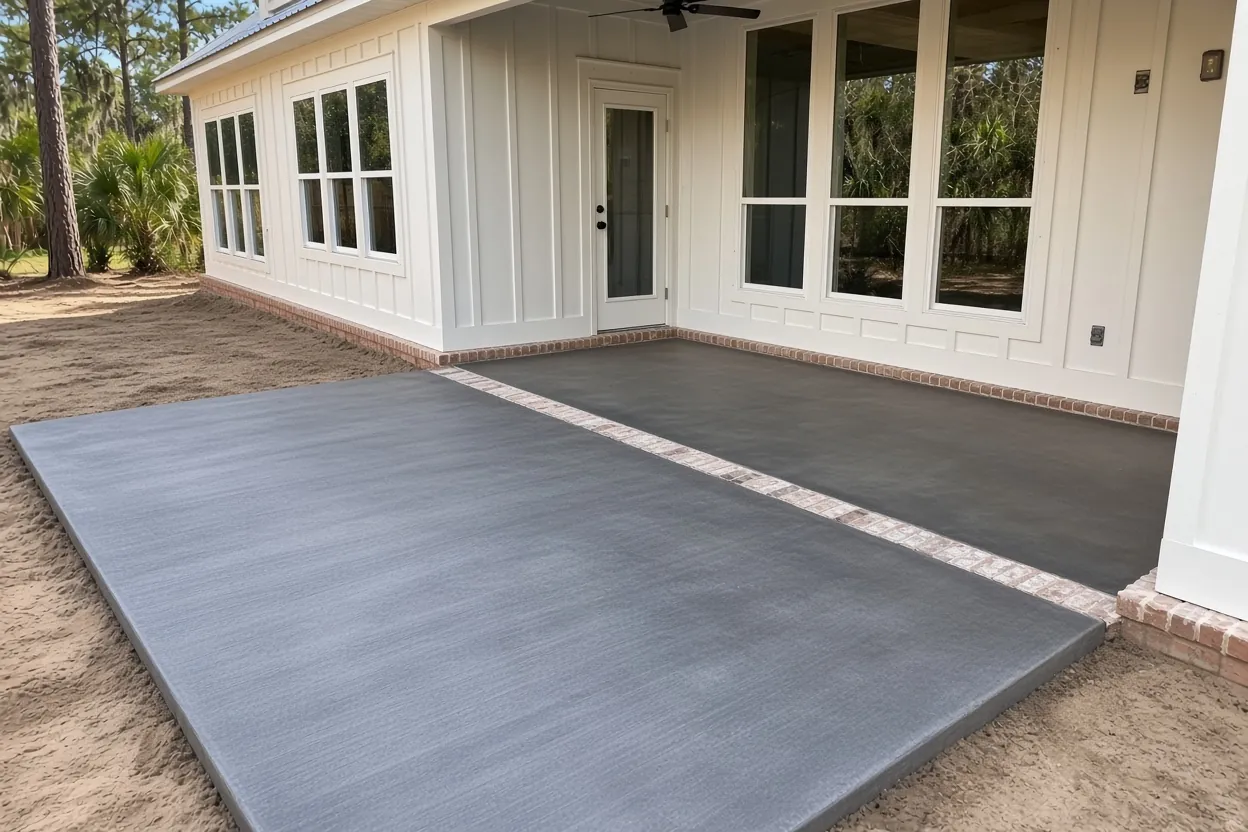
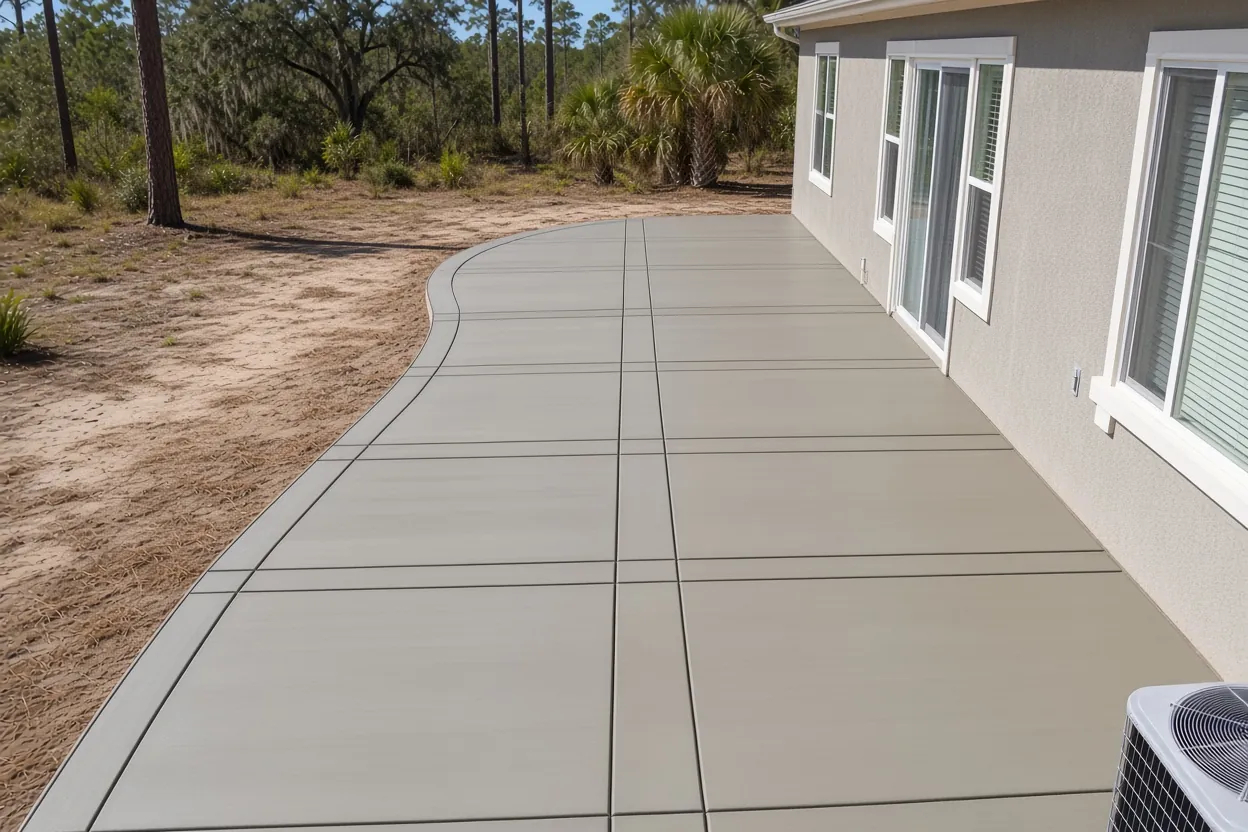
Then comes slope. A patio slab should pitch away from the house. On a lake lot, the water running off it should cross grass or a planted strip before it gets anywhere near the shore, which also helps keep that setback ground covered. Show us where puddles stand the morning after rain, and we'll look closer at that spot during the visit.
Against a 1950s wall: termite treatment and a future screen room
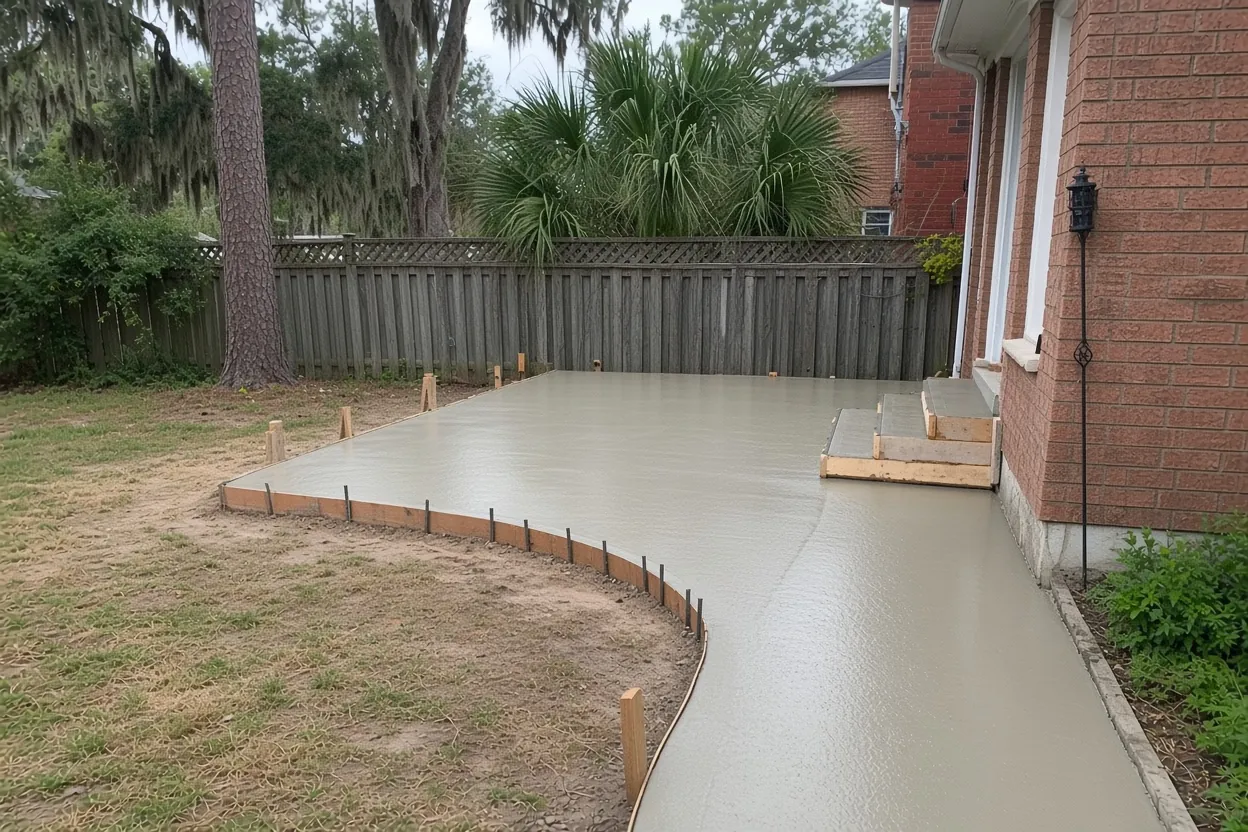
Half the homes here were built by 1955, per county records. Pour a patio against the back wall of one of those houses and two code points come up.
Start with termites. Florida Building Code R318.1.6 is a new-construction rule: when soil treatment is used, chemical treatment goes under all exterior concrete or grade within 1 foot of the house walls, plus a vertical barrier after the work is done. A 1950s house isn't new construction, but a new patio covers exactly that strip of soil. Ask your pest control company before the pour whether they want to treat it, because once the slab is down the soil under it is covered. The code text is on the FBC R318 reprint.
Next, think about the slab's future. R506.2.3 says a vapor retarder isn't needed under a patio unless it's likely to be enclosed and heated later. A screened enclosure isn't heated. A room you might someday enclose and heat as living space is another matter, and NRMCA adds that pouring straight onto a retarder makes finishing and curing trickier in hot weather. If a screen room or a conditioned room is the long-term plan, tell us now. Your answer decides the retarder, the thickness at the edges where posts or walls will land, and where the joints go, and all of it costs far less to settle before the pour than after.
How Your Job Goes
Lot check
We check whether your parcel touches the lake, so the setback question comes up on the first call.
Free yard visit
We measure, mark the slab, look for muck or soft spots and note the oaks, shade and the path for the concrete.
Written quote in 48 hours
Size, thickness, joints, finish and any retarder are listed line by line, with a note on termite treatment at the house wall.
City answers, then forms
Lake lots get the Lakes and Stormwater answer first. The Notice of Commencement is recorded before work starts on larger jobs.
Pour and cure
Morning pour in summer, curing right after finishing, disturbed ground covered, and a clean yard when we leave.
Oak shade, summer heat and a slab you can stand on barefoot
Shade is easy to find here. Tree canopy across Lake Hollingsworth averages 24.8% in the 2021 national land-cover data, and about 5.8% of it sits under 50% cover or more. Nothing keeps a patio comfortable in August more simply than that shade, so it pays to lay the patio out to catch it, ideally on the side of the house that gets afternoon shade.
Size counts as much as color. Lakeland's own historic-district guidelines list large expanses of concrete among the things that increase heat, and the physics is the same behind any house. A 12 by 16 slab under a canopy will feel very different from a 400 sq ft pad in open sun. Want more room? Think about a covered patio slab, or a screen room over part of it.
The trade-off is roots. UF/IFAS warns that live oaks near paved surfaces can lift and crack them. Forms can be set to stay clear of the big roots, and the quote flags any that run under the planned slab. Lakeland's tree-preservation section, LDC 4.5.10, carves out an exemption for single-family lots under one acre, but ask the City before you take down a big oak. If a pool deck is part of the plan, we can price that alongside the patio.
On pour day in summer, NRMCA's hot-weather advice is to skip the hottest part of the day and start curing right after finishing; a white-pigmented curing compound reflects heat. We schedule ours that way.
Patio sizes, our prices and the paperwork that comes with them
Our patio rate is $8 to $14 per sq ft for plain or broom finish, and a typical backyard patio of 250 to 450 sq ft lands at $2,500 to $6,500. Stamped finishes are priced separately. A few sizes worked out at that rate:
- 12 by 16 (192 sq ft): $1,536 to $2,688 in concrete at our per-foot rate. A slab this small can carry setup costs, and the written estimate shows them.
- 16 by 20 (320 sq ft): $2,560 to $4,480.
- 20 by 20 (400 sq ft): $3,200 to $5,600, a good size for a table plus a grill corner.
On a lake lot, two things can move the price: distance from the street, since concrete has to reach the back of a deep yard, and any sod work the setback ground needs.
The contract size brings two rules. Florida law requires a Notice of Commencement recorded before work starts on a direct contract over $2,500, which is where our typical patio range begins. Over $5,000, a copy also goes to the building department before the first inspection. And Florida's HB 803 exemption for small non-structural jobs leaves out properties in a flood hazard area. FEMA maps about 2.2% of the neighborhood in Zone A or AE, with a base flood elevation of 133.9 feet where it's published, and 62 single-family parcels touch it. Our patio cost guide runs more sizes, and the permit guide covers the City steps.
Common Questions
Can I pour a patio inside the 50 foot lakeshore setback on Lake Hollingsworth?
What would a 12 by 16 patio behind a Lake Hollingsworth house run?
Can you pour a slab now for a screen enclosure later on a lake lot?
How do I keep a backyard patio from getting too hot here?
Does a patio against my 1950s house need termite treatment?
Can I take out a backyard oak to make room for a patio?
Sources
- Land Development Code, Sec. 6.4 Lake and Natural Habitat Protection (6.4.2.1 Protected Lakeshores; 6.4.3.2 Minimum Setbacks) (City of Lakeland (Municode))
- Lakeshore Residents (City of Lakeland Lakes and Stormwater)
- SPARR Series (USDA-NRCS Official Soil Series Descriptions)
- CANDLER Series (USDA-NRCS Official Soil Series Descriptions)
- 2023 FBC-Residential Section R318 Protection Against Termites (Charlotte County, FL (reproducing FBC-R 8th Ed.))
- 2023 Florida Building Code, Residential, Chapter 5 Floors (R506) (UpCodes / ICC)
- CIP 12 Hot Weather Concreting (National Ready Mixed Concrete Association)
- Florida Statutes 713.13 Notice of commencement (The Florida Senate)
- Florida Statutes 713.02 Types of lienors and amounts of liens (The Florida Senate)
- Florida Statutes 713.135 Notice of commencement and applicability of lien (The Florida Senate)
- SAMSULA Series (USDA-NRCS Official Soil Series Descriptions)