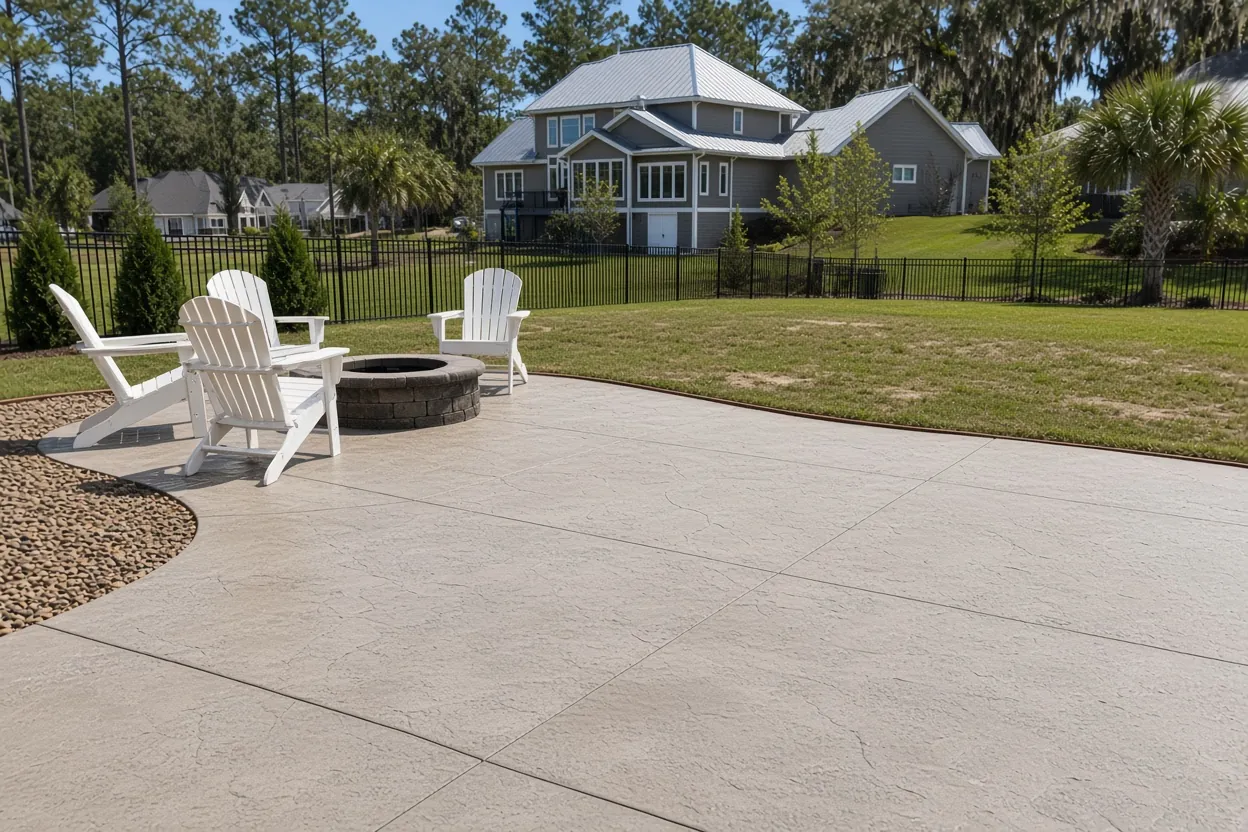
One poured slab or hundreds of set units
Both surfaces can look like stone or brick. The difference is what is underneath the look. Stamped concrete is a single slab, poured, colored and pressed with a pattern while it is soft, then cut with control joints. Pavers are precast units laid one by one on a compacted base and bedding sand, with sand swept into the joints and an edge restraint holding the field together. Concrete Network calls the two similar in appearance and both extremely durable.
So the useful questions are about years three through twenty. What happens when a root pushes up? What chore comes back every couple of years? How fast do you get the yard back? And in some Lakeland neighborhoods, which one is the committee going to approve? This guide takes those in order. If you already lean stamped, our stamped concrete page covers pattern, color and sealer choices, and concrete patios covers sizing a backyard slab.
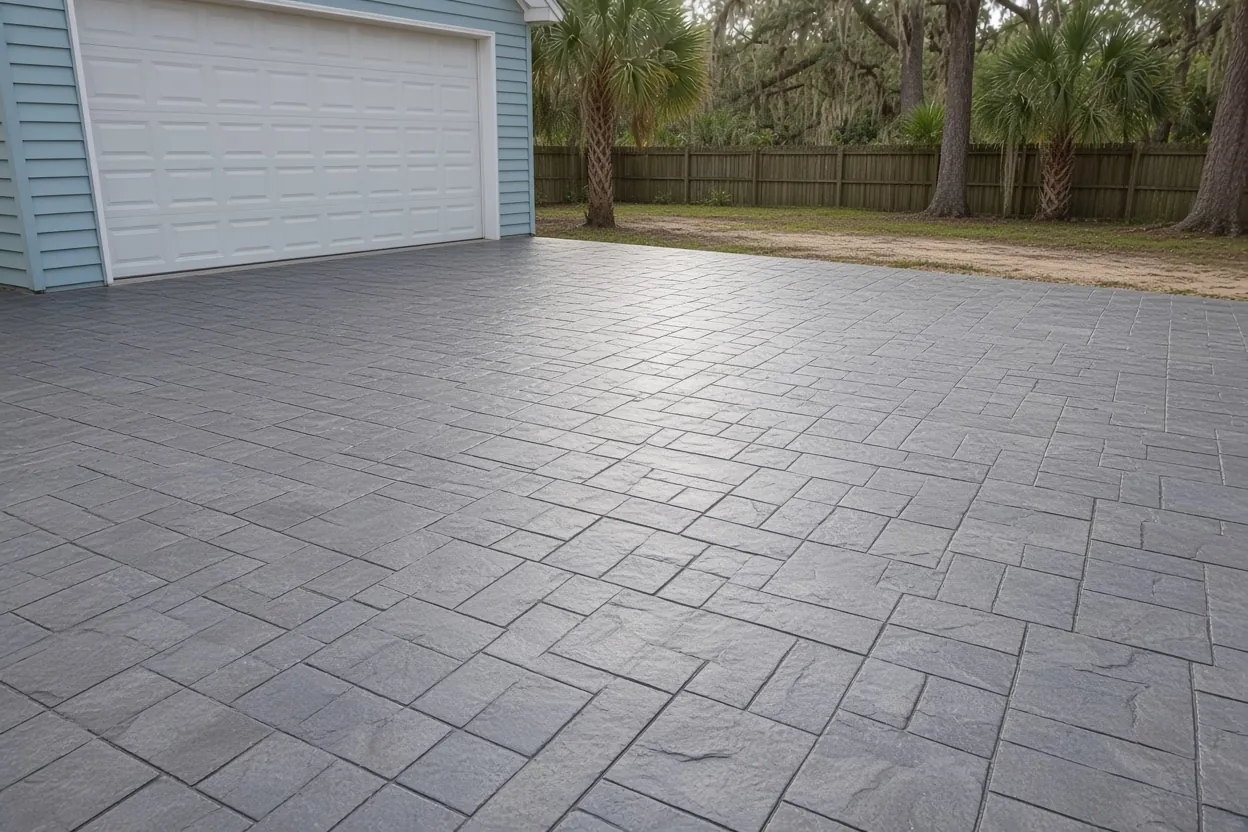
How each surface fails when an oak root pushes up
Historic districts such as Dixieland and Lake Hunter Terrace have mature canopy, and Beacon Hill uses the live oak as its neighborhood symbol. UF/IFAS says live oaks planted too close to curbs, sidewalks or driveways can grow roots large enough to lift and crack them (UF/IFAS live oak guide). A root does not care which surface sits on top. What changes is the damage.
A stamped slab is rigid. When a root lifts one area, the slab can crack across the pattern where no joint was cut, and the lifted piece stays lifted. Concrete Network says repairing stamped concrete is often harder and more costly than fixing pavers, and that a slab with major damage may need to come out whole. Patching a cracked stamped slab so the patch does not show is hard; Concrete Network says there is not much you can do to repair a cracked slab seamlessly.
Pavers are flexible. The units ride up over the root, shift and leave a hump, but nothing breaks. A sunken or damaged paver can be pulled and reset or replaced with no noticeable patchwork, Concrete Network says. With a root, that means lifting the units, dealing with the root the way a tree professional advises, regrading the sand and setting the same pavers back.
If a big oak sits within reach of the work, that alone can tip the choice to pavers, or to a stamped design that keeps the slab edge well back from the trunk.
What It Costs
These are our ranges for the stamped side of the comparison, so you can line them up against a paver price for the same area.
| Job | Per sq ft | Typical project | What moves the price |
|---|---|---|---|
| Stamped patio | $14 to $24 | $5,000 to $16,000 | Size, pattern, color layers and base work |
| Stamped driveway or entry | $14 to $24 | Priced after the site visit | Driveway thickness, apron and area |
| Stamped border on a plain slab | $14 to $24 for the stamped area | Priced after the site visit | Border width and length |
| Plain or broom patio, for comparison | $8 to $14 | $2,500 to $6,500 | Size, shape and drainage |
Ranges only. Pattern, color, base and access change the number, so we price your job in a free written estimate after we see the site.
Sandy ground under both: the base does the real work
Neither surface fixes bad ground. UF/IFAS says Florida's most widespread soil orders are sandy, and that sandy Entisols run more than 98 percent sand with low water-holding capacity (UF/IFAS soils publication). Both stamped concrete and pavers need a well-compacted, properly graded subgrade, and Concrete Network puts prep time at about the same for each.
Where they differ is how they react when the base slips. A slab over a soft spot can crack. Pavers can shift or settle and need releveling, Concrete Network says, but that fix means lifting a few units and adding bedding sand.
Either way, ask the installer three things. How deep is the base under the surface? How is it compacted, and in how many layers? Where does water leave the surface, and does it run toward the house or away from it? A quote that cannot answer those is pricing the top layer only. The edge is the fourth question: pavers need a restraint so the field does not creep, and a slab needs its edges formed and backfilled so sand does not wash out under them.
Joint sand and weeds against a reseal every 2 to 3 years
Every hard surface in a Florida yard has an upkeep chore. They are just different chores.
For pavers, it is the joints. Concrete Network says paver joints need sand topped up, depending on weather exposure maybe every 2 or 3 years, to keep weeds from growing in them, and that polymer sand, which binds and hardens in the joint, can cut that chore down.
For stamped concrete, it is the sealer. Concrete Network puts stamped resealing at about every 2 to 3 years, depending on traffic, weather and chemicals, and the sealer is what keeps the color layer from dulling. There is no sand to lose and no unit to wander. Our stamped concrete page covers sealer types and the first-coat timing.
Installed and maintained properly, both last 30 years or more, per Concrete Network. Be honest about which job you will actually do. A reseal is an afternoon with a roller once every few years. Joint sand is a broom and a bag, more often, plus pulling the weed that always finds a gap.
How Your Job Goes
Share the look
Send photos of the stamped pattern or paver style you like and the spot it goes.
Site visit
We measure, check drainage and nearby oaks, and judge the base.
Written quote
Pattern, color, sealer, base and area in writing, ready to compare with a paver price.
Approvals
Historic Minor Review or HOA approval is in hand before the pour is booked.
Pour, stamp and cure
The slab is placed, colored and stamped, cured, then sealed on schedule.
Install days against cure days: when you get the yard back
Pavers can be walked and driven on as soon as they are set and compacted. Placing them takes longer, since each unit is set by hand, and Concrete Network gives about three days as an average for a 2,000 square foot driveway. A patio a fraction of that size moves faster.
A stamped slab goes in quicker, and then waits. Concrete Network says poured concrete typically needs at least 24 hours before foot traffic and seven days before vehicles. The first sealer coat comes after that, once the slab has cured. In a Lakeland summer, afternoon storms can also move a pour date.
So the trade is a longer install with no wait, or a short install with a week of waiting. If you have a party, a pool fill, a moving truck or a car that has to get in the garage by a certain date, tell the installer the date first and work backward. For a driveway, also ask where you will park during the work, since a stamped driveway keeps cars off for about a week and a paver driveway is closed for the days it takes to lay it.
Price: why the two quotes often land close
Our stamped rate is $14 to $24 per square foot, which includes the pattern, base color, release color and a sealer, and typical stamped projects run $5,000 to $16,000. On a 300 square foot patio that is $4,200 at the low rate or $7,200 at the high rate, before any tear-out or extra base work.
On the paver side, Concrete Network says installs tend to cost more because every unit is hauled and set by hand, but also that the two are often very close and worth pricing side by side. Its own savings tip is to mix stamped sections with plain concrete fields, such as a stamped border around a broom-finish center. Read its full comparison in the Concrete Network stamped concrete vs pavers guide.
To compare fairly, both quotes should use the same measured area, the same base depth and the same edge detail. Then add the long-run cost: a reseal every 2 to 3 years for stamped, joint sand and the occasional reset for pavers. If one quote is far lower, check whether its base line is thinner. That is one place a gap can hide, and it is the part you cannot see once the job is done.
Lakeland rules that pick the surface for you
Before you fall for a look, find out who has to approve it. In Lakeland's local historic districts, the city's Design Guidelines for Historic Properties name concrete, brick and several kinds of porous pavers as fitting driveway materials, and any new or replaced permanent paving goes through a staff Minor Review. They also list alterations to brick streets at curb cuts as not acceptable, which matters on the brick-street blocks of Historic Lake Hunter Terrace and South Lake Morton. Our historic district driveway guide covers the filing.
HOA rules can be more specific. At The Lakes at Laurel Highlands, the ARC guidelines say patios must be pavers or concrete matching the home's materials in color and type, and driveway and sidewalk surfaces must stay consistent with the original materials and colors. A homeowner there who wants to change an original concrete driveway to pavers is asking the ARC for a change, not a repair. In Sandpiper, the Architectural & Appearance Committee reviews driveway expansions, repaving and paver installations, and must approve any change to existing concrete before work.
Get that answer in writing first. An HOA approval is not a city permit, and a city permit is not an HOA approval.
Heat underfoot and big open surfaces
A Florida patio in full afternoon sun gets hot, whichever surface you choose, and color plays a part. Lakeland's historic guidelines go as far as listing large expanses of asphalt or concrete that increase heat as not acceptable in the districts, which is a hint worth taking anywhere in town: break a big surface up.
Both materials let you do that. With stamped concrete, a border in a second color, a planting bed cut into the slab, or a plain broom-finish walkway between stamped rooms all reduce one wide, uniform surface. With pavers, a contrasting soldier course, a mix of unit sizes, or turf strips between pavers do the same. Concrete Network notes stamped color can be tuned with stains and color hardeners, while pavers come in the colors they are manufactured in.
Test before you choose. Ask for a stamped sample board and a few loose pavers, set them where the patio will go, and leave them out on a sunny afternoon. Touch them barefoot at 3 p.m. Your own yard, shade and breeze decide which feels better. If a screened lanai or a pool edge is part of the plan, put the samples there too, since that is where bare feet spend the most time.
Driveway, patio or front walk: which surface fits which job
A backyard patio is the easy case. Either surface works, so it comes down to the chore you prefer and the look. Stamped suits a patio where you want one continuous surface and color control. Pavers suit one where you may need to lift a section later, for a pipe, a root or a future pool line.
Driveways carry more weight. Concrete Network recommends at least 4 inches for a concrete driveway and thickened edges where heavy loads are likely (Concrete Network driveway essentials), so a stamped driveway is priced at driveway thickness, not patio thickness. A stamped border on a broom-finish driveway keeps the cost down. Our driveway cost guide works out what that looks like in dollars, and the concrete driveways page covers the build.
Front walks are about tie-ins. A stamped walk can be poured to meet a new stamped entry and porch in one design, and pavers can echo a brick porch or a brick street in an older neighborhood. Either way, ask how the walk meets the driveway and the steps, because that joint has to be planned on either surface. See concrete sidewalks and walkways for the concrete side.
Comparing a stamped quote with a paver quote
- Same area. Both priced on your measured square footage.
- Base. Depth, material and how many compaction passes.
- Edges. Paver edge restraint, or slab edge forming and backfill.
- Joints. Polymer or plain sand for pavers; control joint layout for stamped.
- Sealer. Type and first-coat timing for stamped; whether pavers get sealed.
- Roots and drainage. How each quote handles nearby oaks and where water goes.
- Approvals. Historic Minor Review or HOA letter, and who files it.
- Schedule. Install days, plus the days before you can walk on it or park on it.
Ready to price the stamped side? Call (863) 400-2934 or use the contact page. The site visit and the written quote are free.
Common Questions
Is stamped concrete or pavers better in Florida?
Which costs more, stamped concrete or pavers?
What happens to each surface when an oak root grows under it?
Is polymer sand worth it for a paver patio?
Can cars use a paver driveway sooner than a stamped one?
Does The Lakes at Laurel Highlands allow a paver patio?
Are pavers allowed on a driveway in a Lakeland historic district?
Can a crack in stamped concrete be repaired so it does not show?
Sources
- Stamped Concrete vs. Pavers (Concrete Network)
- Stamped Concrete Basics (Concrete Network)
- Concrete Driveway Installation: 8 Essentials (Concrete Network)
- Design Guidelines for Historic Properties (City of Lakeland)
- Architectural Review Committee Guidelines (The Lakes at Laurel Highlands HOA)
- Sandpiper ACC Policies & Procedures 2024 (Sandpiper POA)
- Live Oaks (UF/IFAS Gardening Solutions)
- SL441/SS655: Agricultural Soils of Florida (UF/IFAS Extension)