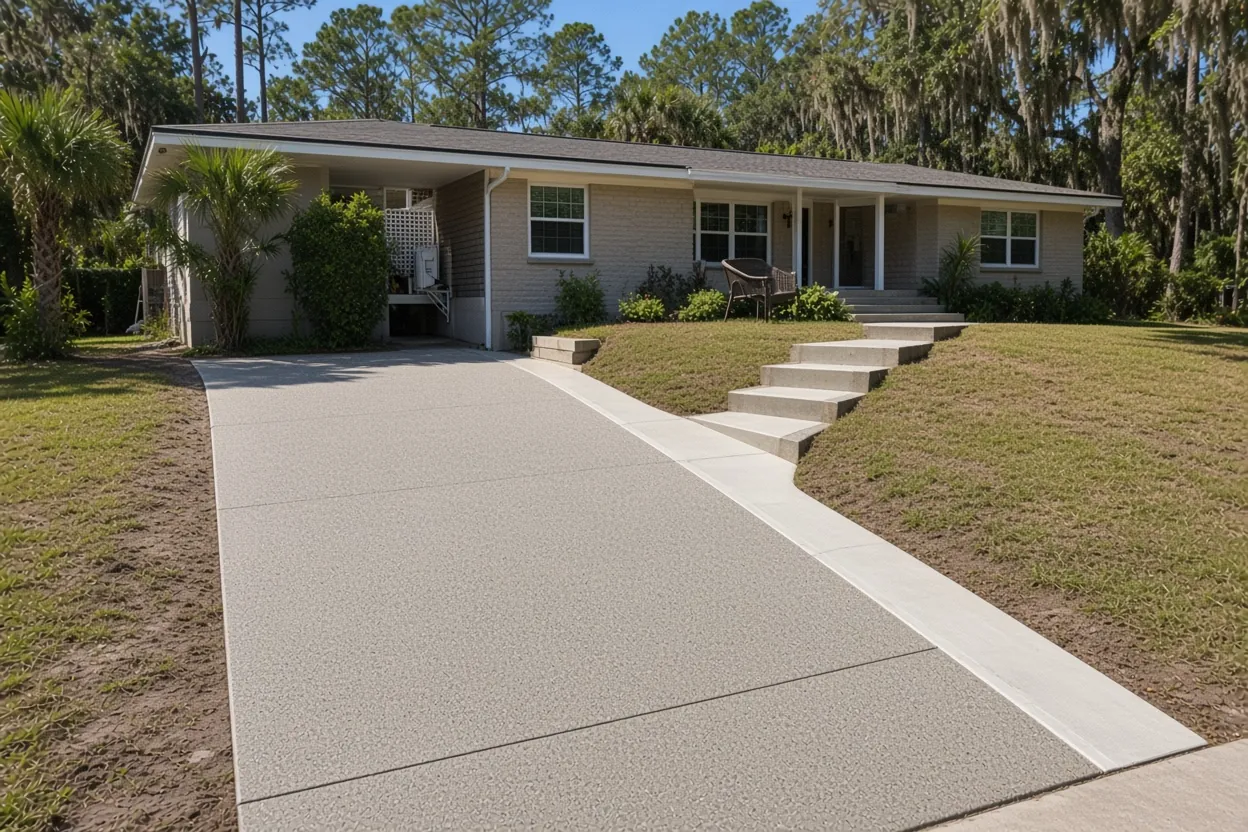
Start with what parks on it: cars, a work truck or a trailer
The first question we ask about a concrete driveway in Lakeland isn't the size. It's what will sit on it. Two sedans, a three-quarter-ton pickup with a toolbox, a boat on a trailer and a motorhome each call for a different slab, and that choice sets thickness, steel and price more than square footage does.
From there, the job is either fresh ground, a widening beside an old slab, or a full tear-out. A driveway extension ties into concrete that has already moved, so the joint between old and new matters. A tear-out adds demolition and a fresh base. A new pour on bare ground needs the most grading. Each one changes the quote, and we cover each below. If you want a pattern or color instead of broom finish, see stamped concrete, and for dollar figures by size, read the driveway cost guide.
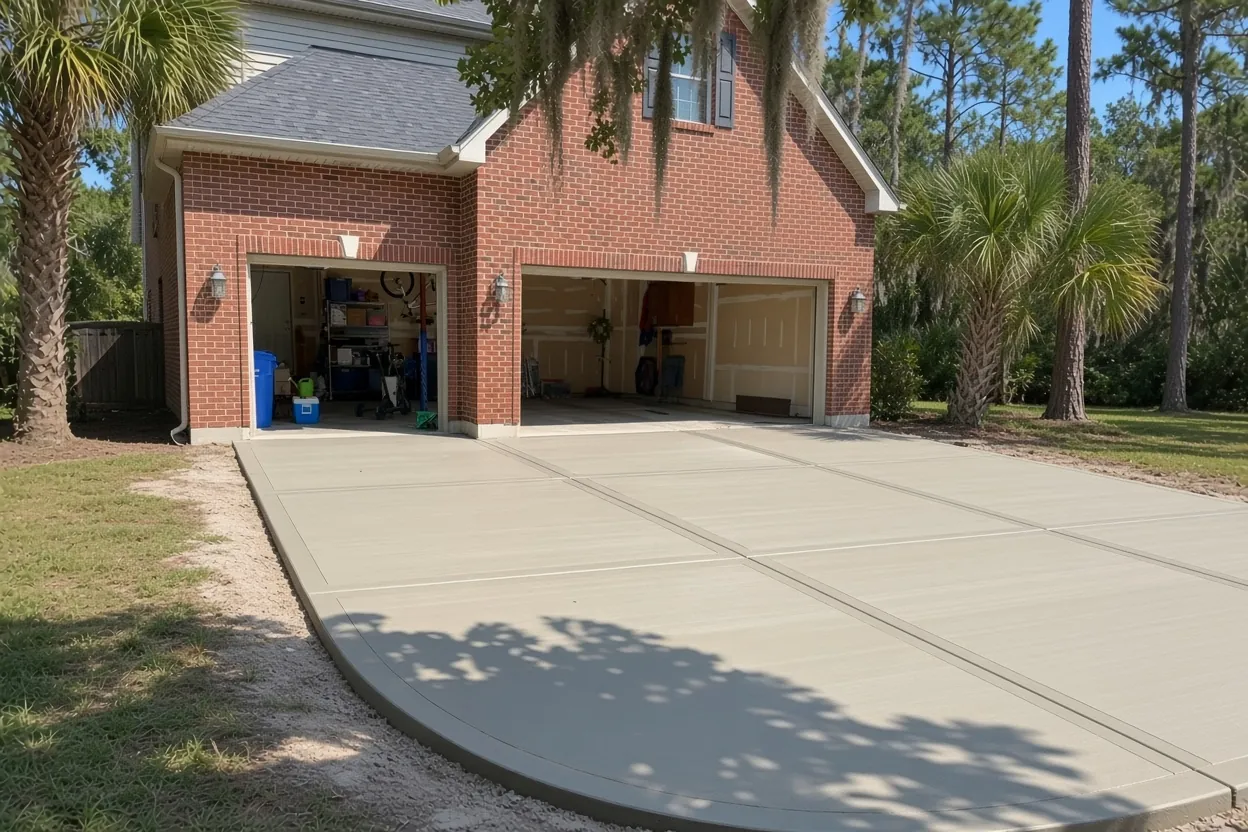
Slab spec: 4 to 6 inches, mesh or rebar, joints every 10 feet
Four inches is the working minimum for a concrete driveway that only sees cars. Concrete Network notes that a fifth inch adds about 20 percent to the concrete cost and close to 50 percent more load capacity, and it suggests 5 to 6 inches where RVs, delivery trucks or heavy pickups park. It also recommends thickened edges, an extra inch or two along the sides where tires roll off. Our range assumes a 4 to 5 inch slab.
Steel follows thickness. Wire mesh suits a 4 to 5 inch slab, and rebar on roughly a 12 inch grid suits 5 inches and up. Synthetic fibers help with early shrinkage cracks, but NRMCA says they must not replace structural steel, thin the slab or stretch the joint spacing.
Joints are where a driveway decides how it cracks. On a 4 inch slab, control joints go no more than 10 feet apart and get cut a quarter of the depth, which is 1 inch. Isolation joints go where the new slab meets the garage floor, the walk and any old pavement, so each piece can move on its own. The apron mix and dimensions follow the city's Engineering Standards Manual, not a number we pick.
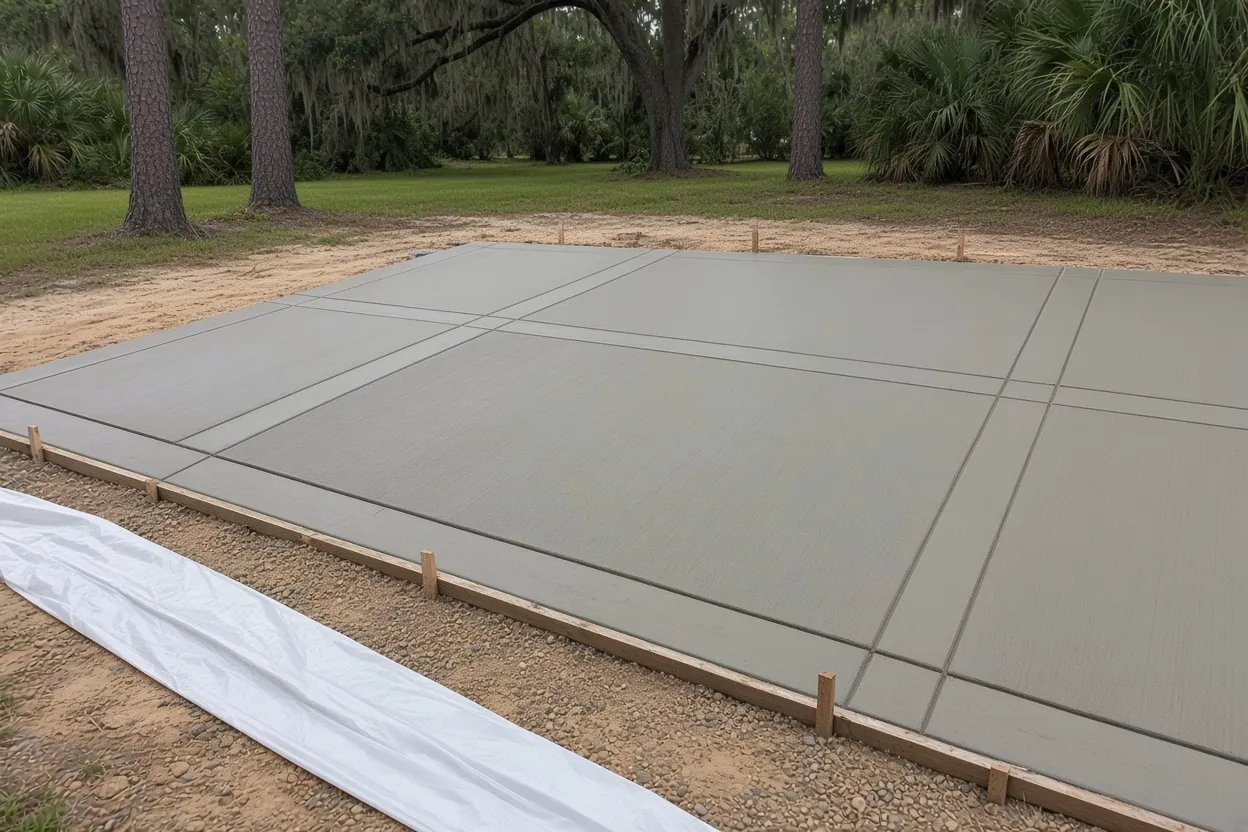
What It Costs
Our range for a 4 to 5 inch broom-finish driveway is $8 to $14 per sq ft. A typical two-car driveway of about 500 to 700 sq ft runs $5,000 to $10,000.
| Job | Per sq ft | Typical project | What moves the price |
|---|---|---|---|
| New two-car driveway, broom finish | $8 to $14 | $5,000 to $10,000 | Size, grade, base work and access for the truck |
| Widening or extension | $8 to $14 | Priced after the site visit | Tying into the old slab with the right joints, HOA setbacks |
| Tear-out and replacement | $8 to $14 plus $2 to $4 tear-out | Priced after the site visit | Old slab thickness and steel, haul-off, base repair |
| Heavy-vehicle driveway (RV, work truck) | $8 to $14 plus thickness | Priced after the site visit | 5 to 6 inch slab, rebar, thickened edges |
Apron work in the right-of-way and permits are listed on their own lines. These are ranges, not a quote. You get a free written estimate after we see the site. The driveway cost guide works through sizes.
The apron and the city: Building Inspection, Public Works and a pre-construction call
Lakeland splits a driveway between two divisions. Building Inspection processes the residential driveway permit, and Public Works Engineering inspects the work. Public Works inspectors also have to be notified through the city's iMS or IVR system for a pre-construction meeting at least 48 hours before site work begins.
The apron is the second permit. Work of any kind in city right-of-way needs a Right-of-Way Use Permit before it starts, and a Maintenance of Traffic plan is required for detours, lane closures and construction work in city rights-of-way. The apron also has to meet the Roadway and Drainage Standards volume of the Engineering Standards Manual, which addresses driveways, sidewalks, curbs and curb ramps. The permit rules are on the city's permit inspection page.
Two state rules can apply too: the Notice of Commencement (recorded on contracts over $2,500, with a copy to the city over $5,000) and the HB 803 exemption for some small jobs, which takes a written request to the building department first. Our Lakeland permit guide explains both, and your quote lists which apply.
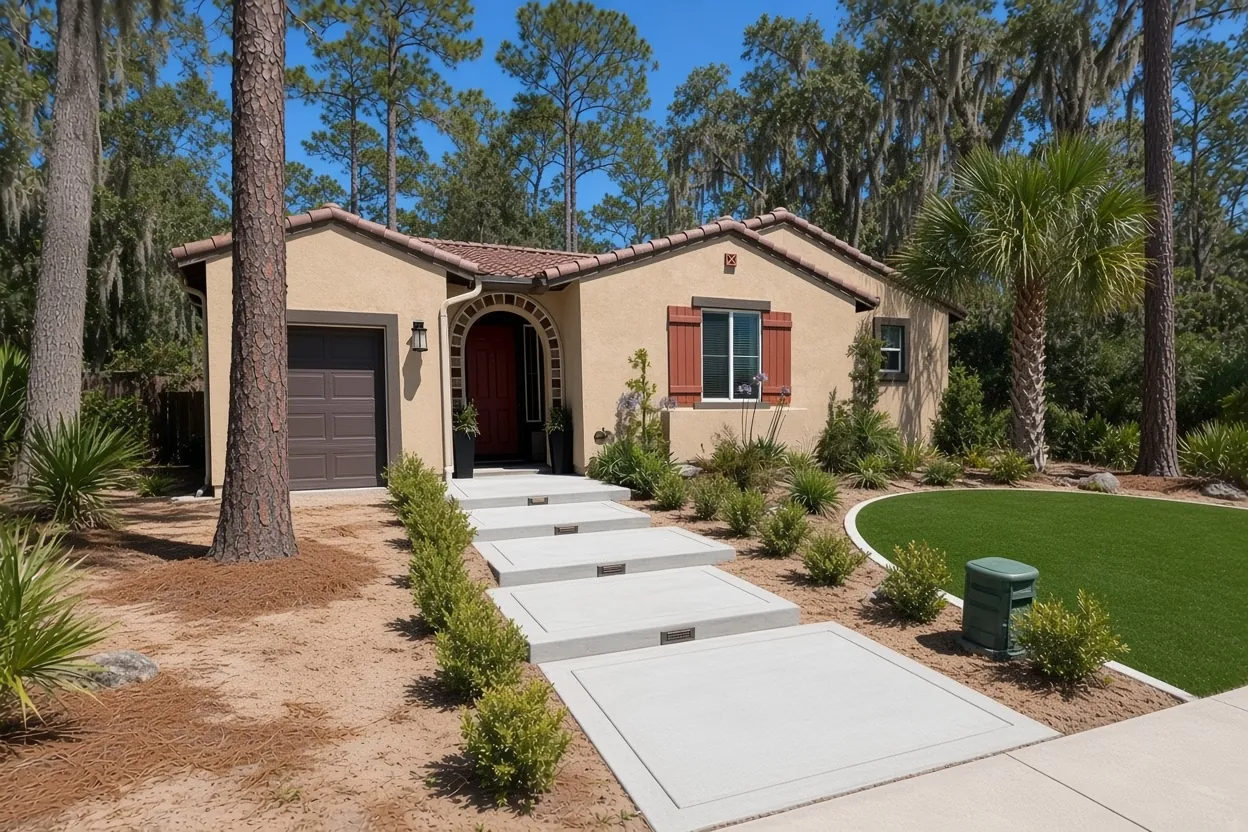
Ten feet wide and to one side: driveways in the historic districts
The city's historic-district guidelines treat a concrete driveway as part of the house's look, not just parking. A historic driveway there typically runs along one side of the house, usually no wider than ten feet, toward a carport, porte cochere or garage at the side or rear. Widths beyond ten feet are on the not acceptable list. If you need room for two cars, tandem parking along the side, one car behind the other, is acceptable for up to two vehicles.
Shape and edges matter as well. A semi-circular driveway is not acceptable in any district except Beacon Hill. A ribbon driveway, two concrete strips under the wheels with grass between, is a historic pattern the guidelines describe, and concrete, brick and porous pavers are all listed as fitting materials. The apron needs care on a brick street, because altering the brick at a curb cut is not acceptable.
All new or replaced paving in a district needs a staff Minor Review before the permit. Owners in Historic Dixieland and Historic Lake Morton, where lots are narrow and detached garages are common, should read our historic district driveway guide before settling on a width.
How Your Job Goes
Site visit
We measure, mark the slope, look at the trees and the old slab, and ask what will park on it.
Written quote
Thickness, steel, joints, finish and each permit or HOA approval are spelled out in writing.
Approvals and pre-construction notice
Committee approval, Minor Review if needed, the driveway permit and the right-of-way permit, then the 48-hour notice to Public Works.
Tear-out and base
Old concrete comes out if needed. We grade and compact the sand base, then set forms and steel.
Pour, finish and joint
We pour early, finish with a broom texture, and cut or tool the control joints.
Cure and hand back
Curing starts right after finishing. We tell you when to walk on it and when to park.
Base, grade and the water coming off a two-car slab
A two-car concrete driveway sheds a lot of rain, and it all goes somewhere. We grade the slab so water runs to the street or the yard, away from the garage door and the house. On Florida's sandy ground, UF/IFAS describes the sandiest soils as more than 98 percent sand, so a base that is compacted well holds up, and one that is left loose washes out at the edges.
The Florida residential code wants fill under a slab cleared of roots and debris and compacted for uniform support. A driveway is flatwork rather than a house floor, but the same logic holds. The code also skips the plastic vapor retarder under driveways, and NRMCA notes that pouring straight onto plastic raises the risk of surface cracking in heat. So the base is sand, compacted and graded, with no sheet.
Lake lots need the most thought on slope. Around Lake Hollingsworth, Lake Bonny and Lake Bentley, where the yard falls toward the water, a driveway that dumps runoff toward the shoreline is a problem for you and the lake. We mark the fall of the lot at the visit and plan the pitch from there.
Tear-out jobs: what comes out, what goes back and what it adds
A concrete driveway replacement means breaking out the old slab, hauling it off, fixing whatever made it fail, and then pouring new. Tear-out adds $2 to $4 per sq ft to our concrete driveway range, depending on how thick the old slab is and whether it has steel in it. On a 600 sq ft driveway, that is about $1,200 at the low end and $2,400 at the high end, on top of the new concrete.
The failure matters more than the cracks. A slab that sank in one corner can point to a soft spot or washed-out base, and pouring over it again repeats the problem. A slab that cracked beside an oak may have roots under it. A slab that heaved at the garage may be missing an isolation joint. We look at the pattern before we price, and the quote says what we are fixing underneath.
The same permits apply to a driveway replacement as to a new concrete driveway installation, including the apron and, in a historic district, the Minor Review. The guidelines call a coordinated replacement of driveway and walk with consistent materials acceptable, so it can make sense to redo the front walk in the same pour. See sidewalks and walkways for that side of the job.
Oaks next to the slab: roots, tree permits and layout
If your driveway runs beside a live oak, start with the roots. UF/IFAS warns that oaks planted close to driveways can grow roots big enough to lift and crack them. If your slab has a raised panel near a trunk, a new pour in the same spot will meet the same roots.
The fixes are in the layout. We can shift a widening to the far side, narrow the slab where it passes the tree, or set a joint so the slab breaks cleanly instead of across the middle. Cutting big roots is a decision we make with you, never a default.
Taking a tree out needs a city Tree Removal Permit, and in a historic district the guidelines list cutting large shade trees as not acceptable. Sunshine 811 gets contacted before any digging so its member utilities mark their lines, a free service, and that happens before the tear-out starts.
Sandpiper setbacks and Laurel Highlands colors: HOA driveway rules
Two Lakeland communities publish clear driveway rules. In Sandpiper, every driveway expansion, repave or paver job goes to the Architectural Committee first, with a sketch showing distances. A new or wider driveway cannot cross the 5 foot side setback in Sandpiper West or 7 feet in Sandpiper East, it has to keep 5 feet from planting beds, trees and structures so mowers can get through, and parking more than two vehicles on a lot needs special arrangements.
At the Lakes at Laurel Highlands, driveway and walk surfaces have to stay consistent with the original materials and colors and be kept free of oil and stains, and every application needs a site plat showing the location and size of the work. The committee has 30 days to act. In both places, the committee's approval comes before the city permit, not instead of it.
Bring the approval letter, or the rules you have, to the estimate. We draw the slab to the setback and note it on the quote.
Pour day and the first week on a new driveway
From late May into October, summer storms set the schedule, so driveway pours go early in the day and we keep covers on hand. Heat is the bigger enemy on a big flat slab. NRMCA's guidance is to avoid the hottest hours when you can, never add water at the site beyond the mix design, and start curing the moment finishing ends.
Curing runs at least 3 days in hot weather, using wet burlap, plastic sheeting or a curing compound. Keep cars off for at least 7 days, and we tell you when heavier vehicles can go on. A new driveway can also show fine surface cracks if it dries too fast in wind, which is why curing starts right away and not the next morning.
Plan on a week without the driveway. Park on the street or in a neighbor's spot, keep sprinklers off the fresh slab, and watch for delivery trucks on the apron.
Common Questions
How thick should a concrete driveway be in Florida?
Rebar, wire mesh or fiber for a driveway?
Can I widen a historic-district driveway to fit two cars side by side?
Who inspects the apron where my driveway meets the street?
How much does tear-out add to a driveway replacement?
Will a driveway extension match my old slab?
How long before I can park on a new driveway?
Sources
- Engineering Permit Inspection Information (City of Lakeland Public Works Engineering)
- Engineering Standards (City of Lakeland Public Works)
- Design Guidelines for Historic Properties (City of Lakeland)
- Concrete Driveway Installation: 8 Essentials (Concrete Network)
- CIP 24 - Synthetic Fibers for Concrete (NRMCA)
- 2023 Florida Building Code, Residential, Section R506 Floors (UpCodes / ICC)
- CIP 12 - Hot Weather Concreting (NRMCA)
- Sandpiper Architectural Committee Policies and Procedures 2024 (Sandpiper Property Owners Association)
- Sandpiper Architectural Rules and Restrictions 2019 (Sandpiper Property Owners Association)
- ARC Guidelines (The Lakes at Laurel Highlands HOA)
- Live Oaks (UF/IFAS Gardening Solutions)
- CIP 5 - Plastic Shrinkage Cracking (NRMCA)
- Agricultural Soils of Florida (SL441/SS655) (UF/IFAS Extension)
- Florida Thunderstorm Season / Rainy Season (NOAA National Weather Service Tampa Bay)
- Sunshine 811 (Sunshine State One-Call of Florida)
- CS/CS/HB 803 Enrolled Bill Text (The Florida Senate)