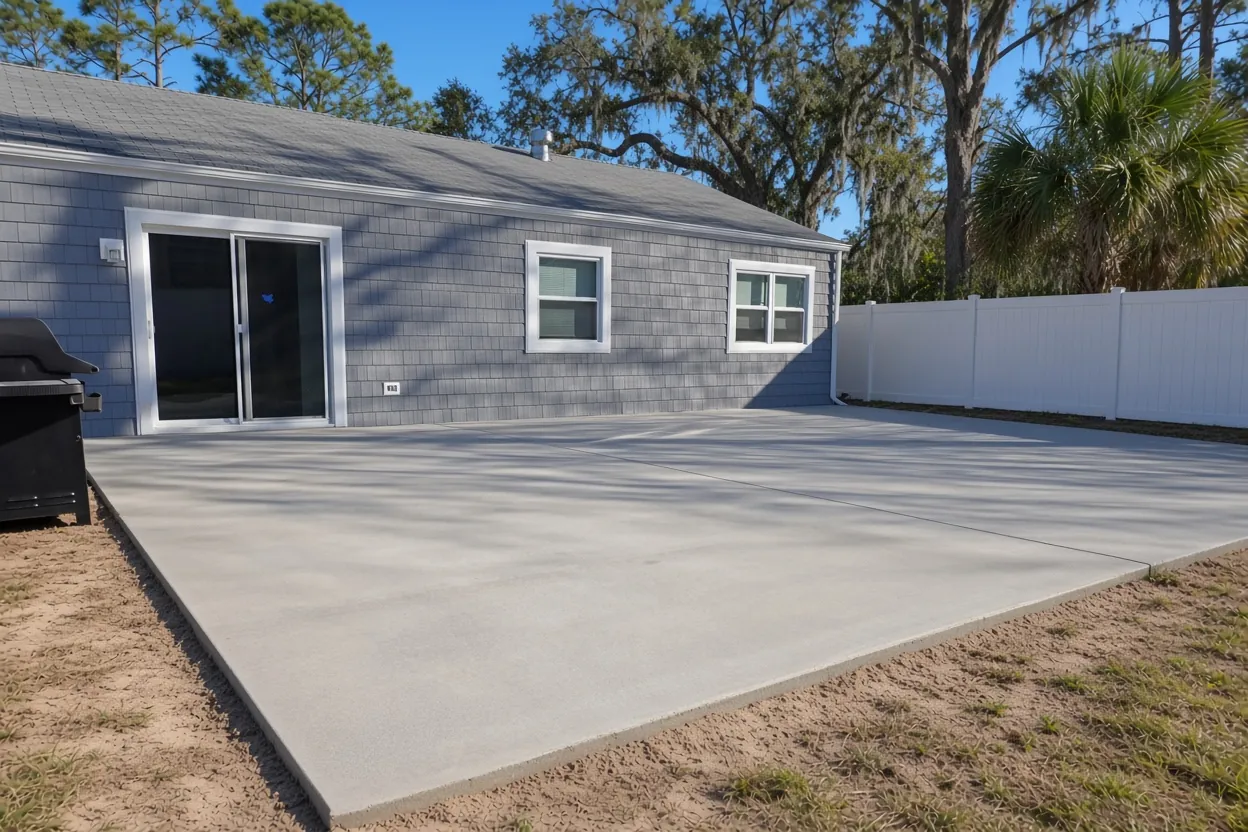
Our patio range and what it buys
Plain or broom-finished concrete patios from Lakeland Concrete Co run $8 to $14 per sq ft, and our typical patio project lands at $2,500 to $6,500. That range is for a slab of about 250 to 450 sq ft: forms, a compacted base, the pour, a broom finish, joints and curing. Stamped and colored work is priced on its own scale at $14 to $24 per sq ft, with typical stamped projects from $5,000 to $16,000.
The spread is wide for a reason: no two backyards match. Two 14 by 20 patios can sit far apart once one needs an old slab broken out, an oak root cut back or concrete wheeled a hundred feet past the side gate. The rest of this guide does the multiplication first, then walks through each line that pushes a Lakeland patio quote up or down, so you can read ours, or anyone's, line by line.
For how the job runs from the first visit to the cure, see our concrete patios page. When you want your own number, it comes from the free on-site estimate.
Five patio sizes multiplied out
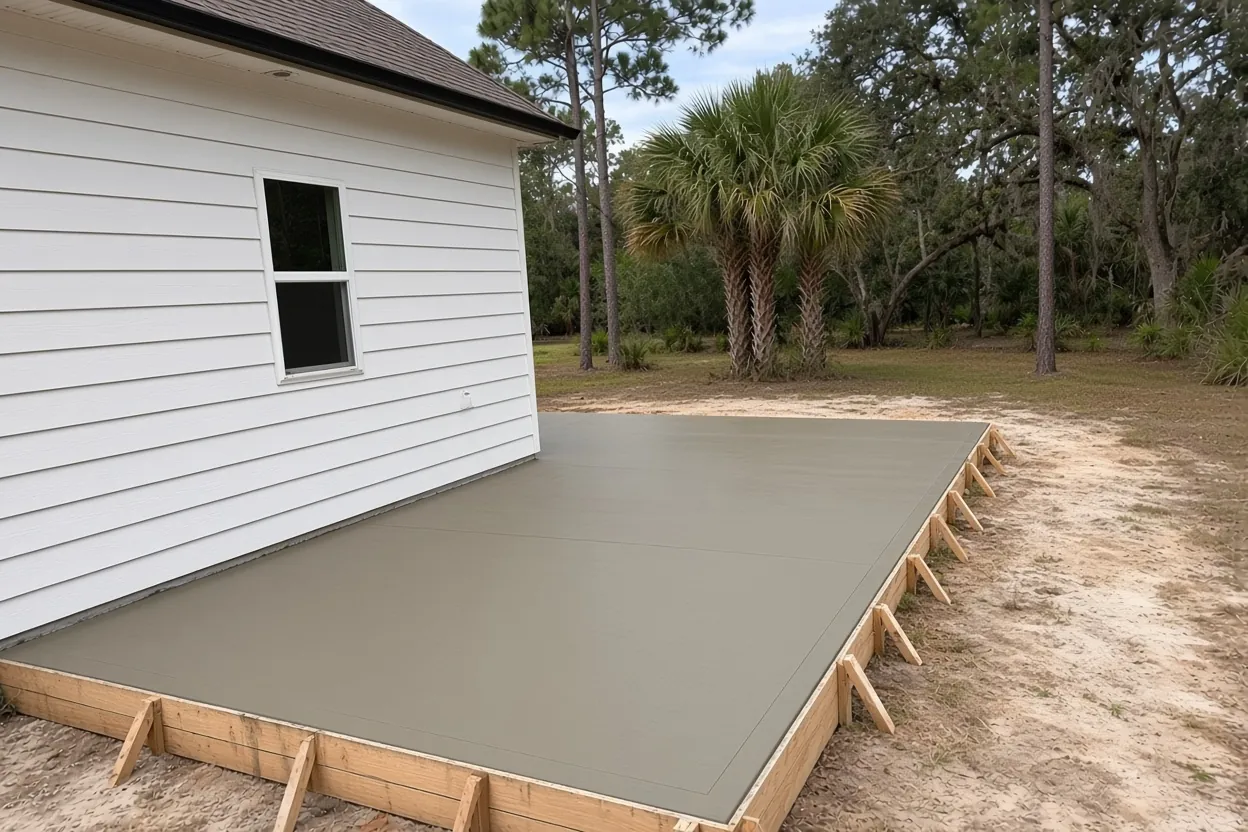
Length times width gives square feet. Multiply that by the low and high end of our range and you have the opening ballpark for a broom finish and for stamped.
| Patio size | Sq ft | Broom at $8 | Broom at $14 | Stamped at $14 | Stamped at $24 |
|---|---|---|---|---|---|
| 10 by 10 ft | 100 | $800 | $1,400 | $1,400 | $2,400 |
| 12 by 16 ft | 192 | $1,536 | $2,688 | $2,688 | $4,608 |
| 14 by 20 ft | 280 | $2,240 | $3,920 | $3,920 | $6,720 |
| 16 by 24 ft | 384 | $3,072 | $5,376 | $5,376 | $9,216 |
| 20 by 30 ft | 600 | $4,800 | $8,400 | $8,400 | $14,400 |
The top two rows come in under our typical project for a reason: a 10 by 10 slab still needs a truck, forms, a crew and a finish, and that setup does not shrink with the slab. Expect a small patio to price above straight multiplication. From 16 by 24 up, a broom quote can cross $5,000, and stamped work crosses it sooner. Past that line the city also needs a copy of the recorded Notice of Commencement covered below, which Florida requires on jobs over $2,500.
What It Costs
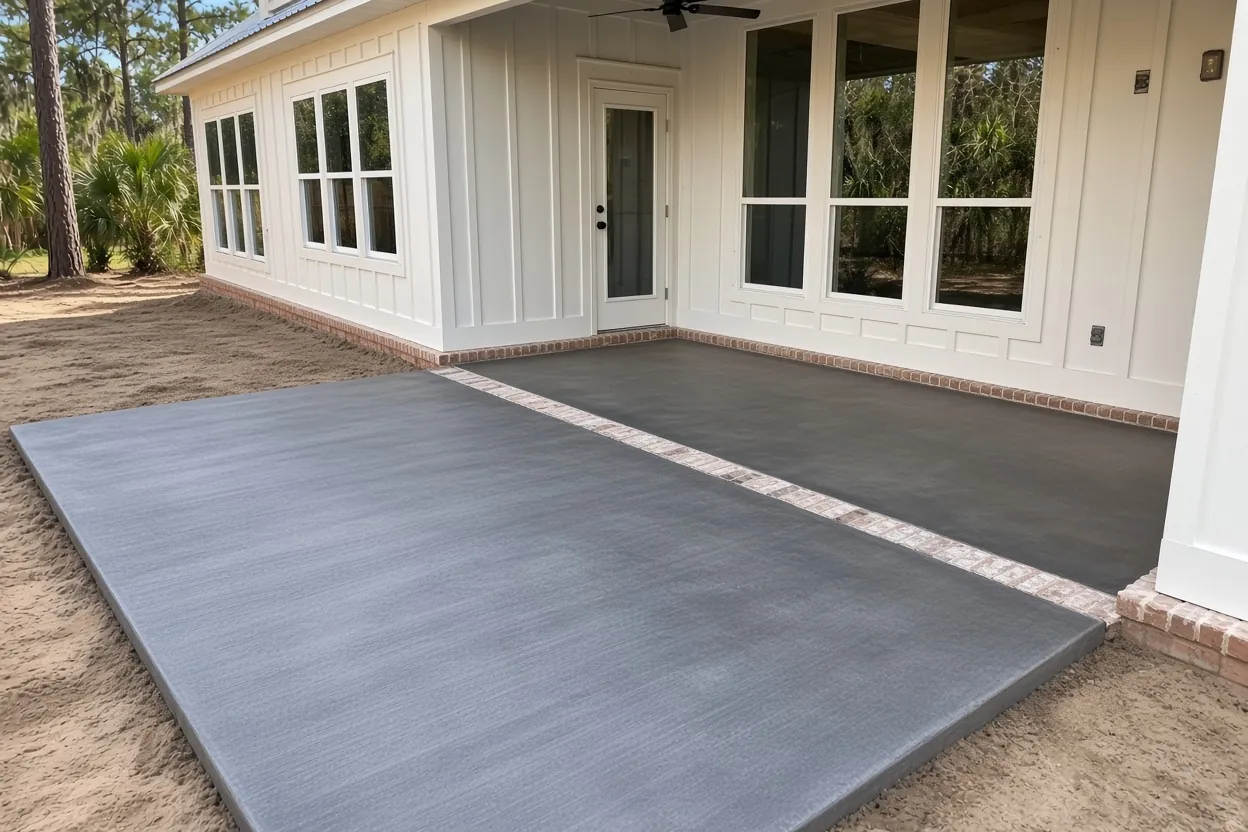
Our typical Lakeland ranges around a patio job. Plain and broom finish are priced together, stamped work separately.
| Job | Per sq ft | Typical project | What moves the price |
|---|---|---|---|
| Patio, plain or broom finish | $8 to $14 | $2,500 to $6,500 | About 250 to 450 sq ft; tear-out adds $2 to $4 per sq ft |
| Stamped or decorative patio | $14 to $24 | $5,000 to $16,000 | Pattern, integral or release color and sealer |
| Walkway to the patio | $8 to $14 | $1,500 to $4,500 | 4 in., 3 to 5 ft wide; short runs hit a job minimum |
| Slab for a screen room or roof | $7 to $12 | $2,000 to $7,500 | 4 in. reinforced; thicker or monolithic priced higher |
Ranges, not a quote. Your price depends on the yard, so we give a free written estimate after we see the site.
Open yard, lanai or future screen room: what the patio will carry
The biggest pricing question is not size. It is what the slab will hold in five years. A patio that stays open to the sky is flatwork, priced on the patio range. A slab that will carry a screen room, a roofed porch or a pool cage is a different job, because the City of Lakeland's forms and checklists page files screen rooms, pool cages and attached carports under Residential Addition permits.
That changes the slab. The enclosure drawings can call for deeper edges where posts or walls land, and the layout has to match them. We price that kind of slab on our slab range, $7 to $12 per sq ft, with typical projects of $2,000 to $7,500 for a 4 inch reinforced slab, and thicker or monolithic work priced higher. The slabs and foundations page covers it.
If an enclosure is even a maybe, say so at the estimate. Pouring the edges for it now costs less than cutting out and repouring a patio later. If it is a firm no, you skip the extra depth and stay on the patio range.
Thickness, reinforcement and joints on the quote
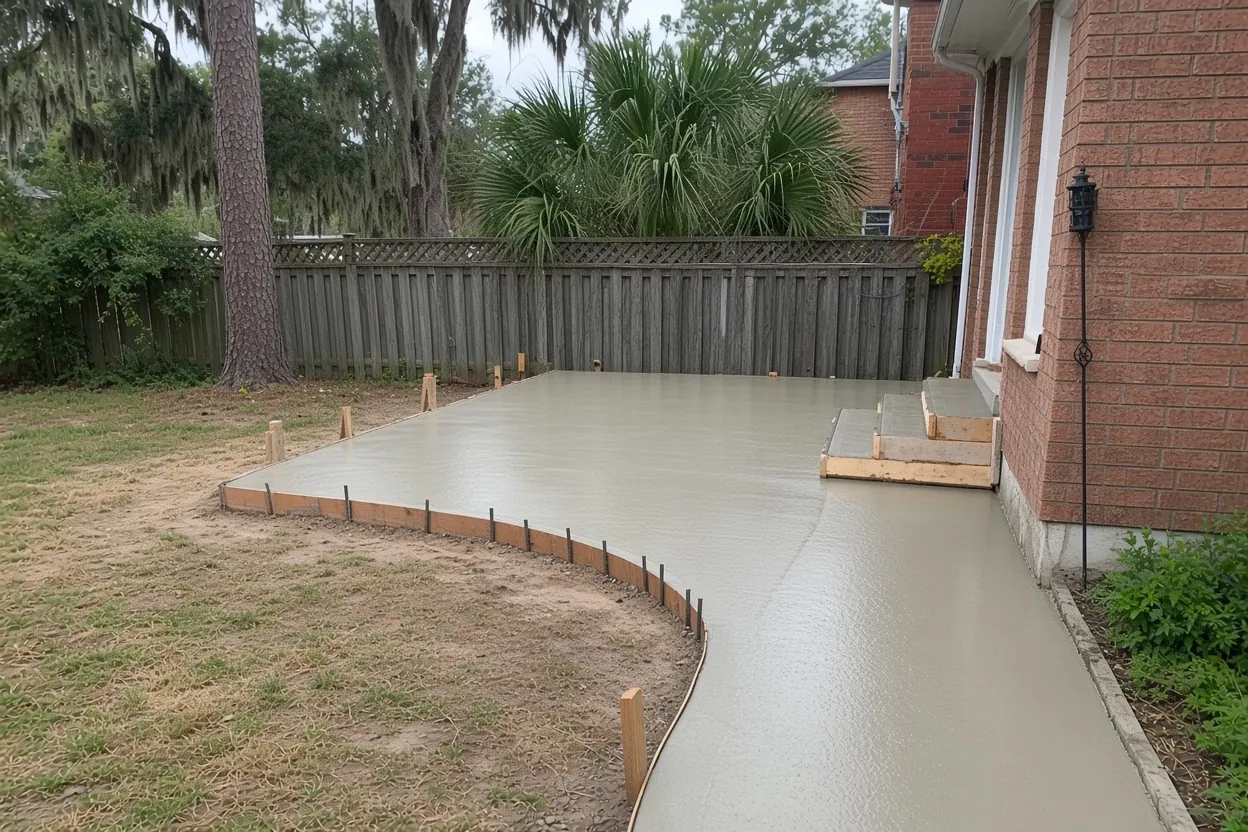
The slab spec is where real money moves. The Florida residential code sets 3 1/2 inches as the minimum for slab-on-ground floors inside a house, per Section R506. A patio is outdoor flatwork, so its thickness is a choice we write on your quote, with extra depth priced where a hot tub or outdoor kitchen will sit.
Concrete Network gives a rule of thumb from driveway work: going from 4 to 5 inches adds roughly 20 percent to the concrete cost and nearly 50 percent to load capacity. On a patio that extra inch earns its keep only under heavy fixtures, so ask for both thicknesses priced and decide with the numbers in front of you.
Reinforcement is the next line. Wire mesh suits 4 to 5 inch slabs, rebar on about a 12 inch grid suits 5 inches and up, and synthetic fibers cut shrinkage cracks without adding structural strength. Joints come last: control joints no more than 10 feet apart on a 4 inch slab, cut a quarter of the depth, and an isolation joint where the patio meets the house. A quote that names all three tells you what you are paying for.
How Your Job Goes
Free on-site estimate
We measure the yard, check access, grade and trees, and ask what the patio will hold.
Itemized written quote
Size, thickness, steel, finish, tear-out and every extra on its own line.
Permits and approvals
Any city permit, Notice of Commencement or HOA approval is settled before forms go in.
Base, forms and pour
Ground compacted and graded, forms set, slab poured and finished.
Cure and clean-up
Curing starts as soon as finishing is done, and we tell you when the slab can take furniture.
Tear-out, roots and base: the lines under the slab
Removing an old patio or a layer of pavers adds $2 to $4 per sq ft to the job. On a 280 sq ft slab that comes to $560 at the low end and $1,120 at the high end, before the new concrete. If the old slab is cracked but level, ask whether it has to come out at all; sometimes the answer depends on what sits under it.
Base work is the line you pay for and never see. UF/IFAS describes Florida's sandy Entisols as low in organic matter and water-holding capacity, and its flatwoods Spodosols as mostly poorly drained. Under a Lakeland patio that means stripping roots and soft spots, compacting the sand and shaping the grade so water runs away from the house instead of under it.
There is also what sits deeper. The USGS says most of Florida sits on thick carbonate deposits, counts sinkholes among the state's predominant landforms, and notes that many of the lakes and ponds in central Polk County are subsidence depressions filled with water. That is no reason to skip a patio. It is a reason to point out an old slab that has dropped at one corner, so the cause gets looked at before new concrete goes on top.
Trees matter here too. UF/IFAS warns that live oak roots can lift and crack paving placed too close. Setting the patio edge back from a big oak can cost nothing and save a cracked corner. Cutting roots or removing the tree is extra, and removing a tree takes a city Tree Removal Permit.
Patios against the house: termite treatment and paperwork
A patio that touches the wall raises a termite question before it raises a price question. Section R318 of the residential code is written for new buildings: when soil treatment is used, it also goes under exterior concrete within 1 foot of the house's sidewalls. On an existing house, call your pest control company before the forms go in so the new slab does not cover an untreated gap.
Paperwork adds steps to a patio job. Whether a plain patio needs a city permit, how the $7,500 HB 803 exemption request works and when a Notice of Commencement applies are all in our Lakeland concrete permit guide. The short version for patios: a slab under a future screen room goes with that addition permit, and a contract over $5,000 needs the recorded notice before the first inspection.
Your quote should say who files what. Ask for every permit, the notice if it applies and any HOA submittal as their own lines, on ours or anyone's, so nothing lands on your desk the week of the pour.
Broom, color or stamp: where the price steps up
Finish is the largest single jump in the table. A broom finish sits in the $8 to $14 range. Stamped concrete runs $14 to $24 because the pattern, the integral or release-agent color and the sealer all go into the job, and the stamping has to happen at the right point in the set. Our stamped concrete page shows the patterns.
Stamped work also carries an upkeep cost. Concrete Network puts cleaning and resealing at every 2 to 3 years, depending on traffic and weather. Budget for that the way you would budget for a roof, as a known future line.
Texture is the last trade-off. The same source notes stamped surfaces can turn slick when wet, especially under a film-forming sealer, and that non-skid additives help. Near a hose bib or the steps to a pool, ask for one. A pool deck around a screened pool can be quoted on the same visit as the patio.
HOA and historic rules that move the layout
A committee can move a patio price as much as the yard does. In Sandpiper, the Architectural Committee must approve any concrete slab before work, and the community's rules keep patios at least 5 feet from the rear and side lot lines in Sandpiper West and 7 feet from the side in Sandpiper East. On a tight lot, that setback can trim the slab and the bill.
At the Lakes at Laurel Highlands, patios must be pavers or concrete matched to the home, may not reach past the side plane of the house and must stay clear of drainage and utility easements. The ARC wants a survey and a materials sample with the application, so have both ready.
Inside one of Lakeland's historic districts, the guidelines treat "any permanent paving on a property" as a Minor Review item, which can reach a backyard patio. Our historic-district paving guide covers the filing. Bring the HOA or district paperwork to the estimate and we price against it.
Cutting the bill without thinning the slab
A lower number should come from choices you make, not steps someone skips.
- Size it to the furniture. Lay the table, chairs and grill out on the grass with a hose around them, then pour what you actually stand on.
- Stamp a border, broom the field. A stamped band around a broom center keeps the stamped square footage, and the cost, down.
- Stay clear of the oak. Moving the edge back can skip root work entirely.
- Pour together. A walkway to the back door or a driveway job quoted with the patio shares one visit and one truck schedule.
- Watch the calendar. Our range does not change with the season, but the National Weather Service puts the heaviest West Central Florida rain in July to early September, so a pour then is likelier to lose a day to storms.
We lay these options out on the visit and put each on the written quote, so you pick from real numbers.
What a complete patio quote spells out
- Patio size in feet and square feet, with a sketch.
- Slab thickness and reinforcement: mesh, rebar or fibers.
- Joint layout and the isolation joint at the house.
- Base preparation and grading for drainage.
- Removal of any old slab, pavers or roots, priced as its own line.
- The finish, and whether sealer is included on stamped work.
- Who handles any permit, the Notice of Commencement and the HOA submittal.
- The schedule, the rain plan and when the slab can take furniture.
Photos of the yard, the nearest trees and your HOA name speed up the visit.
Common Questions
How much does a concrete patio cost in Lakeland?
What does a 14 by 20 foot patio cost?
Why doesn't a 10 by 10 patio cost $800?
How much does removing an old patio add?
Should a slab for a future screen room be priced differently?
Does Sandpiper or Laurel Highlands approval change my patio quote?
Is a thicker patio slab worth the extra cost?
Sources
- Concrete Driveway Installation: 8 Essentials (Concrete Network)
- 2023 Florida Building Code, Residential, Chapter 5 Floors (R506) (UpCodes / ICC)
- 2023 Florida Building Code, Residential, Chapter 3 Building Planning (R318) (UpCodes / ICC)
- Forms & Checklists (City of Lakeland Building Inspection)
- SL441/SS655: Agricultural Soils of Florida (UF/IFAS Extension)
- Live Oaks (UF/IFAS Gardening Solutions)
- Stamped Concrete Basics (Concrete Network)
- Sandpiper Architectural Rules and Restrictions (2019) (Sandpiper Property Owners Association)
- Florida Thunderstorm Season / Rainy Season (NOAA National Weather Service Tampa Bay)
- Sinkholes, West-Central Florida (Circular 1182) (U.S. Geological Survey)