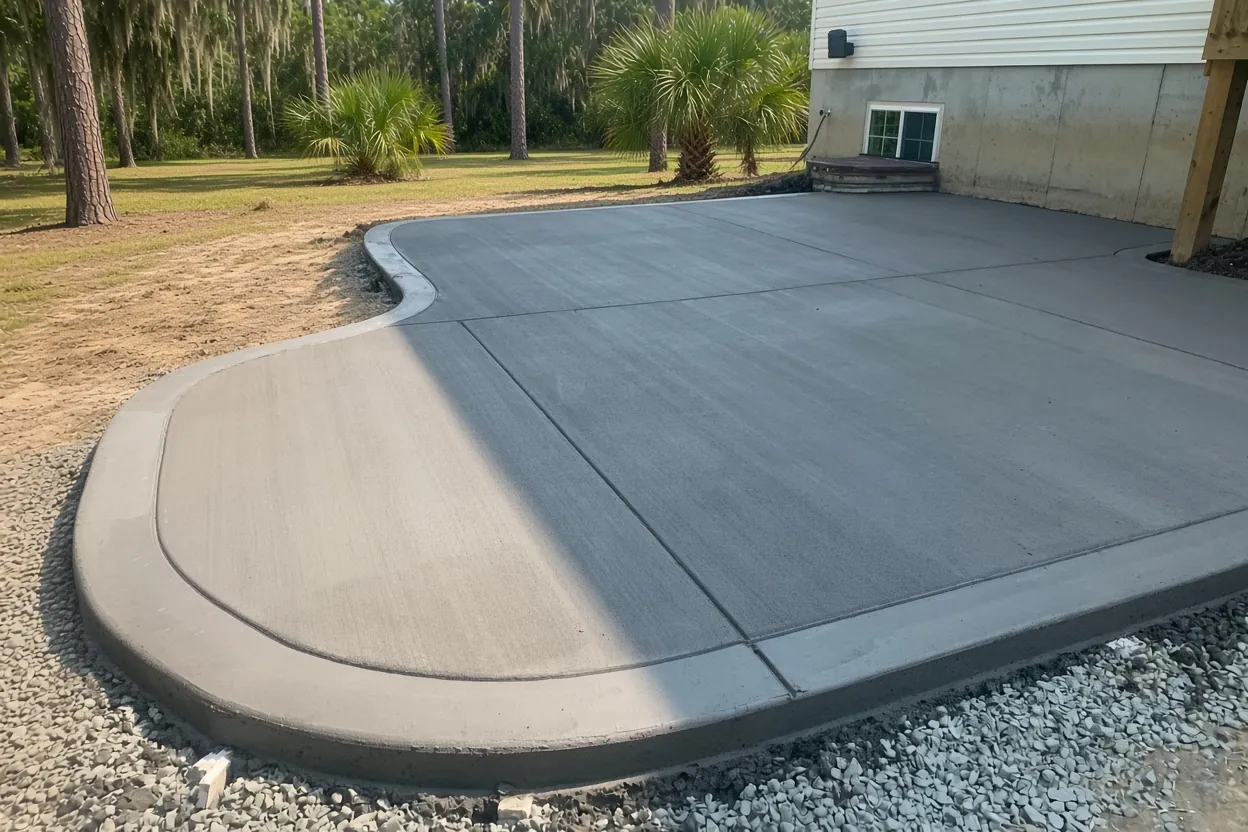
Open sky over a Sandpiper backyard: plan the shade first
Sandpiper's average cover comes to about 8.1 percent in the 2021 national tree canopy data, and almost none of the neighborhood sits under heavy canopy. The National Weather Service describes West Central Florida summers as dew points above 70 degrees with highs from the upper 80s to the mid 90s. Put a bare slab on a lot like that and it soaks up the whole afternoon.
No finish comes with a temperature promise. The layout does that job. Set the seating where the house throws its shadow during the hours you sit out, and give the grill the open sun. Decide early whether a cover or screen room is coming, too, because in Sandpiper that choice moves where the backyard patio can stop. Finishes and sizes for all of Lakeland live on our concrete patios page, and the Sandpiper neighborhood page covers the rest of the community's concrete work.
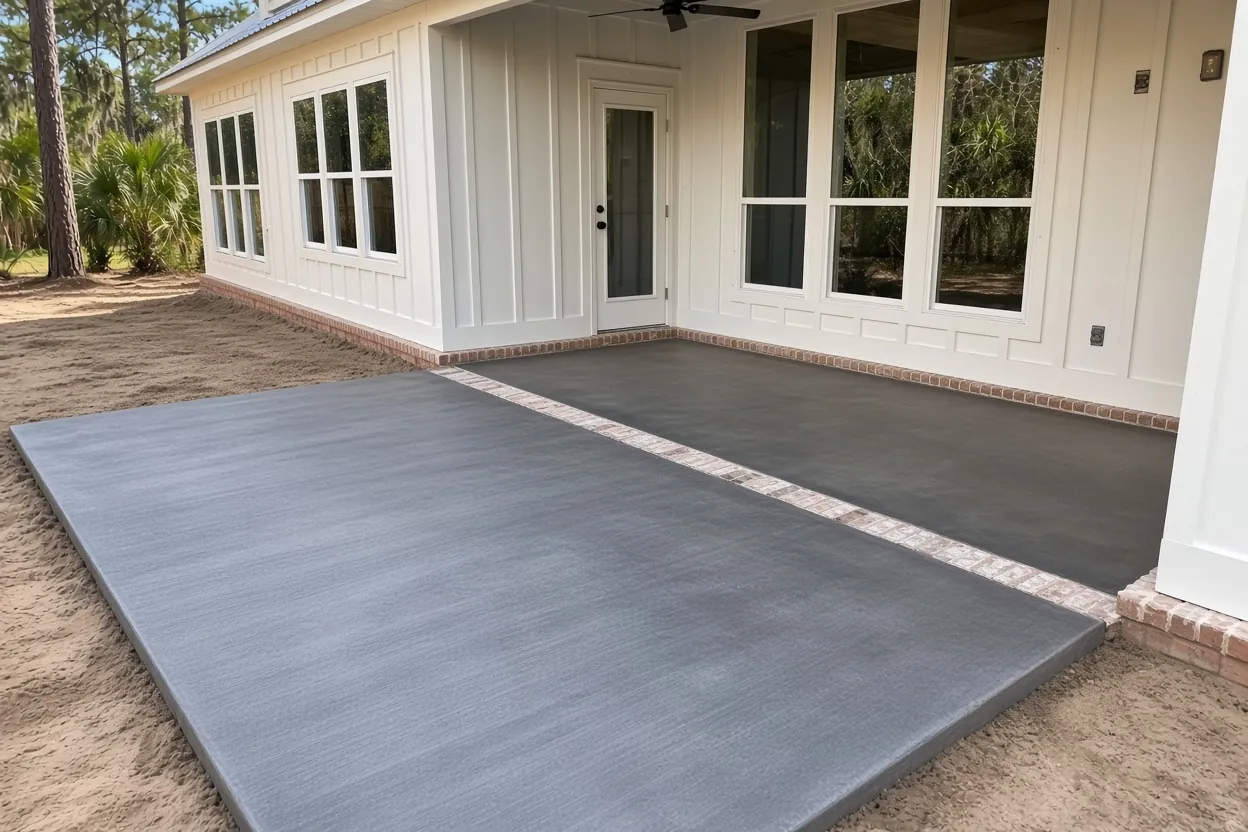
Hard roof, screen room or open slab: the setback that sets the back edge
Under the Sandpiper committee's 2024 policies, lanai roof rules change by section. In Sandpiper West a hard roof stays 15 ft off the rear line and 5 ft off the side. In Sandpiper East it's 20 ft rear and 7 ft side. A soft-roof enclosure only needs 5 ft at the rear, with the same 5 ft (West) or 7 ft (East) at the side. An open patio, under the 2019 rules, needs 5 ft at the rear and 5 ft (West) or 7 ft (East) at the side.
Here's why that gap matters. Say your back wall sits 30 ft from the rear line in Sandpiper East. An open patio slab can run 25 ft deep, but a hard roof over it stops at the 20 ft mark, leaving 10 ft of roofable depth. Pour the full 25 ft, add a hard roof later, and the back 15 ft stays in the sun. That's why the first question at the estimate is what the slab will carry.
The code has a say as well. Florida's residential code, R506.2.3, drops the 6-mil vapor retarder under patios that aren't likely to be enclosed and heated later. If a heated room is in your plans, the retarder goes down now with joints lapped 6 inches. Nobody can slip it in once the covered patio slab is poured.
What It Costs
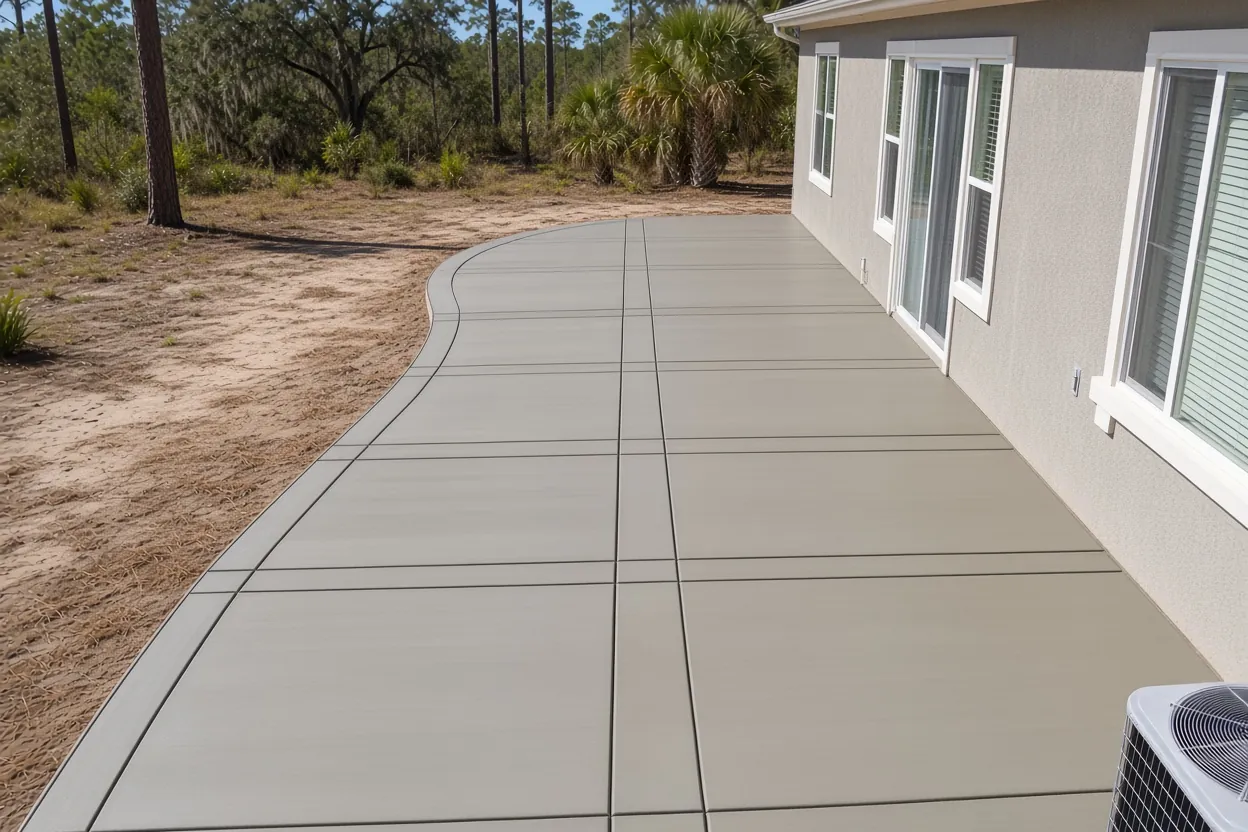
These are our patio ranges, worked out for the sizes that fit Sandpiper's compact backyards. The real number comes from measuring your lot.
| Job | Per sq ft | Typical project | What moves the price |
|---|---|---|---|
| 12 by 16 patio (192 sq ft) | $8 to $14 | $1,536 to $2,688 | Small slabs carry setup that doesn't shrink |
| Backyard patio, about 250 to 450 sq ft | $8 to $14 | $2,500 to $6,500 | Pump or buggy access on golf course lots |
| Stamped or colored patio | $14 to $24 | Priced at the visit | Pattern and the color the committee approves |
| Removing an old slab first | $2 to $4 added | Priced at the visit | Thickness and access to the back yard |
Ranges only. Every Sandpiper patio gets a free written estimate once we've seen the yard, and the written quote arrives within 48 hours.
Golf course frontage and lots near 5,870 square feet
The Polk County Property Appraiser codes 261 Sandpiper parcels as single-family golf course frontage and 55 more as other waterfront. The plats start with Sandpiper Golf and Country Club Phases 01 and 02, recorded in 1987, and run through Phases 15 and 16 in 1993. All of them wrap around the Links of Sandpiper course off N Socrum Loop Rd near I-4. Lots are compact. The median single-family lot is about 5,870 sq ft, and the middle half falls between about 5,400 and 6,640 sq ft.
On a lot that backs onto the course, the rear line is the fairway side, and the 5 ft rear setback is measured from it. With yards this small, size becomes a real decision. A 12 by 16 patio is 192 sq ft. A 16 by 20 is 320 sq ft and lands inside our typical project range. At the estimate we can paint the outline and offsets on the grass, so you can stand on it before anything goes to the committee. When the mixer can't reach the back of the lot, the concrete may come in by pump or buggy, and that shows up as a line on the quote.
Sand that drains fast, and the lots that slope
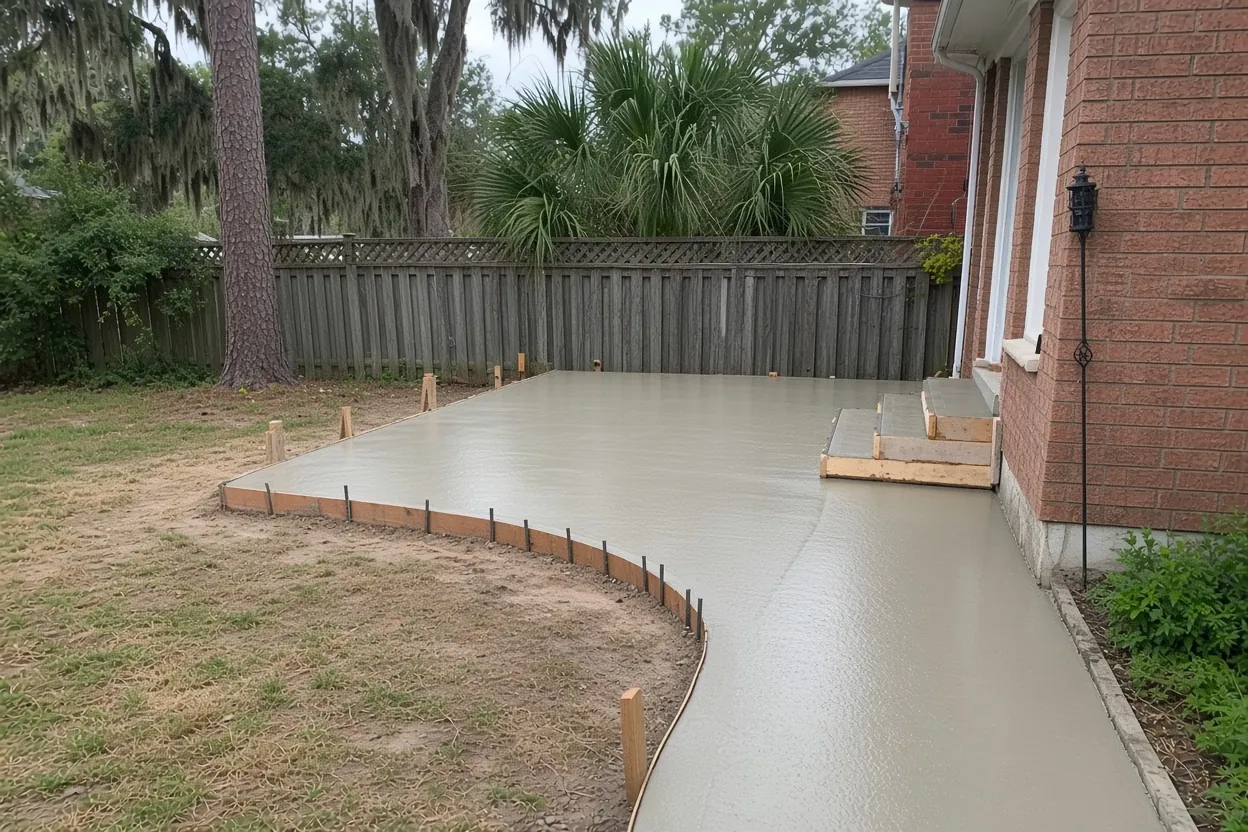
Candler sand covers about 89 percent of Sandpiper. Tavares fine sand, Sparr sand and a sliver of Apopka fine sand make up the rest. Candler is excessively drained and takes water very rapidly, and the National Wetlands Inventory maps no wetlands inside the neighborhood. Standing water under the slab is less of a worry here. The risk runs the other way: dry, loose sand under the slab that settles if nobody packs it. The building code calls for fill free of vegetation and compacted for uniform support, so the sand gets compacted before the forms go in.
About 6.6 percent of the ground is mapped on 5 to 8 percent slopes, where a yard can fall toward the course or a neighbor. On those lots the patio slab should pitch away from the house wall, and the low edge can be formed deeper rather than built up on loose fill. The code floor is 3 1/2 inches; your written quote states the thickness, the mesh or fibers and the joint layout. Slabs on ground need contraction joints unless code-listed fibers or welded wire handle crack control, and NRMCA says fibers must not be used to stretch joint spacing. A short pool deck surround can go on the same quote.
How Your Job Goes
Decide on a roof
Open slab, screen room or hard roof. Your answer decides how deep the patio can go and whether a vapor retarder goes under it.
Paint the outline
The slab and the rear and side offsets can be marked on the lawn, so you see it before the committee does.
File and wait
Form AR-1/2004 goes to the POA office with our dimensions, and we get the City permit question answered at the same time.
Compact and form
Sand packed tight, the slab pitched away from the house, and the low edge formed deeper on sloped lots.
Early pour, slow cure
A morning pour, with curing started right after finishing and kept going for at least 3 days.
Committee papers, the no-shed rule and the City permit question
Under the 2024 committee policies, all concrete porches, slabs, driveway extensions, pathways and changes to existing concrete need approval wherever the concrete is permanent. A new patio counts. So do a patio extension and a lanai slab. Requests go to the POA office on Form AR-1/2004, and four committee members have to initial an approval. Allow two weeks for a decision. Once approved, work starts within 30 days and wraps up within 90.
Sandpiper doesn't permit sheds at all, so a shed pad beside the patio is off the table. The committee can approve a Rubbermaid-type cabinet behind the home, though. If you want one on the slab, put it on the same request. Sandpiper has no historic district the way Historic Lake Morton does, so no Certificate of Review applies. On the City side, ask the Building Inspection Division whether your patio needs a permit. Florida's HB 803 lets qualifying non-structural work under $7,500 on a single-family home skip the permit after a written exemption request, but not in a flood hazard area. FEMA maps put 99.43 percent of Sandpiper in Zone X, and no single-family parcel touches a special flood hazard area, so that exclusion doesn't reach these lots. The City decides whether your job qualifies. Separately, Florida law calls for a Notice of Commencement recorded with the County Clerk before work starts on a direct contract over $2,500, and above $5,000 a copy goes to the building department before the first inspection. The Lakeland concrete permit guide walks through the order.
Pouring in the open sun, and the days after
Fresh concrete gets little shelter on a low-canopy lot. NRMCA's hot-weather guidance says to skip the hottest part of the day, never sprinkle water on the surface to help finishing, and never add water at the truck beyond the design amount. On hot, dry days the subgrade and forms get dampened without ponding. That counts for a lot on sand that drinks water as fast as Candler does. Curing starts the moment finishing ends and runs at least 3 days under wet burlap, plastic or a membrane compound. A white-pigmented compound reflects heat.
Then there's wind. NRMCA's note on plastic shrinkage cracking ties those shallow cracks to wind over 5 mph, low humidity and high temperatures. An open fairway lot has plenty of all three, so sunshades or windbreaks can go up when the day calls for them. The National Weather Service runs the rainy season from May 25 to October 10 for West Central Florida, and during it we pour early and keep plastic close. Once the curing period ends, the furniture, planters and grill can go back.
Common Questions
What does a 12x16 concrete patio cost in Sandpiper?
Can a Sandpiper patio slab be poured now for a screen room later?
How do I keep a patio from getting too hot on a Sandpiper lot with almost no shade?
How close to the golf course can my Sandpiper patio go?
Is a Sandpiper patio extension reviewed like a brand-new patio?
Can I add a shed slab next to my Sandpiper patio?
Sources
- Sandpiper Architectural Committee Policies and Procedures (2024) (Sandpiper Property Owners Association)
- Sandpiper Architectural Rules and Restrictions (2019) (Sandpiper Property Owners Association)
- 2023 Florida Building Code, Residential, Chapter 5 Floors (R506) (UpCodes / ICC)
- CIP 12, Hot Weather Concreting (National Ready Mixed Concrete Association)
- CIP 5, Plastic Shrinkage Cracking (National Ready Mixed Concrete Association)
- Florida Thunderstorm Season / Rainy Season (NOAA National Weather Service Tampa Bay)
- National Flood Hazard Layer, Flood Hazard Zones (FEMA)
- Building Inspection (City of Lakeland)
- Florida Statutes 713.02, Types of lienors and amount of liens (The Florida Legislature (Online Sunshine))
- Florida Statutes 713.135, Notice of commencement and applicability of lien (The Florida Legislature (Online Sunshine))
- CIP 24, Synthetic Fibers for Concrete (National Ready Mixed Concrete Association)