One city, three offices: who approves concrete at a Lakeland address
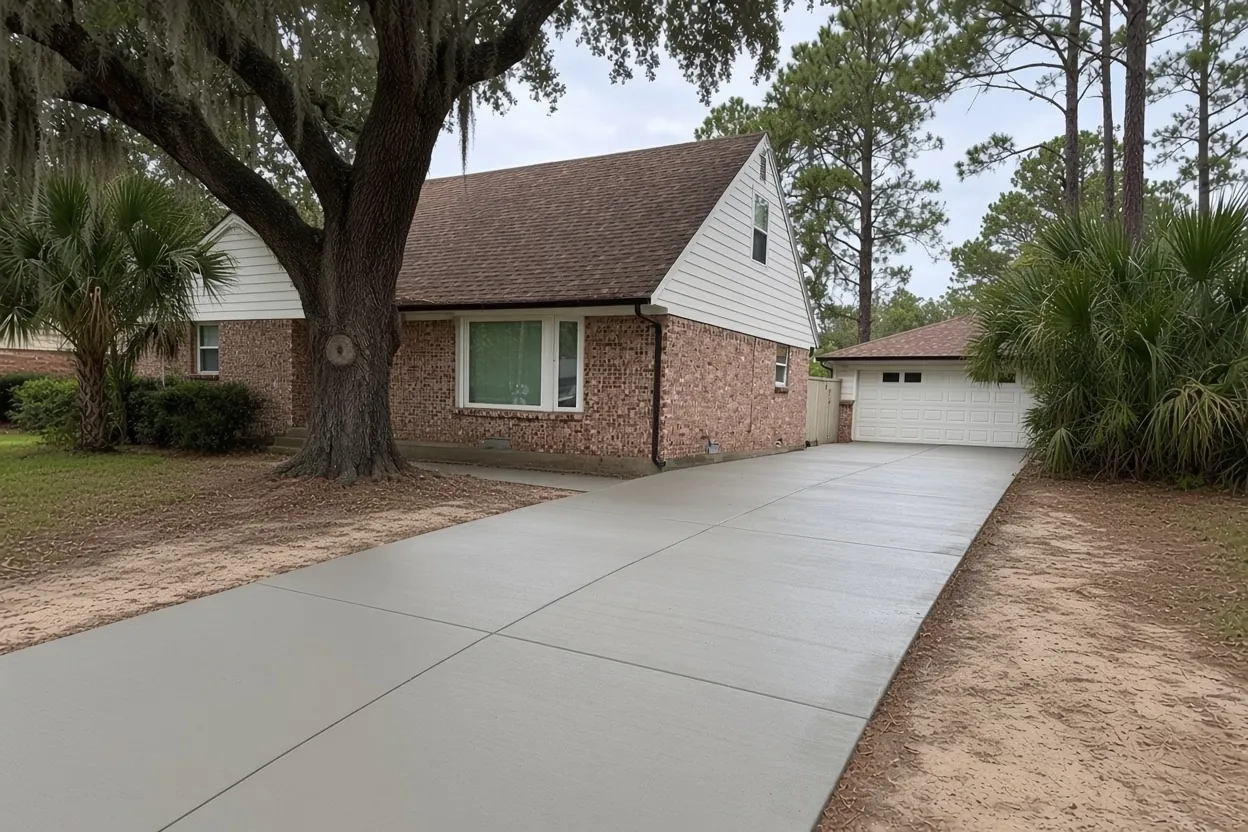
Picture a typical front-yard job here: a new driveway, a wider apron and a walk to the porch. The driveway is processed by the city's Building Inspection Division. The apron, where it crosses city right-of-way, needs a Right-of-Way Use Permit from Public Works Engineering. If the house sits in Dixieland, Beacon Hill or one of the other local historic districts, the walk and the driveway both need a staff Certificate of Review before the building permit. Three offices, one job.
As a concrete contractor in Lakeland, FL that works only inside the city, we deal with just these three offices. Before you sign anything, ask who files each approval and who books the inspections. Our Lakeland concrete permit guide lays out the order, from the first call to pour day.
Five pours we quote, and what each one runs in 2026
Driveways. New, widened or torn out and replaced, at 4 to 5 inches with a broom finish. Our range is $8 to $14 per sq ft, and a typical two-car driveway of about 500 to 700 sq ft lands at $5,000 to $10,000. Tear-out adds $2 to $4 per sq ft. The driveway cost guide works through sizes, and the driveways page covers the apron and the spec.
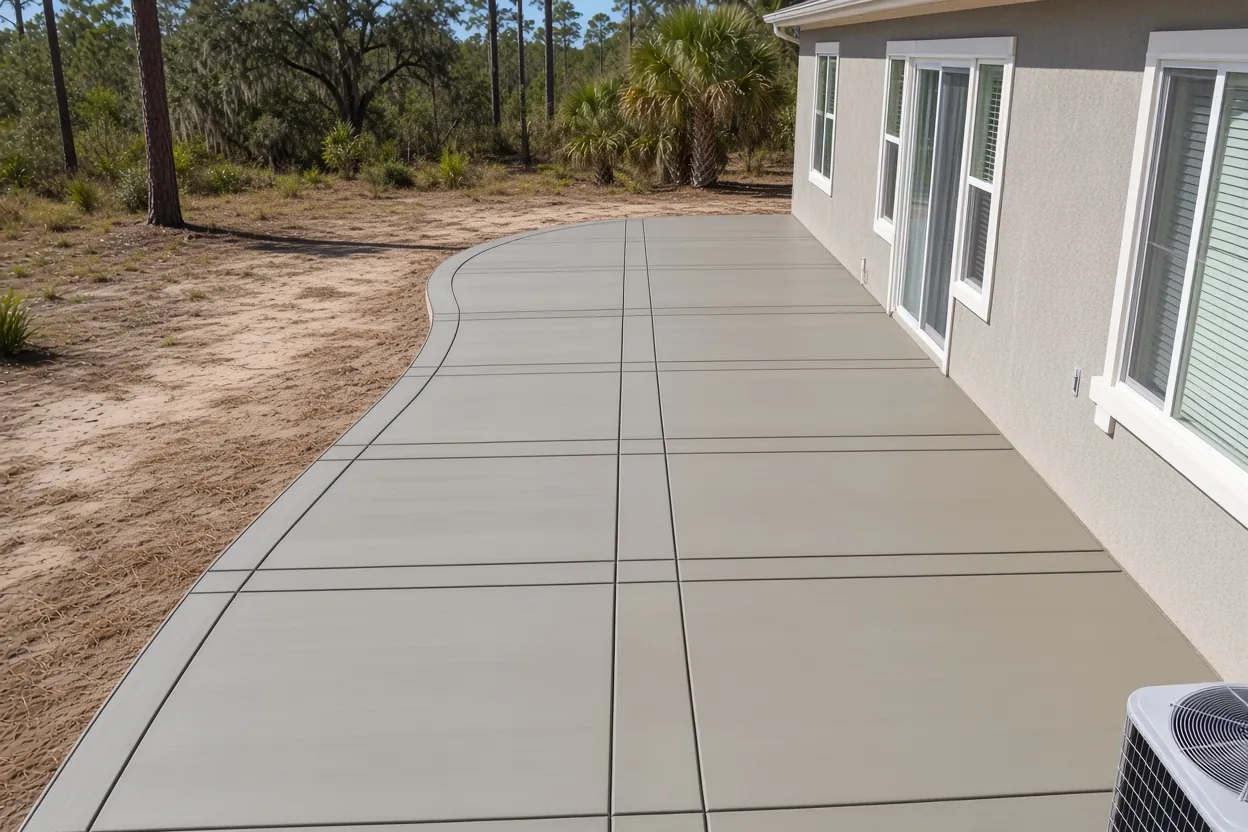
Patios. Plain or broom slabs of about 250 to 450 sq ft run $2,500 to $6,500. See concrete patios and the patio cost guide. A pool deck can be quoted with the patio after we see the yard.
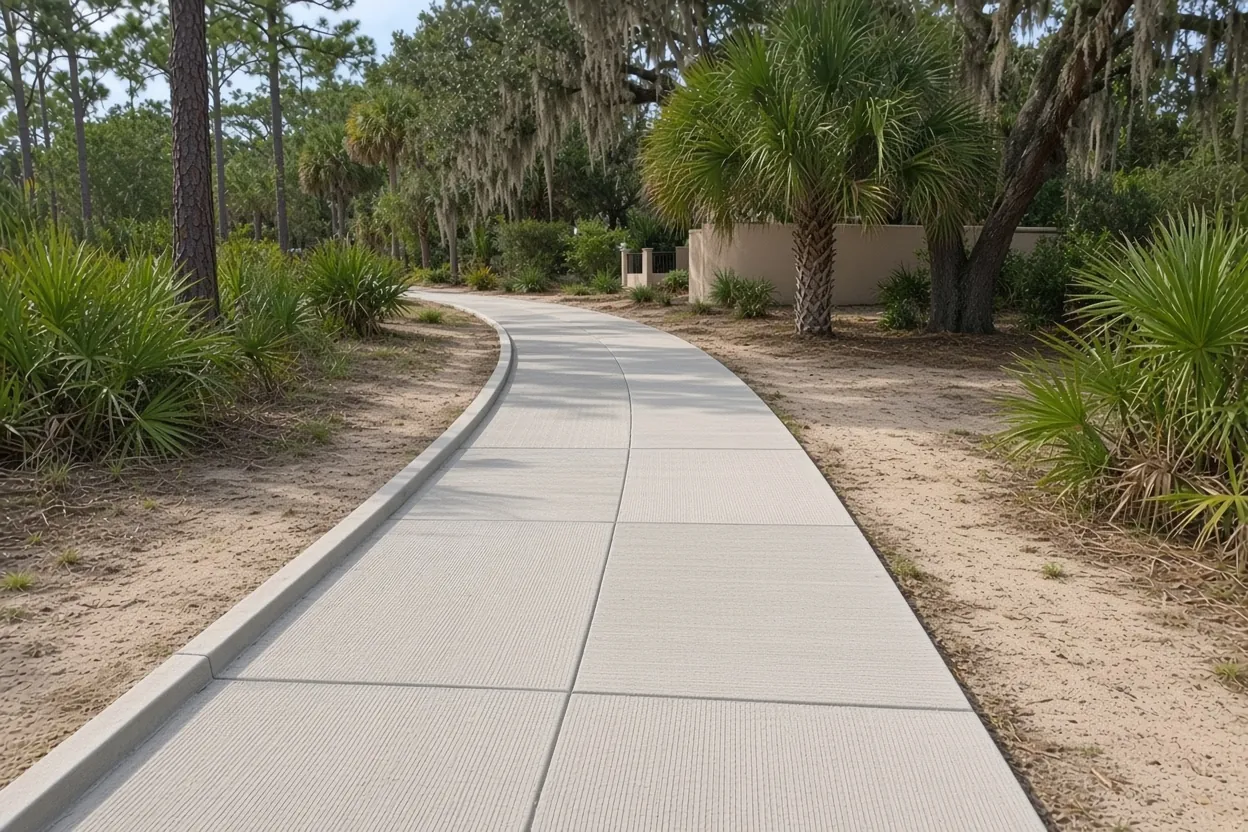
Walks and sidewalks. Four inches thick and 3 to 5 feet wide, with projects at $1,500 to $4,500. Short runs hit a job minimum. Details on the sidewalks page.
Stamped and decorative. Pattern, color and sealer at $14 to $24 per sq ft, with projects at $5,000 to $16,000. Weighing pavers? Read stamped concrete versus pavers before choosing, then the stamped concrete page.
Slabs. Reinforced 4 inch slabs for sheds, garages and pads at $7 to $12 per sq ft. Projects run $2,000 to $7,500. Thicker or monolithic work is priced higher. See slabs and foundations.
What It Costs
Our 2026 ranges for jobs inside Lakeland city limits. Your price is set after we see the site.
| Job | Per sq ft | Typical project | What moves the price |
|---|---|---|---|
| Concrete driveways | $8 to $14 | $5,000 to $10,000 | 4 to 5 in. broom finish, typical 2-car of about 500 to 700 sq ft; tear-out adds $2 to $4 per sq ft |
| Concrete patios | $8 to $14 | $2,500 to $6,500 | Plain or broom, about 250 to 450 sq ft; stamped priced separately |
| Sidewalks and walkways | $8 to $14 | $1,500 to $4,500 | 4 in. thick, 3 to 5 ft wide; short runs hit a job minimum |
| Stamped and decorative concrete | $14 to $24 | $5,000 to $16,000 | Pattern, integral or release color, sealer |
| Slabs and foundations | $7 to $12 | $2,000 to $7,500 | 4 in. reinforced; thicker or monolithic priced higher |
These are ranges, not quotes. You get a free written estimate after we see the site, with tear-out, apron work and permits listed on their own lines.
Brick streets, alleys and ten-foot drives in the older neighborhoods
The blocks around Lake Morton and Lake Hunter were laid out early. The city's district narratives describe the South and East Lake Morton districts as first-generation suburbs begun about 1906, with narrow lots, close setbacks, alleys and many brick streets, and Dixieland as grid streets and alleys running from the east shore of Lake Hunter to S. Florida Avenue. Detached garages and porte cocheres are common in both, so a driveway may run all the way to a garage at the rear of the lot.
That history shapes the design. The city's guidelines describe district driveways as typically on one side of the house, list widths over ten feet as not acceptable, and allow tandem parking for two cars along the side. Semi-circular driveways are out in every district except Historic Beacon Hill, where the curving streets and larger lots were platted in the 1920s land boom. A ribbon layout, two strips under the wheels, is an older pattern the guidelines name. Changing a brick street at a curb cut is also on the not acceptable list, which matters when the apron is part of the job.
If you own in Historic Dixieland or Historic Lake Morton, start with our guide to historic district driveway rules, which covers the Minor Review filing step by step.
Lake lots: Hollingsworth, Bonny, Parker and the smaller lakes
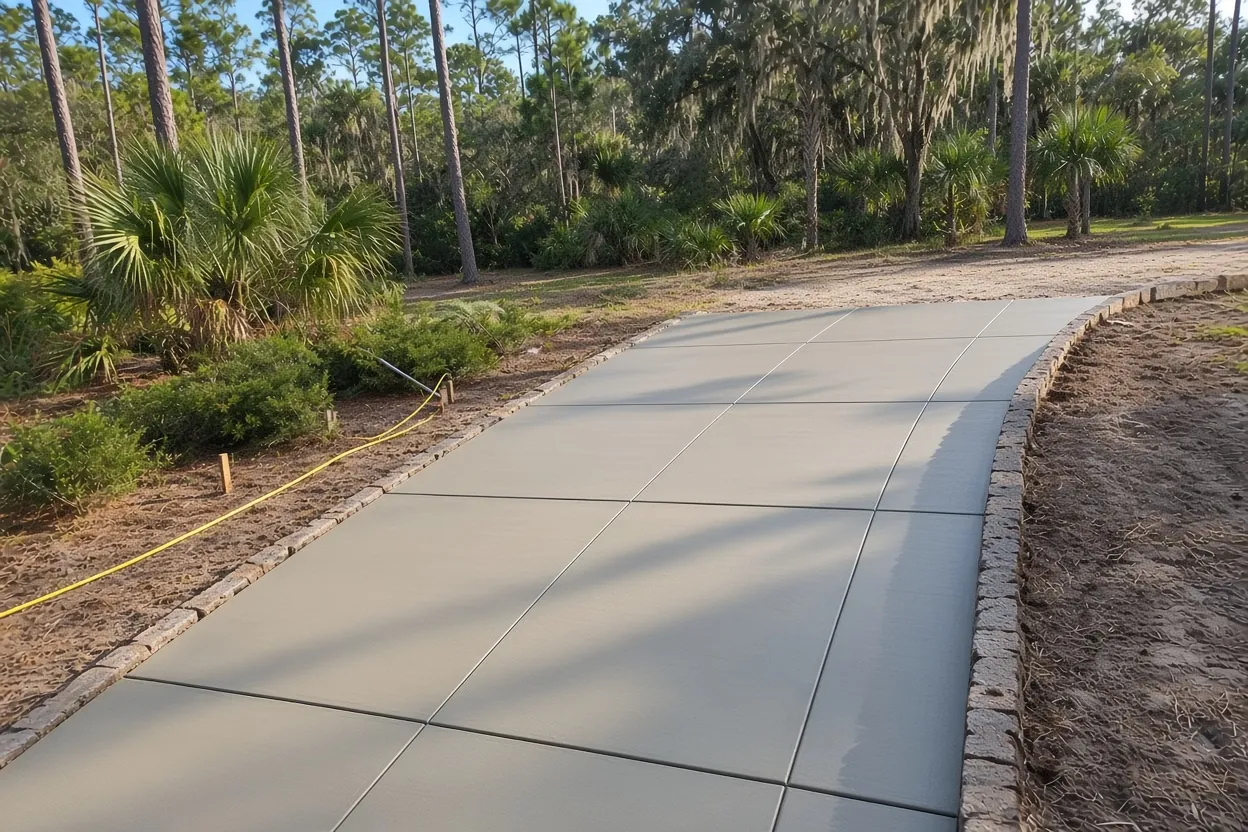
A lot that slopes toward one of Lakeland's lakes changes how we grade a slab. Water off a new patio or driveway has to go somewhere, and on a lake lot the wrong answer is the shoreline. So we look at the fall of the yard, the downspouts and the low spots first, and the slab gets pitched to match.
Lake Hollingsworth covers 354 acres, with Florida Southern College on its north shore and a paved trail around it. Shore Acres was platted as the Shore Acres Lake Bonny addition, tied to the 203-acre Lake Bonny. The Lakeshore neighborhood runs along the west side of Lake Parker, a 2,109-acre public lake. Lake Bentley is a 53-acre private lake, and Cleveland Heights grew up around the golf course that opened in 1925 on the Hollingsworth side of town, which the city has run since the late 1930s.
A walk to a dock or a patio at the seawall can count as a shoreline project, and the city's Lakes and Stormwater Division says those need city permits and sometimes other agencies too. We settle that before we draw the plan.
How Your Job Goes
Call or send the job
Give us the address, a rough size and a photo at (863) 400-2934 or on the contact page.
Site visit
We measure, look at drainage, roots and access, and ask about your HOA or district.
Written quote and approvals
You get the quote in writing. Once you say go, the permits and committee approvals get filed.
Pour, cure and clean up
We form, pour and finish, start curing right away, and tell you when you can walk and park on it.
HOA streets: Sandpiper, Laurel Highlands and the reclaimed-land golf communities
In a planned community the committee says yes before the city does. Sandpiper, the 55+ golf community in north Lakeland with about 1,180 homes built from 1985 to 1998, sends every concrete porch, slab, path and driveway extension through its Architectural Committee. A wider driveway cannot cross the 5 foot side setback in Sandpiper West or 7 feet in Sandpiper East, and parking more than two vehicles on a lot needs special arrangements, so a third-car pad starts with the committee.
The Lakes at Laurel Highlands, a D.R. Horton community, wants a site plat with every application, a survey and a material sample with a patio request, driveway and walk surfaces to match the original materials and colors, and gives its committee 30 days to act. Approval there does not replace the city permit.
Grasslands and Oakbridge sit on reclaimed phosphate-mine land, which is why we walk the base on those lots before pricing. We pour in Webster Park North and the other city neighborhoods too.
Sand, oak roots and summer storms: what a slab here has to survive
Florida's most extensive soils are sandy, and UF/IFAS puts the sandiest group at more than 98 percent sand with little ability to hold water. Sand is easy to compact and just as easy to wash out from under an edge, so the base and the grade get as much attention as the pour. The slabs page walks through the base and fill rules.
Oaks are the other force. Lakeland manages more than 56,000 street and park trees, and a live oak's roots can lift a walk or driveway that sits too close. When a slab keeps cracking beside a big tree, the roots may be part of the answer, and the sidewalks page covers how we route around them. Taking a tree out needs a city permit.
Weather runs the calendar. The wet season runs from late May into October, with the heaviest rain from July through early September, so summer pours get booked for dry mornings and covered when a storm builds. Fresh concrete needs at least 3 days of curing, and a driveway needs about a week before a car rolls on it.
Reading our written quote: what is in the price and what is its own line
Our quote breaks the job into parts so you can line it up against another bid. The square foot price covers forming, base prep, concrete, steel or mesh, finishing, joints and curing. Separate lines cover tear-out and haul-off of old concrete, apron work in the right-of-way, extra thickness for an RV or a work truck, and any permit or review fee.
Paperwork shows up too. Florida requires a recorded Notice of Commencement on jobs over $2,500, and under Florida Statute 713.135 a permitted job over $5,000 needs a copy filed with the city before the first inspection. Florida's HB 803 lets some small single-family jobs under $7,500 skip a permit, but only after a written exemption request with the contract goes to the building department, and structural work and flood hazard lots are excluded, so we never assume a job qualifies. The permit guide explains both.
What moves the number most: how much old concrete comes out, how soft or wet the base is, roots to cut around, access for the truck on a narrow lot, and whether the slab goes from 4 inches to 5 or 6. Going from 4 to 5 inches adds roughly 20 percent to the concrete cost and nearly 50 percent to load capacity, per Concrete Network. Call (863) 400-2934 with photos and a rough size, and the visit goes faster.
Why Lakeland Homeowners Call Us
Free on-site estimate
We measure the job, check the grade and the trees, and talk through the spec before any price goes on paper.
Written quote within 48 hours
The scope, thickness, steel and finish come in writing, so you can compare bids line by line.
City of Lakeland only
Every job we pour is inside city limits, so each one runs through the same city permit, right-of-way and historic review offices.
Approvals on the quote
Each permit, HOA application or Minor Review your job needs is listed, with who files it.
Common Questions
Do you pour concrete outside Lakeland city limits?
How much does concrete cost per square foot in Lakeland?
Who files the permits for my concrete job?
What changes if my house is in one of Lakeland's historic districts?
Does HOA approval replace the city permit?
Can you pour a pool deck along with a new patio?
How long before I can use new concrete?
Sources
- Engineering Permit Inspection Information (City of Lakeland Public Works Engineering)
- Design Guidelines for Historic Properties (City of Lakeland)
- Historic District Narratives (City of Lakeland)
- Design Review (City of Lakeland Historic Preservation)
- Lakeshore Residents (City of Lakeland Lakes & Stormwater Division)
- Lake Hollingsworth (USF Water Institute / Polk County Water Atlas)
- Sandpiper Architectural Committee Policies and Procedures 2024 (Sandpiper Property Owners Association)
- ARC Guidelines (The Lakes at Laurel Highlands HOA)
- Agricultural Soils of Florida (SL441/SS655) (UF/IFAS Extension)
- Lakeland's Urban Forest (City of Lakeland Parks & Recreation)
- Concrete Driveway Installation: 8 Essentials (Concrete Network)
- CS/CS/HB 803: Building Permits and Inspections (The Florida Senate)
- CIP 12 - Hot Weather Concreting (NRMCA)
- Florida Thunderstorm Season / Rainy Season (NOAA National Weather Service Tampa Bay)
- Florida Statutes 713.135 Notice of commencement and applicability of lien (The Florida Legislature (Online Sunshine))
- CS/CS/HB 803 Enrolled Bill Text (The Florida Senate)