Width, length and curb cuts: the City rule for Bridgewater driveways
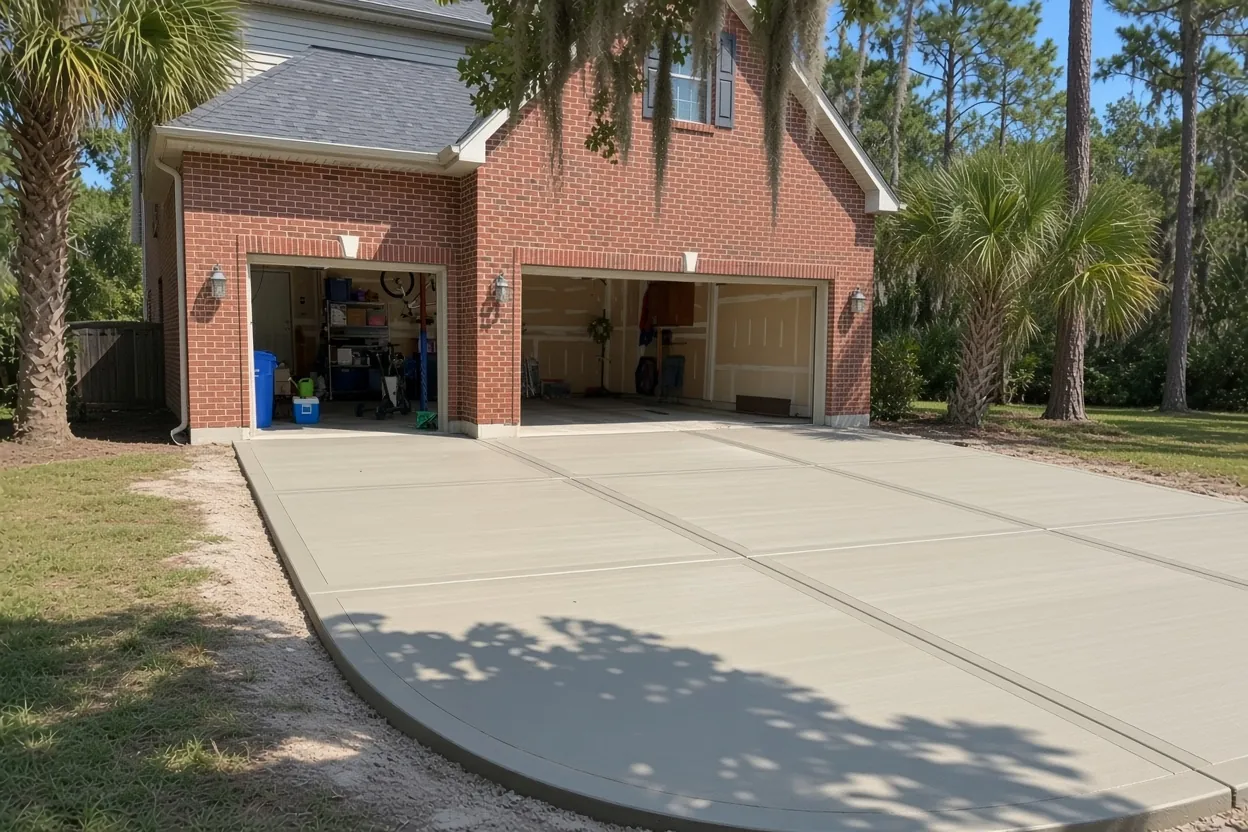
Lakeland's Land Development Code sets residential driveway sizes in Section 4.11.4.6, adopted by Ordinance 5793 in 2019. Inside a historic district, such as the ones around Lake Morton, a standard driveway is held to 8 to 10 feet. Bridgewater doesn't show up anywhere on the City's historic-district map. That means the wider range covers every lot here, and a standard driveway can run 10 to 24 feet across.
You'll find the rest of the numbers for your layout in that same section. A driveway or parking pad has to run at least 20 feet onto the lot. A ribbon driveway, two tire strips with grass between, measures 7 to 10 feet from outer edge to outer edge, and each strip has to be at least 2 feet wide. Thinking about a circular driveway? It needs at least 75 feet of lot frontage, so measure yours before you fall for one. Each lot gets one curb cut unless it has access to an improved alley. Want room for a third car? The code allows an accessory parking pad up to 10 feet wide, attached to a legal, conforming driveway and kept entirely on your lot. The slab spec itself is on our concrete driveways page.
The apron on Bridgewater Lakes Way and the lake-named side streets
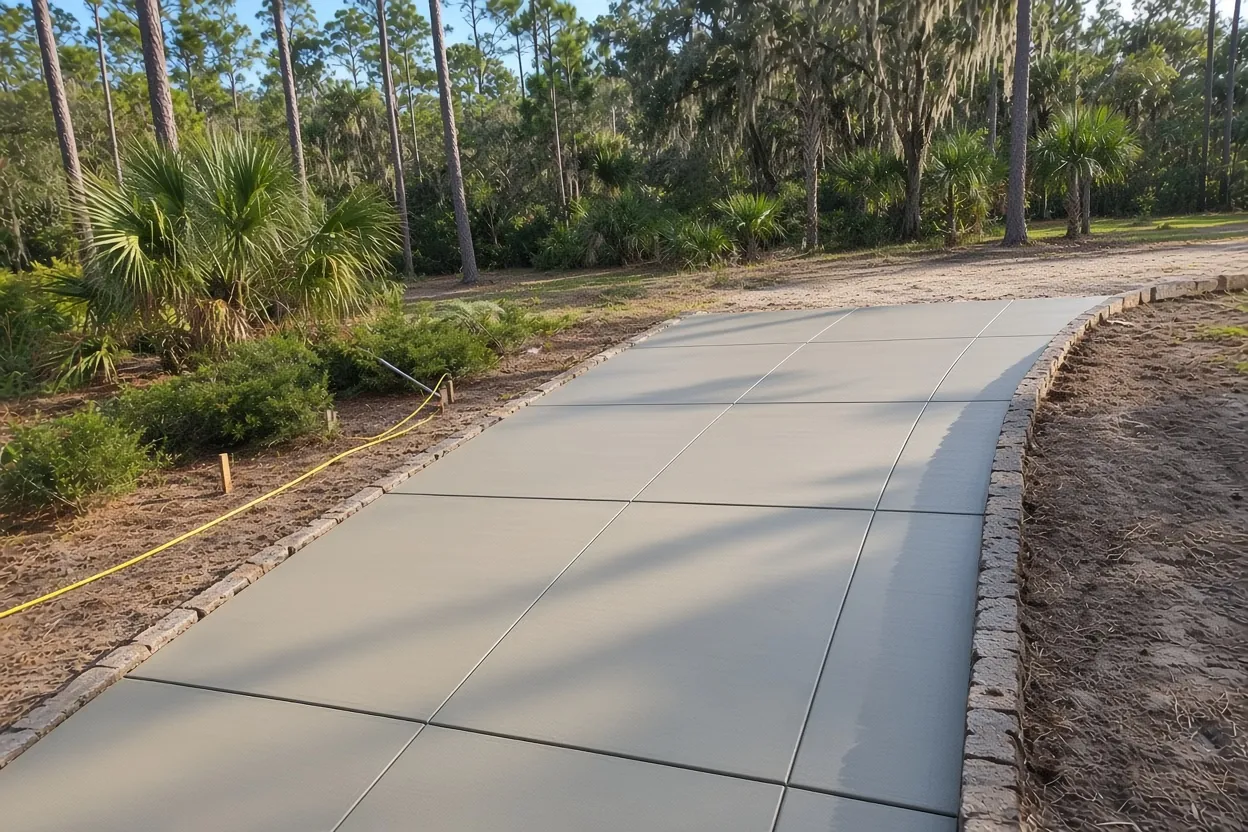
The concrete stops being yours where the driveway meets the street. The City's street centerline map lists every street in Bridgewater as City-owned, from Village Lakes Boulevard and Bridgewater Lakes Way to Ladoga Drive, Tahoe Drive, Huron Way and Great Bear Drive. That makes the apron on any driveway replacement here right-of-way work, and Public Works Engineering requires a Right-of-Way Use Permit before it starts.
Building Inspection processes the residential driveway permit, and Public Works Engineering inspects the work. The City wants a pre-construction notice at least 48 hours before work begins, so that notice goes on the calendar before a pour date is set. The apron, the curb and any public sidewalk that crosses your driveway are built to the City's Engineering Standards Manual, in its volume on roadway and drainage standards.
On a narrow village lot, two more apron details from Section 4.11.4.6 come into play. The apron may flare up to 3 feet past the driveway's maximum width on each side, and the part inside the right-of-way has to stay at least 3 feet from your side lot line. That side-line distance can decide how far a wider driveway gets to swing toward the neighbor's yard.
What It Costs
Our usual driveway ranges hold in Bridgewater. On these lots, the number moves with base work on fill, the apron at the street and tear-out.
| Job | Per sq ft | Typical project | What moves the price |
|---|---|---|---|
| New two-car driveway, 4 to 5 in. broom finish (about 500 to 700 sq ft) | $8 to $14 | $5,000 to $10,000 | Thickness, base repair on fill, apron length |
| Replacement with tear-out | $8 to $14 plus $2 to $4 tear-out | Priced after the site visit | Old slab thickness, haul-off, apron rebuild |
| Driveway extension or accessory parking pad | $8 to $14 | Priced after the site visit | Joint tie-in, width limits in Sec. 4.11.4.6 |
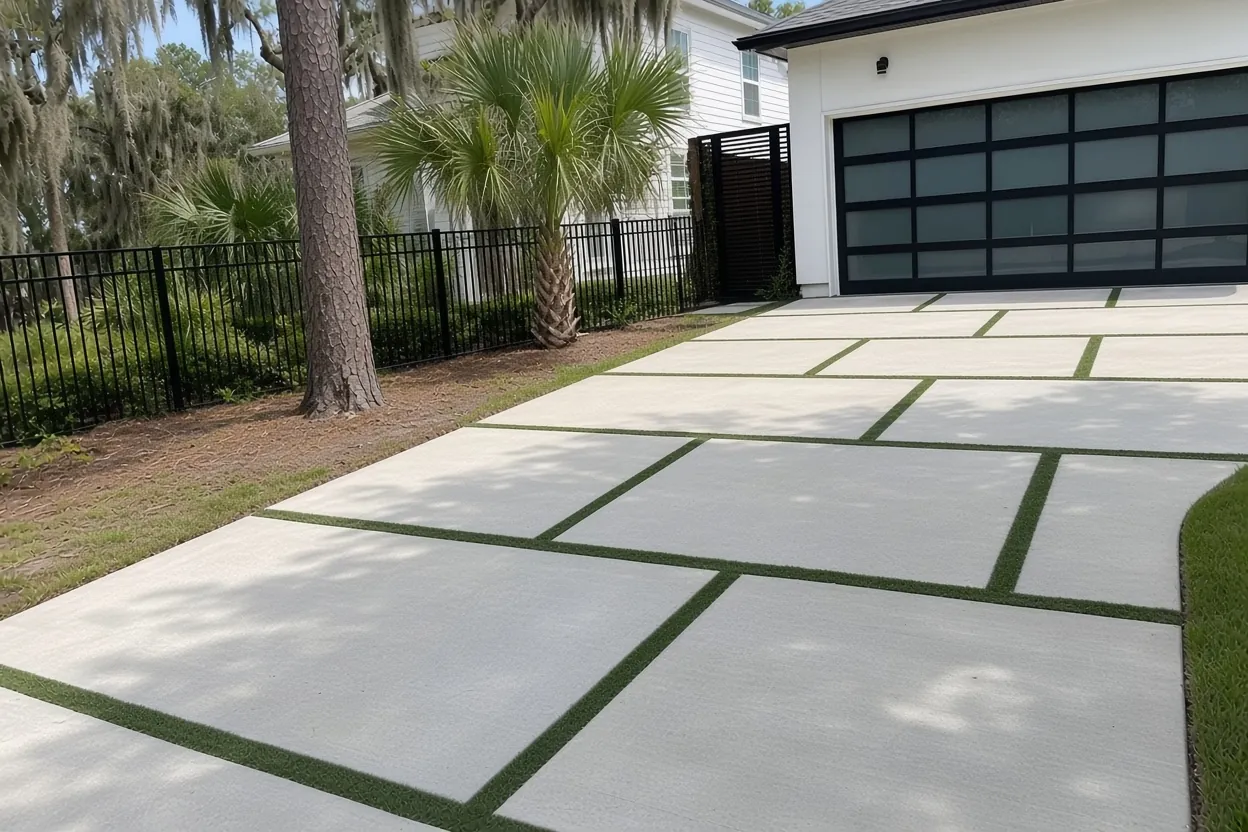
| Ribbon driveway | $8 to $14 | Priced after the site visit | Strip width, length, grass center |
A 550 sq ft driveway works out to $4,400 to $7,700 at our per-foot rate before any tear-out. These are ranges, not quotes. Once we see the site, you get a firm number in a free written estimate within 48 hours.
Under the slab in Bridgewater: Arents fill, mine-spoil sand and thickness
Polk County's copy of the USDA soil survey maps about 53 percent of Bridgewater as Arents, the label for reworked or human-altered fill. Another 14 percent is Neilhurst sand, which its official series description calls excessively drained sand formed in spoil from mining operations. Slivers of Tavares and Adamsville fine sand fill in the rest of the dry ground. Add it up and roughly two-thirds of the neighborhood is made ground, and fill can vary from one yard to the next.
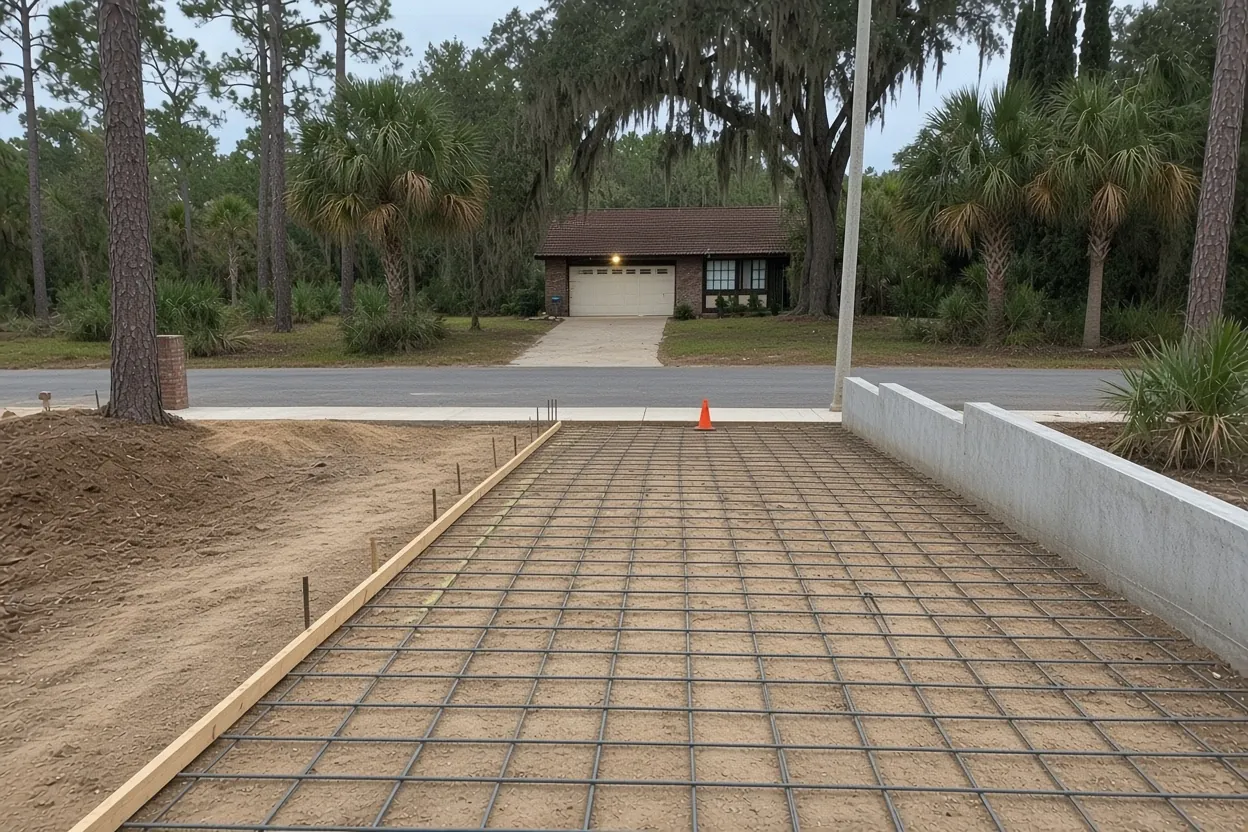
A driveway carries its weight at four tire patches. Here, the base belongs in the price from the start. Where a soft or organic pocket turns up, it can be dug out and replaced with clean sand compacted in thin lifts, priced on its own line. On that base, Concrete Network puts the minimum residential driveway at 4 inches and says stepping up to 5 inches adds roughly 20 percent to the concrete cost while raising load capacity by nearly half. It also suggests thickened edges, 1 to 2 inches extra along the sides, where tires roll off the slab. Wire mesh suits a 4 to 5 inch driveway. Rebar on about a 12 inch grid belongs in slabs 5 inches and thicker. Synthetic fibers cut plastic shrinkage cracks, but they don't stand in for steel.
Widening an original village driveway or tearing it out
Bridgewater has 779 single-family homes and 120 townhomes, and its village plats were recorded from 2006, when Villages 5A and 6A came first, through 2021, when Villages 12 and 13 were added. Repairing and enlarging aren't the same thing under the code. An existing driveway that doesn't meet today's standard may be maintained and repaired as long as it isn't enlarged. Widening increases its size, which that repair allowance doesn't cover, so plan a widened layout to fit Section 4.11.4.6 and confirm it with the City at permit time.
Joints matter on an extension, since the new concrete ties into the old. Isolation joints go where the driveway meets the garage floor, a sidewalk or existing pavement, letting each slab move on its own. Concrete Network's guidance is control joints no more than 10 feet apart on a 4 inch slab, cut to a quarter of the slab depth, about 1 inch. A full driveway replacement adds tear-out at $2 to $4 per sq ft for breaking, loading and hauling the old slab.
Check the zoning too. About 60 percent of the neighborhood is zoned PUD 4322, a planned development from 2002, and a sliver is PUD 5708 from 2018. Check your parcel's zoning before the permit is filed. Our Lakeland driveway cost guide runs the numbers on widening versus replacing.
How Your Job Goes
Walk the lot
We measure the frontage, the side-line distances and the run to the street. Where the fill looks soft, we can probe the base where the slab will go.
Written quote
You get width, thickness, reinforcement, joints, base work and permits on paper within 48 hours.
Permits and notices
Driveway permit, Right-of-Way Use Permit for the apron, the 48-hour City notice and, over $2,500, the Notice of Commencement.
Pour, cure, clean up
We pour, start curing the moment finishing ends and leave the street and yard clean.
CDD questions, the Notice of Commencement and a flood-zone check
A special district sits over this neighborhood: the Bridgewater Community Development District. Its audited financial report says it was established by City of Lakeland Ordinance No. 01-079 on November 19, 2001, under Chapter 190 of the Florida Statutes. Before the estimate, ask the district manager and any homeowners association whether they review a driveway widening or a new finish. Bring their answer with you.
Florida's lien law also adds paperwork. The owner, or the owner's authorized agent, records a Notice of Commencement with the County Clerk before work starts on a direct contract over $2,500, and once the contract tops $5,000 a copy also goes to the building department before the first inspection. A two-car driveway in our $5,000 to $10,000 range clears both lines. A small repair may not. Your written quote spells out which ones apply.
HB 803's exemption request for non-structural work under $7,500 skips properties in a flood hazard area, and FEMA maps about 44 percent of Bridgewater in Zone AE, mostly the lakes. Look up your address on the FEMA Flood Map Service Center. The building official has the final say on what qualifies. Our Lakeland concrete permit guide lays out the order, and our Bridgewater neighborhood page covers the rest of the area.
Curing in open sun and the first week before you park
NLCD tree canopy data averages about 8 percent cover over Bridgewater, so a new driveway here cures with almost nothing between it and the sun. Those first few days count. NRMCA's guide to curing in-place concrete says curing should start right after finishing and typically continue 3 to 7 days, and that concrete left to dry can lose as much as 50 percent of its potential strength compared with moist-cured concrete.
We pick the curing method before the truck shows up: plastic sheeting at least 4 mils thick, wet coverings kept damp, or a liquid membrane compound. West Central Florida's rainy season runs May 25 to October 10, and the National Weather Service puts its peak of heavy rain in July through early September. NRMCA's hot-weather advice is to avoid the hottest part of the day when possible, so that's how the pour gets scheduled.
After that, you wait. Keep cars off for at least 7 days. We leave the street, the walk and your yard clean when the forms come off. Comparing neighborhoods? See our pages for concrete driveways in Sandpiper, Lake Hollingsworth and Riverstone, or plan the backyard with our Bridgewater patio page.
Common Questions
How wide can I make my driveway in Bridgewater?
Can I add a circular driveway on a Bridgewater lot?
How thick should a driveway be over Bridgewater's fill soils?
Does replacing a Bridgewater driveway need both a building permit and a right-of-way permit?
When can I park on a new driveway in Bridgewater's full sun?
Mesh, rebar or fiber for a driveway on reworked fill?
Who records the Notice of Commencement on a $5,000 to $10,000 driveway?
Sources
- Land Development Code, Sec. 4.11.4.6 Vehicle Use Area Design & Construction Standards (Ord. 5793) (City of Lakeland (Municode))
- Historic Districts (Historic_Dist25) (City of Lakeland GIS)
- iMS Centerlines (FULLSTREETNAME, OWNERSHIP) (City of Lakeland GIS)
- Engineering Permit Inspection Information (City of Lakeland Public Works Engineering)
- Official Series Description: NEILHURST (USDA-NRCS (NCSS OSD Registry))
- Concrete Driveway Installation: 8 Essentials (Concrete Network)
- CIP 11 - Curing In-Place Concrete (National Ready Mixed Concrete Association)
- Florida Statutes 713.13 Notice of Commencement (Florida Legislature)