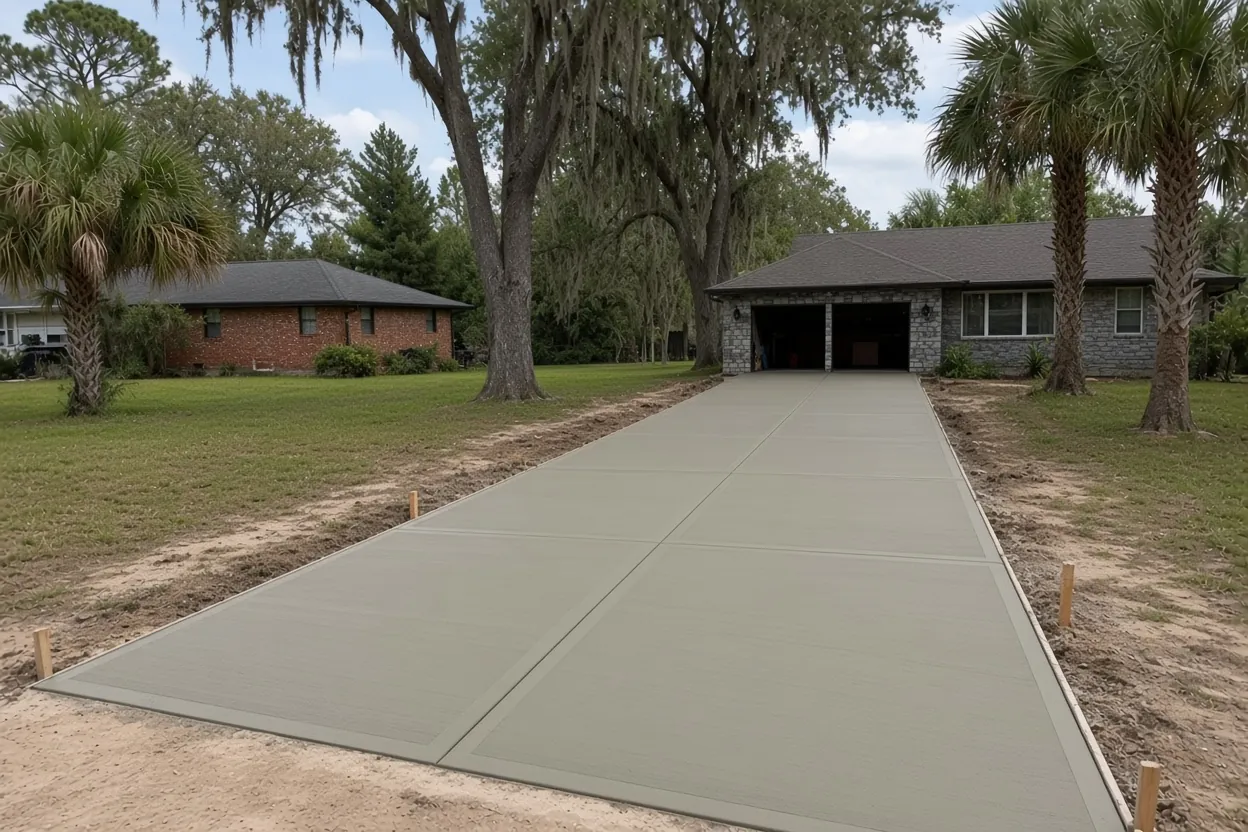
The two-car number: $5,000 to $10,000 for 500 to 700 sq ft
Lakeland Concrete Co prices a new Lakeland concrete driveway at $8 to $14 per square foot. That rate assumes a 4 to 5 inch slab with a broom finish, the plain, lightly textured surface. A typical two-car driveway covers about 500 to 700 square feet, so the project usually lands at $5,000 to $10,000.
The rate covers grading the base, forms, reinforcement, placing and finishing the concrete, cutting the joints and cleanup. What it does not cover shows up as its own line on the quote: breaking out an old slab, extra fill for a soft spot, an apron in the city right-of-way, or a thicker section for an RV. Keeping those separate is how you compare two quotes fairly.
For how we build the slab itself, see our concrete driveways page. If you want pattern and color, that is a separate rate covered on stamped concrete.
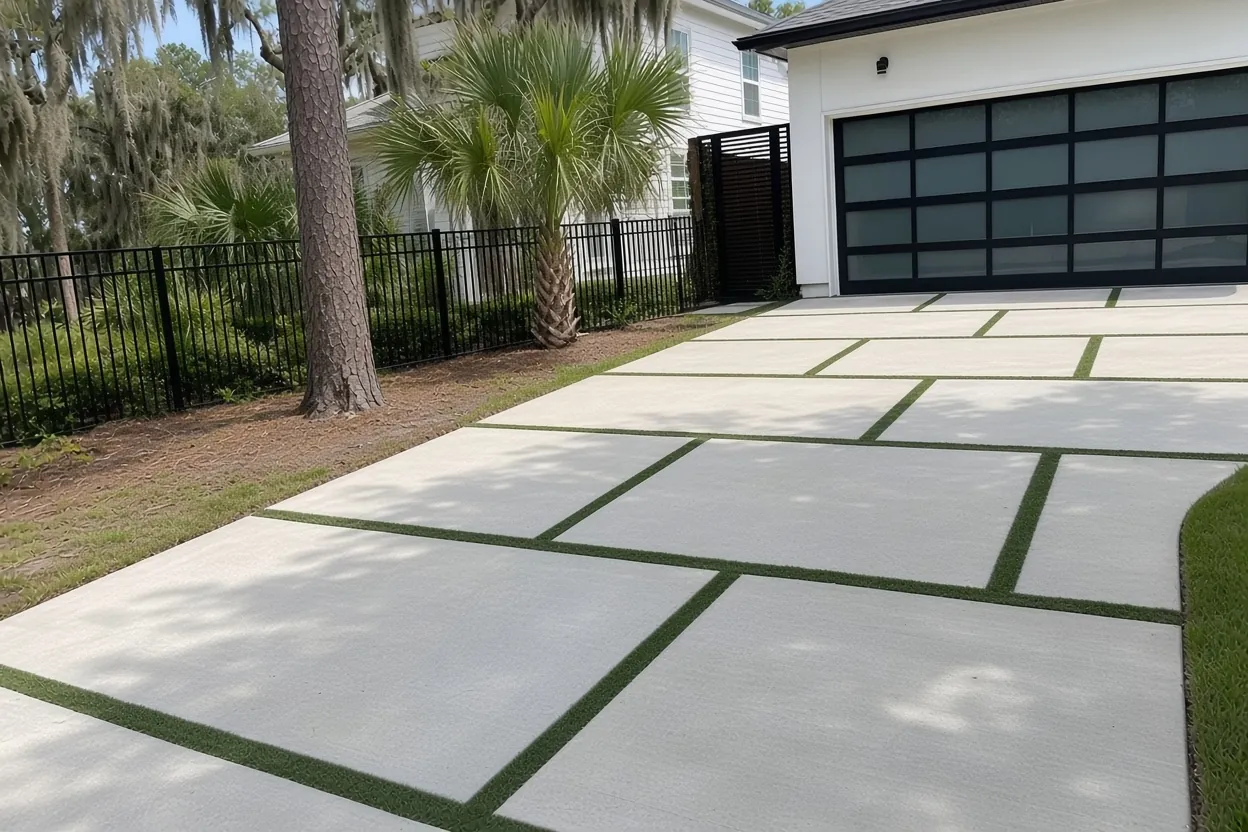
Single-car strips to long two-car driveways: the math by size
Measure length times width in feet, then multiply by our low and high rate. These are worked examples for new pours, before tear-out or extras.
| Driveway | Area | At $8 per sq ft | At $14 per sq ft |
|---|---|---|---|
| Single-car strip, 10 x 30 ft | 300 sq ft | $2,400 | $4,200 |
| Long single lane, 12 x 40 ft | 480 sq ft | $3,840 | $6,720 |
| Two-car square, 24 x 24 ft | 576 sq ft | $4,608 | $8,064 |
| Two-car with turnaround, 20 x 35 ft | 700 sq ft | $5,600 | $9,800 |
| Deep two-car on a long lot, 20 x 45 ft | 900 sq ft | $7,200 | $12,600 |
A flared apron, a curve or a parking pad beside the garage adds area you may not notice from the front door, so measure the whole slab, not just the lane.
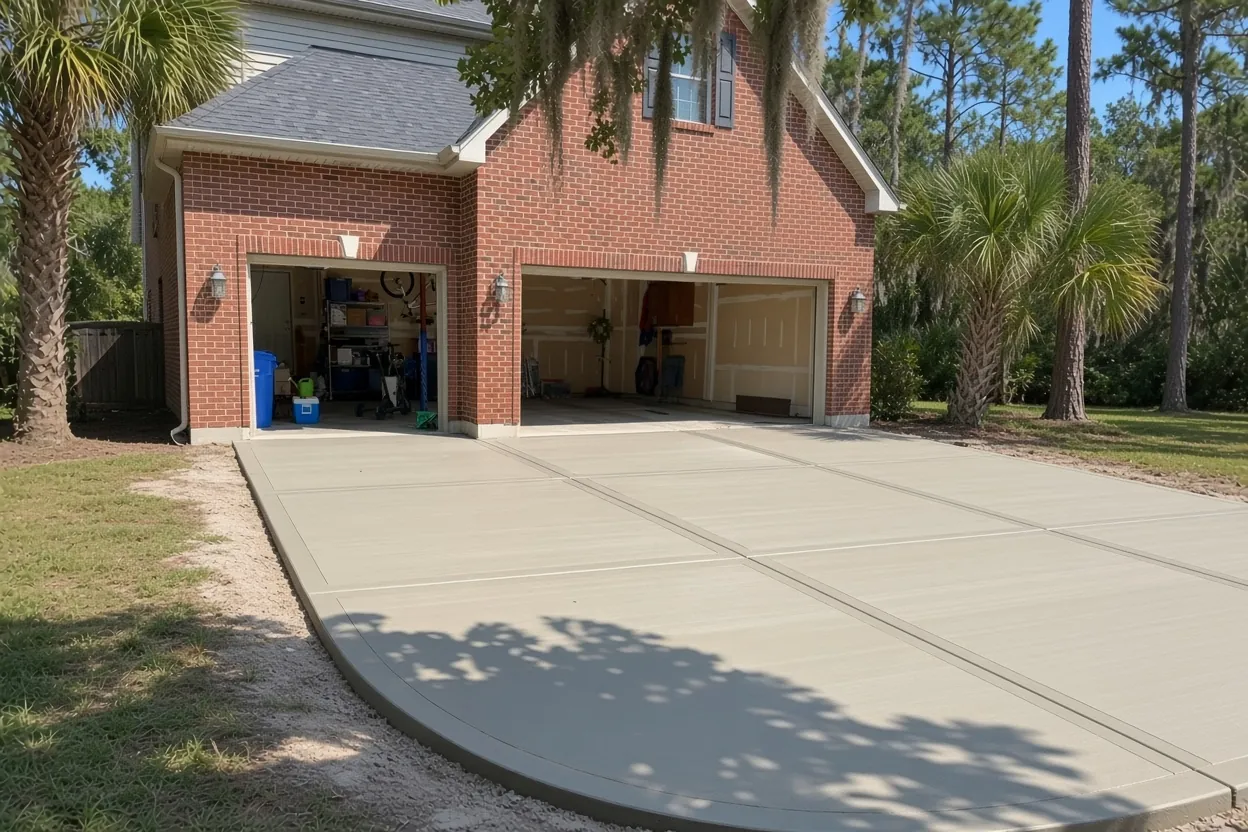
What It Costs
Our typical ranges for Lakeland driveways and the jobs people price alongside them.
| Job | Per sq ft | Typical project | What moves the price |
|---|---|---|---|
| New 2-car driveway, broom finish (about 500 to 700 sq ft) | $8 to $14 | $5,000 to $10,000 | Area, 4 or 5 inch thickness, base work |
| Tear-out of the old slab | Adds $2 to $4 | Priced after the site visit | Old slab thickness, steel, haul distance |
| Extension or widening | $8 to $14 | Priced by the square foot | Tying into the old slab and matching its level |
| Stamped driveway, border or entry | $14 to $24 | Priced after the site visit | Stamped area, pattern, color and sealer |
| Front walk tied to the driveway | $8 to $14 | $1,500 to $4,500 | Width, length and steps |
Ranges only. Thickness, tear-out, apron work and access set the final number, so we price your driveway in a free written estimate after we see it.
Tear-out: the $2 to $4 per sq ft line on a replacement
On a replacement, the old slab has to go before the new one goes in. Tear-out adds $2 to $4 per square foot on top of the new-pour rate. Where you land depends on how thick the old concrete is, whether it has wire or rebar in it, and how far the truck has to haul it.
Work the numbers on a 576 square foot two-car driveway. Removal adds $1,152 at the low end and $2,304 at the high end, on top of the new slab. That is why a replacement and a new pour of the same size never carry the same total.
The base is the other half of a replacement. Once the old slab is up, we see what it was sitting on. Sand that washed out under a cracked corner, a root mat from a nearby oak, or a low spot that held water all get fixed before forms go in, and any extra fill shows up as a line item. If your old driveway sank at one corner or cracked in a spiderweb near the street, mention it at the visit, because that pattern tells us where the base failed.
Partial replacement is sometimes possible. If only the street end or one panel between joints is broken, cutting out and repouring that section can make sense, though the new concrete will not match the old color exactly.
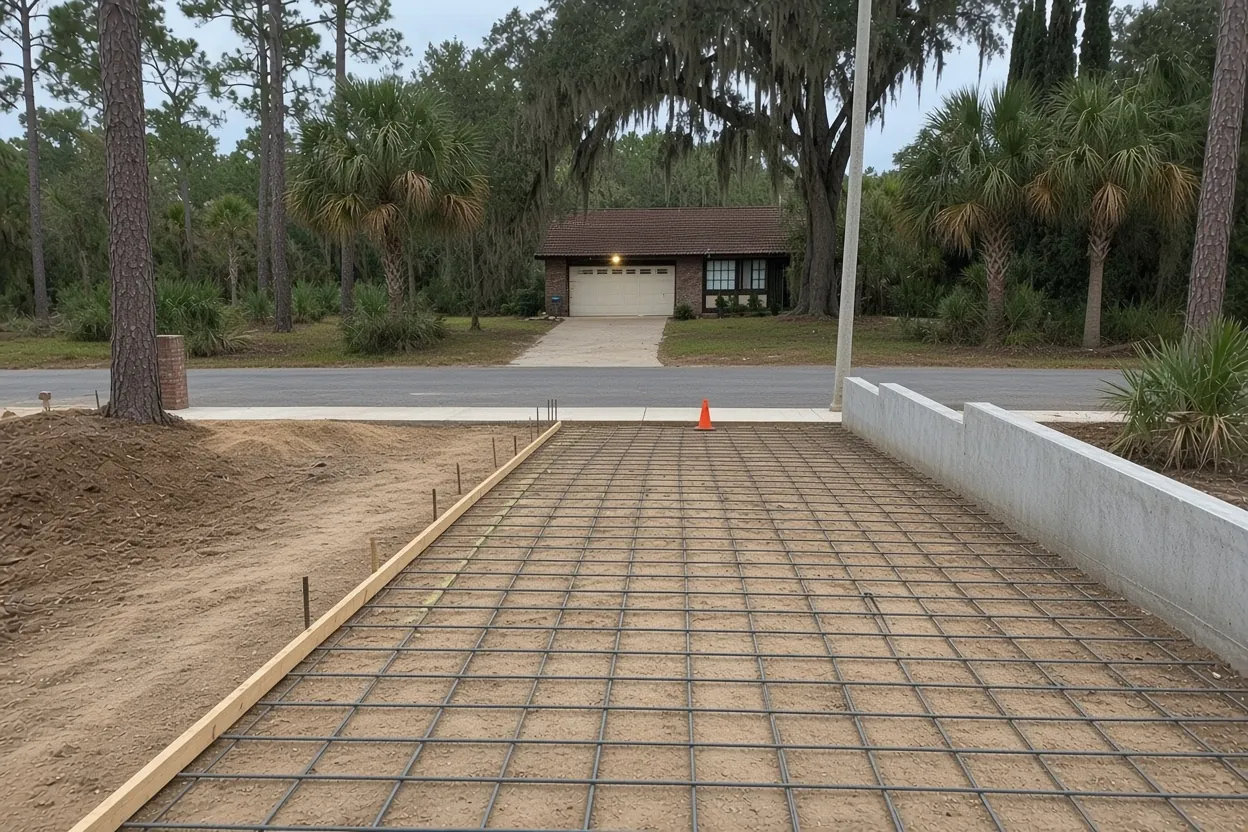
Going from 4 to 5 inches, and when 6 makes sense
Thickness is the spec that changes the price most after area. Concrete Network, a trade education site, says to place a driveway at least 4 inches thick and, citing the Tennessee Concrete Association, that going from 4 to 5 inches adds about 20 percent to the concrete cost while raising load capacity by nearly 50 percent. Our $8 to $14 rate covers 4 to 5 inches, so a thicker section for a motorhome pad is priced at the visit. Read the guidance in Concrete Network's driveway installation guide.
You do not always need the whole driveway thick. Concrete Network also suggests thickening the edges by 1 or 2 inches, reaching 4 to 8 inches in from the slab edge, where heavy loads are most likely. A 5 inch slab with thickened edges, or a 6 inch strip only where the RV parks, can cost less than going 6 inches wall to wall.
Steel and joints are smaller costs with big effects. The same source pairs wire mesh with 4 to 5 inch slabs and rebar on about a 12 inch grid at 5 inches and up, and says fibers help with shrinkage cracks but are not structural reinforcement. Joints go no more than about 10 feet apart on a 4 inch slab, cut a quarter of the thickness deep. Make sure your quote names all three: inches, steel and joint spacing.
How Your Job Goes
Measure and look
We measure the slab, check the base, trees, irrigation and the street edge.
Written quote
Area, thickness, steel, joints, tear-out and extras are listed line by line.
Approvals
Driveway permit, right-of-way permit, historic review or HOA letter are lined up before the date.
Tear-out and base
The old slab comes out, the base is repaired and compacted, and forms go in.
Pour, cut and cure
Concrete is placed and finished, joints are cut, and the slab cures before cars go on it.
City line items: the permit, the apron and the $5,000 notice
The city's paperwork belongs on the quote. In Lakeland, residential driveways are processed by the Building Inspection Division and inspected by Public Works Engineering. The apron, the piece between your property line and the street, sits in public right-of-way, and on a city street any work there needs a Right-of-Way Use Permit from Public Works. Public Works lists those permit fees on its permit inspection page. Its fee table lists no fee for Tier 1 work outside downtown that lasts up to 90 days, closes no travel lane and closes no more than 300 feet of sidewalk; longer or lane-closing work, and some downtown work, carries a $250 or $500 fee. The apron also has to meet the city's engineering standards.
The bigger paperwork trigger is the contract amount. Florida requires a recorded Notice of Commencement on jobs over $2,500, and Lakeland's forms and checklists page lists it for projects over $5,000. Our two-car range is $5,000 to $10,000 before tear-out, so a two-car replacement will usually cross that line, and the recorded notice has to reach the city before the first inspection. Plan time to record it with the Polk County Clerk of Courts.
Our Lakeland concrete permit guide covers the order of approvals and the newer state permit exemption in full, so here we only list what touches the price.
Ribbon driveways and the ten-foot rule: when historic review shrinks the bill
On a historic lot, the rules can make the driveway smaller, and a smaller slab costs less at the same rate. Lakeland's Design Guidelines for Historic Properties say driveways usually run along one side of the house, list driveways wider than ten feet as not acceptable, and describe the old ribbon style, two strips under the wheels, as part of the historic pattern. New or replaced paving there goes through a staff Minor Review first, explained step by step in our historic district driveway guide.
Here is the arithmetic. A 10 by 40 foot side driveway is 400 square feet, which is $3,200 at the $8 rate or $5,600 at the $14 rate. A ribbon driveway of the same length with two strips each 2 feet wide is 160 square feet, or $1,280 and $2,240, before any grass or brick between the strips. Ribbons have more edge to form per square foot, so the rate tends to sit toward the high end, but the total still drops.
Width rules also cut the tear-out line. An old driveway that grew past ten feet over the years may come back narrower, which means less new concrete. Your quote should show the area for the design that will actually pass review.
Oaks, sprinkler lines and soft spots that turn into line items
Some driveway cost hides in the yard around the slab. UF/IFAS says live oaks planted close to curbs, sidewalks or driveways can grow roots big enough to lift and crack them (UF/IFAS live oak guide). If a root is what broke your old driveway, the new one needs a plan for it. That can mean shaping the slab edge away from the trunk, a thicker section over the root zone, or a narrower pour. Removing a tree is its own job, and in Lakeland it starts with the city's Tree Removal Permit Application.
Irrigation is the next surprise. Sprinkler lines can run under or across an old driveway edge. Mark the heads and valves before the visit so we can price capping or rerouting, and know that a line we find under the slab during tear-out gets flagged before anything is cut.
Soft spots come last. Florida's most widespread soils are sandy, and sand that stayed wet under a cracked slab has to be dug out or compacted before forms go in. That work is priced by what we find, which is why the base line on a replacement quote reads as a range until the old slab is up.
Broom finish, a stamped border or a full stamp: the price steps
Finish is the last big lever. A broom finish is included in our $8 to $14 rate. Stamped and decorative concrete runs $14 to $24 per square foot, because it adds color, release agent, stamp mats, hand detailing and sealer. On a 576 square foot two-car driveway, a full stamp at the low stamped rate adds $3,456 over the low broom rate.
A border is the middle path. Two stamped bands 2 feet wide down each side of a 40 foot driveway cover 160 square feet. Priced at the stamped rate, those bands cost about $6 more per square foot than broom finish at the low end of both ranges, or $960 extra, and the rest of the slab stays at the broom rate. A stamped landing where the driveway meets the front walk is another small-area option.
Keep upkeep in mind. Stamped surfaces need resealing every 2 to 3 years to hold their color, so add that to the long-run cost. If you are weighing stamped against pavers for the whole driveway, our stamped concrete vs pavers guide compares the two on repairs, roots and maintenance.
Line items a fair driveway quote spells out
- Area and rate. Square footage that matches your own tape, and the per square foot price.
- Thickness. 4, 5 or 6 inches, and any thickened edges.
- Steel. Mesh, rebar or fiber, with spacing.
- Joints. Spacing and depth, about a quarter of the slab thickness.
- Tear-out. Removal of the old slab at its own rate, and who hauls it.
- Base. Fill and compaction, and how soft spots will be priced if found.
- Apron and permits. Whether the right-of-way permit, apron work and inspections are included.
- Trees and irrigation. How roots near the slab and sprinkler lines are handled.
- Finish. Broom, or the stamped area at the stamped rate.
Bring photos of the old driveway, rough measurements and any HOA or historic paperwork to the visit. Call (863) 400-2934 or use the contact page to book it.
Common Questions
What does a 24 by 24 concrete driveway cost at your rates?
How much does tearing out my old driveway add?
Can a single-car driveway come in under $5,000?
Does a 5 inch driveway cost much more than 4 inches?
Is the apron at the street priced separately?
Is a ribbon driveway cheaper than a full slab?
Will my driveway job need a Notice of Commencement?
Is widening my driveway cheaper than replacing it?
Sources
- Concrete Driveway Installation: 8 Essentials (Concrete Network)
- Engineering Permit Inspection Information (City of Lakeland Public Works Engineering)
- Engineering Standards (City of Lakeland Public Works)
- Forms & Checklists (City of Lakeland Building Inspection)
- Design Guidelines for Historic Properties (City of Lakeland)
- Live Oaks (UF/IFAS Gardening Solutions)
- Lakeland's Urban Forest (City of Lakeland Parks & Recreation)
- SL441/SS655: Agricultural Soils of Florida (UF/IFAS Extension)