Backyard slab sizes that fit a 2019 to 2021 Riverstone house
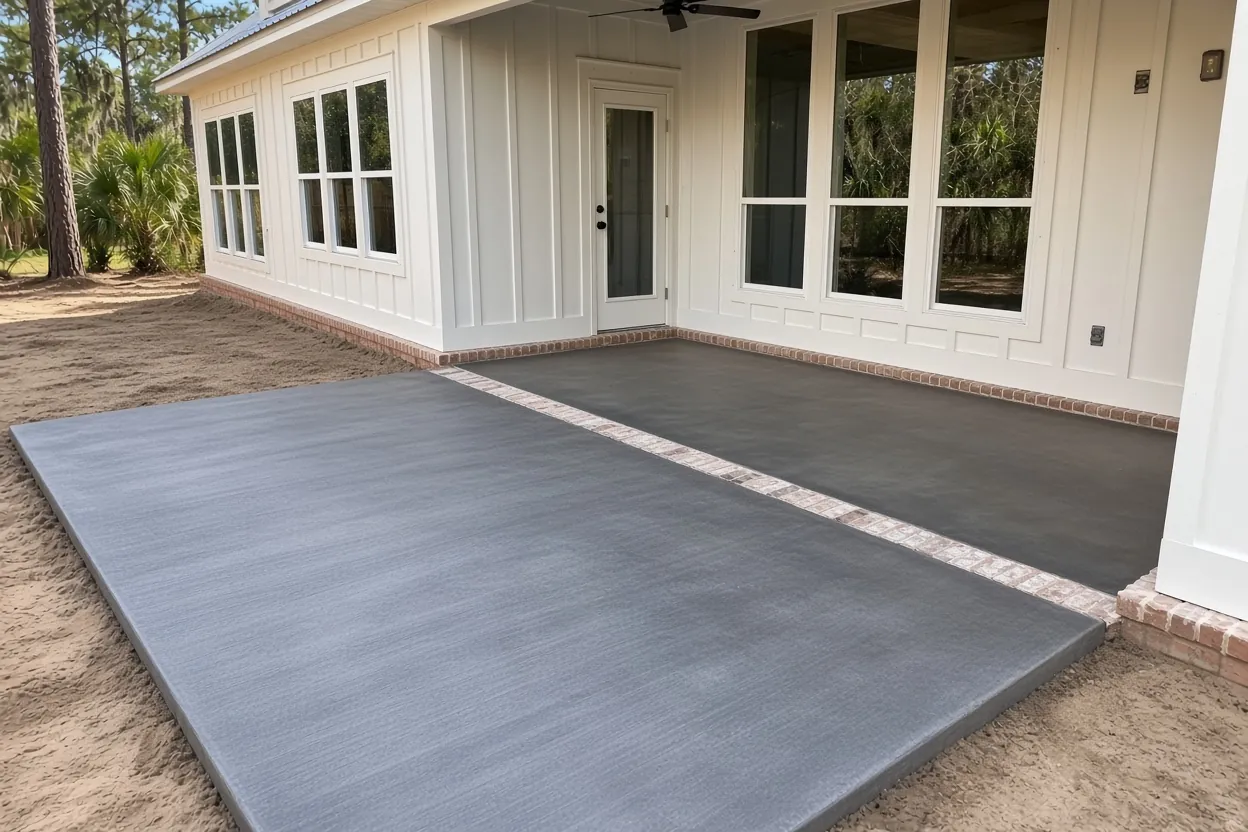
The Polk County Property Appraiser shows Riverstone's plats recorded from 2019 to 2021, so on most lots you're planning in a young yard, not working around an old patio. A 12 by 16 patio fits a dining table and chairs. Go closer to 16 by 20 and you fit a table, a grill corner and a couple of lounge chairs. Measure your furniture, then leave walking room around it.
Tying into an existing slab outside the back door? Where old meets new, an isolation joint lets each piece move on its own, and the new surface should slope so rain runs into the yard, not back toward the door. Our concrete patios page covers the job across Lakeland, and the patio cost guide multiplies out common sizes.
Muck, clay and the low spots toward the wetland line
Pomona fine sand covers about 70% of Riverstone, and it's poorly drained flatwoods ground on its own. Patio trouble hides in the smaller map units. Floridana mucky fine sand covers 5.6% and Eaton mucky fine sand 5.2%, both in depressions. The Eaton series description puts clayey marine sediment under the sand, with slow permeability. Samsula muck, about 2%, formed in plant remains, and its water table sits at or above the surface except in long dry spells. Federal wetland maps show freshwater emergent wetland on 8.5% of the neighborhood and forested or shrub wetland on another 4.6%.
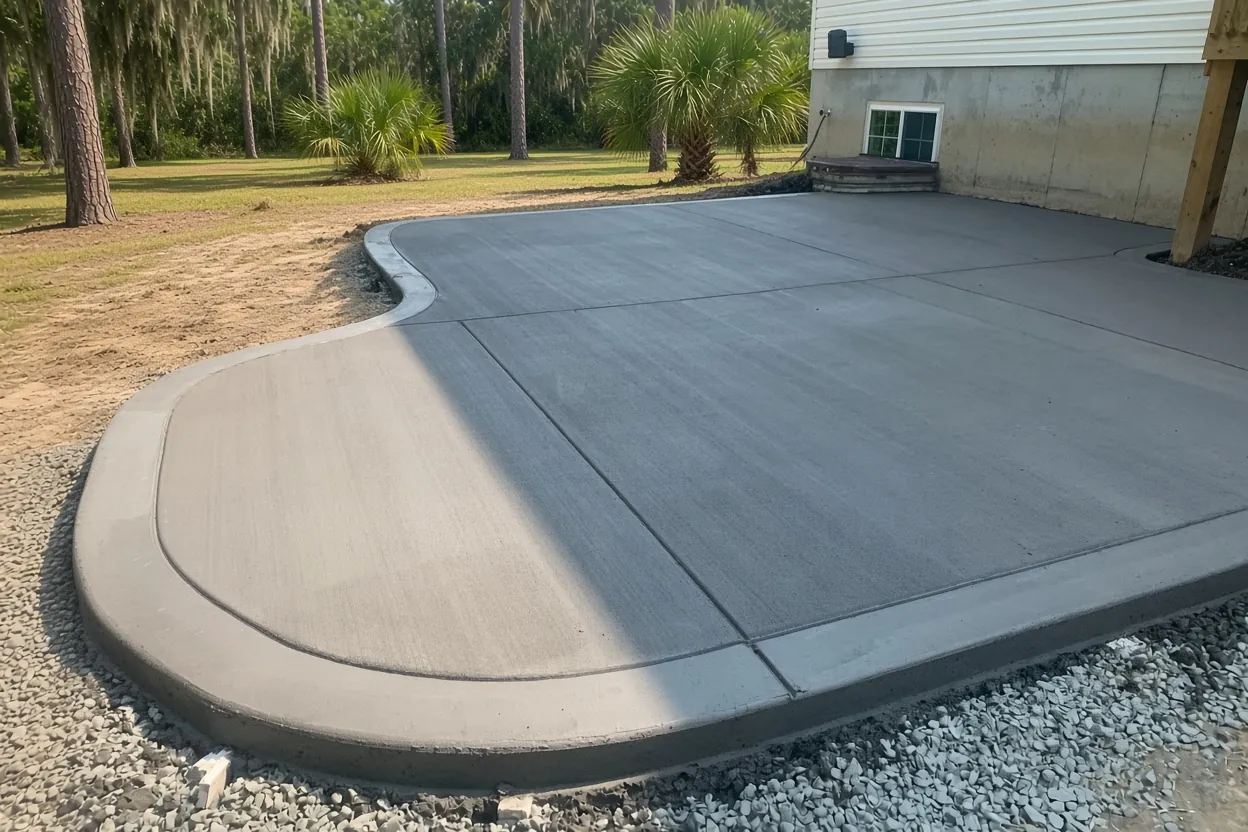
Does your yard back onto one of those edges? Then the soil gets checked before we quote. Organic muck can't carry a slab, so it can be dug out and replaced with clean sand, compacted and free of roots and vegetation, the same standard the Florida residential code sets for fill under a house slab. That code also caps clean sand fill at 24 inches without approval. After that, the backyard patio gets sloped away from the house so storm water doesn't pool against the wall.
What It Costs
Here are our patio ranges, worked out for common Riverstone patio sizes.
| Job | Per sq ft | Typical project | What moves the price |
|---|---|---|---|
| 12 by 16 patio, 192 sq ft | $8 to $14 | $1,536 to $2,688 | Tie-in to the builder slab, muck removal in low yards |
| 14 by 20 patio, 280 sq ft | $8 to $14 | $2,240 to $3,920 | Thickened edge for a future screen room |
| Larger backyard patio, about 250 to 450 sq ft | $8 to $14 | $2,500 to $6,500 | Base fill depth, access along the side yard |
| Stamped or decorative patio | $14 to $24 | $5,000 to $16,000 | Pattern, color, border and sealer |
These are ranges only. You get a free written estimate after we see the site, with the written quote inside 48 hours.
Curtis Lake and the lakeshore setback question
Curtis Lake sits inside Riverstone. Lakeland's Land Development Code keeps a 50 ft landward setback from the high water line for structures on eleven protected lakeshores, among them Lake Hollingsworth, Lake Morton, Lake Parker and Lake Bonny. Curtis Lake didn't make that list, so the setback doesn't name it.
Don't stop there, though. Wetland rules can still apply, and the City's Lakes and Stormwater Division says shoreline projects on City lakes need City permits, with other agencies sometimes adding their own. The City, not us, decides whether a ground-level patio counts as a structure under the lakeshore rules. If your lot touches the water or a wetland edge, ask Lakes and Stormwater before we set forms.
Then check the flood zone. FEMA puts about 22% of the neighborhood in Zone A. A lot in that zone can't use the HB 803 permit exemption for work under $7,500, so a modest patio there goes through regular City permitting if a permit applies. Ask the City's Building Inspection Division what your patio needs, with your address in hand, and mention any plan to roof or screen it later. A Notice of Commencement gets recorded before work starts on direct contracts over $2,500; our permit guide has the order.
Against the stucco: termite treatment and the plastic sheet
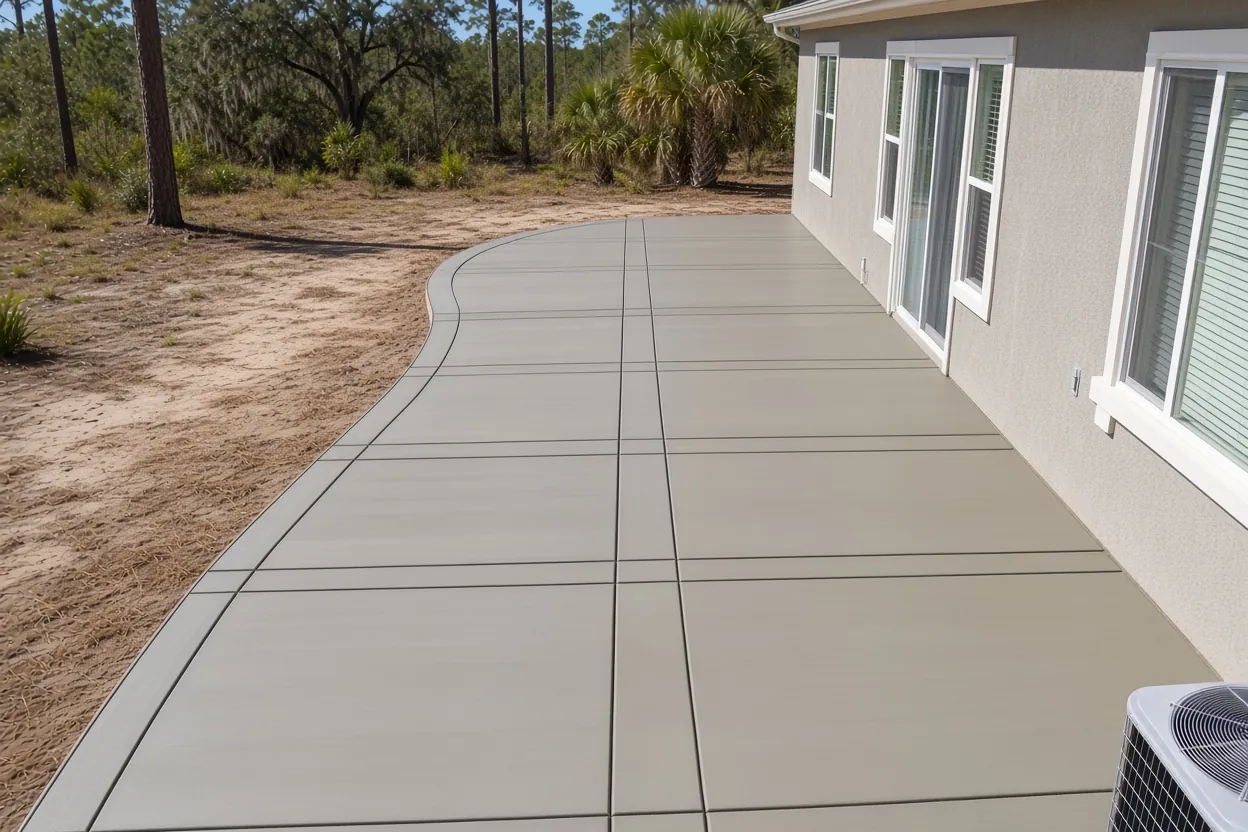
When a patio touches the house, two details change. Termites come first. The Florida Building Code's new-construction rule, R318.1.6, says that where soil treatment is used, the chemical goes under all exterior concrete within 1 foot of the house walls, with a vertical barrier afterward. Your home got its termite protection only a few years ago, by soil treatment, a bait system or treated wood. A new slab means digging along the foundation, which disturbs that soil. Call your pest control company before the pour and ask whether they want to retreat the strip or check the bait stations.
Next up is the vapor retarder. Code section R506.2.3 requires a 6-mil plastic sheet under slabs that may be enclosed and heated, and skips it for patios and flatwork that won't be. NRMCA notes that pouring straight onto plastic outdoors raises the risk of plastic shrinkage cracks and slows finishing. So the sheet belongs only under a space that might become a conditioned room someday. An open patio or a screen room can go without it.
How Your Job Goes
Check the lot
Look up your flood zone, dig out your survey and ask your pest control company about the strip along the wall.
Site visit
We check the low spots, mark the outline and talk through any screen room or roof you have in mind.
Written quote
Size, thickness, joints, base work and price in writing within 48 hours.
Pour and cure
We pour in the morning, start curing right after finishing and leave a clean jobsite.
Screen room or roof later: settle it before the forms
Want the patio slab now and a screen enclosure or roof in a year or two? No problem, as long as we know today. Whatever bolts onto the slab later decides its edge and its permit. A screen room or roof is a building job with its own drawings, and its maker's plans spell out what the slab under the posts has to be. Get those plans, or at least the enclosure company's footing detail, before we pour, and we form the edge to match.
The residential code sets 3 1/2 inches as the minimum for a slab-on-ground floor. A patio can be poured at 4, and the quote states the thickness. The code covers joints as well: contraction joints unless crack control comes from synthetic fibers at 0.75 to 3 pounds per cubic yard or 6x6 welded wire in the middle to upper third of the slab. Joints can be laid out so a future post or screen track doesn't land on one.
Pool deck on the list too? Mention it at the visit.
Afternoon sun on an open lot: keeping the slab usable
You won't find much shade in Riverstone. Tree canopy averages about 11.9% across the neighborhood, and much of what exists lines the wetland edges, not the back yards. Unless you plan around it, a patio here is likely to sit in full sun for much of the day.
What helps is simple. Put the seating end on the side of the house that shades first in the afternoon. Keep the finish a light broom or a light color, since darker tints soak up more sun. Put a roof, pergola or screen room over part of it. That's one more reason to plan the edge now. If you want a stamped finish, ask about a non-skid additive, since a film-forming sealer can turn slick when wet.
NRMCA's hot-weather rules say to avoid the hottest part of the day, keep water out of the mix beyond the design, and start curing as soon as finishing ends, for at least 3 days. White pigmented curing compounds reflect heat. Between May 25 and October 10, the local rainy season, we pour early and watch the radar. Light furniture can go back on the concrete patio once curing ends, after at least 3 days. Heavy planters can wait a week.
Common Questions
What would a 12 by 16 concrete patio cost behind a Riverstone home?
Does the lakeshore setback apply to a patio near Curtis Lake?
Can you pour a Riverstone patio now and add a screen enclosure later?
My Riverstone backyard stays wet after storms. Can a patio go there?
How do I keep a patio in Riverstone from getting too hot?
Does a patio poured against my house need termite treatment?
Sources
- Official Series Description: EATON (USDA-NRCS (NCSS OSD Registry))
- Official Series Description: SAMSULA (USDA-NRCS (NCSS OSD Registry))
- Wetlands NWI layer (Polk County GIS (U.S. Fish and Wildlife Service National Wetlands Inventory))
- Land Development Code, Sec. 6.4 Lake and Natural Habitat Protection (City of Lakeland via Municode)
- Lakeshore Residents (City of Lakeland Lakes and Stormwater)
- 2023 Florida Building Code, Residential, Chapter 5 Floors (R506) (UpCodes / ICC)
- Termite Protection, Florida Building Code Residential R318 (Charlotte County, FL)
- CIP 12: Hot Weather Concreting (NRMCA)
- Florida Statutes 713.02 Types of lienors and amounts of liens (The Florida Senate)
- Florida Statutes 713.13 Notice of commencement (The Florida Senate)
- Florida Thunderstorm Season / Rainy Season (NOAA National Weather Service Tampa Bay)