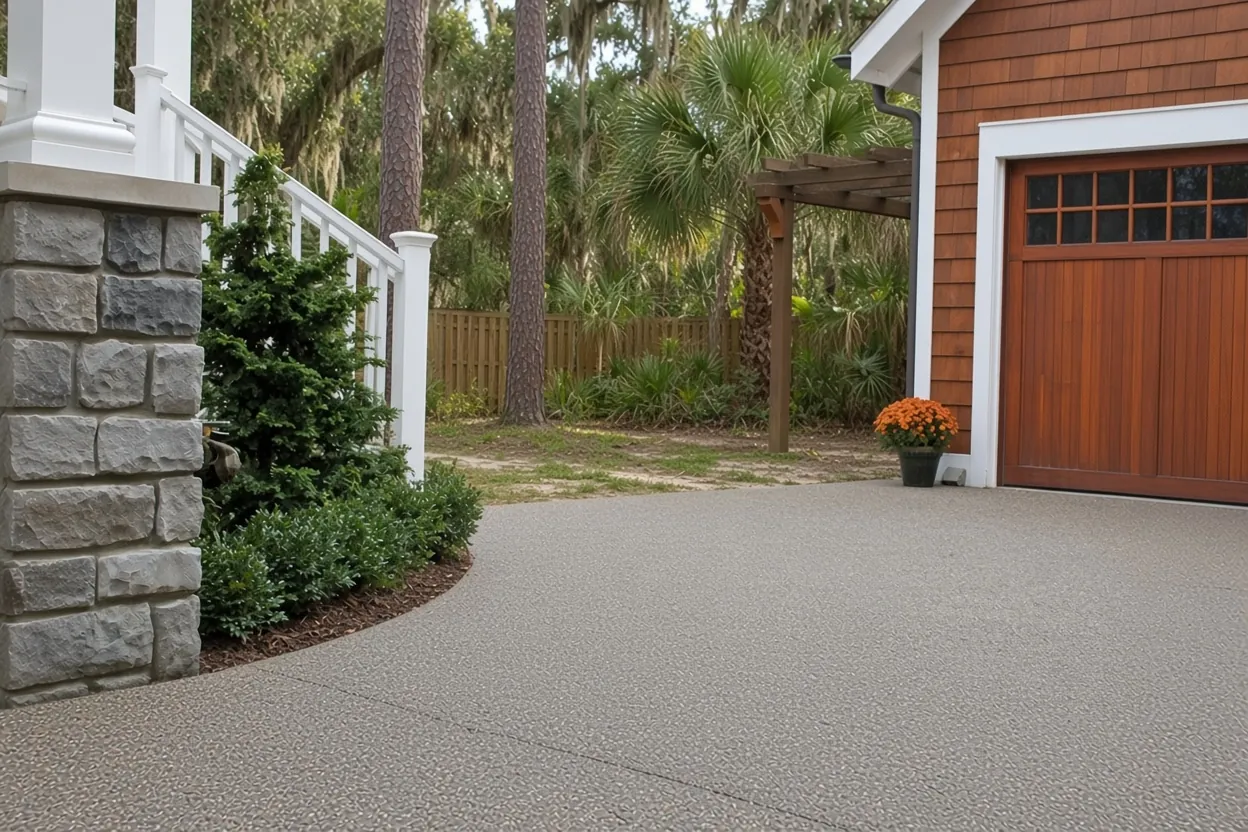
Your block isn't historic, so the wider City limit applies
The City of Lakeland maps the Lake Hollingsworth neighborhood as a 722-acre area wrapping the east and south sides of the lake, bounded by roads like Edgewood Dr E, Crystal Lake Dr, E Belmar St and New Jersey Rd. None of it overlaps the City's historic-district layer. South Lake Morton, Dixieland and Beacon Hill just touch the edge.
For a concrete driveway in Lake Hollingsworth, that one fact matters more than anything else on this page. Inside a district, width tops out at 8 to 10 feet and paving waits on a staff review. Out here, Sec. 4.11.4.6 of the Land Development Code sets the ordinary residential limits, and there's no historic review step ahead of the permit. Live on the north shore near Florida Southern College? That's Historic Lake Morton, with its own rules, and they're covered in our historic driveway guide. For everyone else around Cleveland Heights Blvd and E Beacon Rd, start with our concrete driveways overview and the Lake Hollingsworth neighborhood page, then read on for the numbers.
Sizing under Sec. 4.11.4.6: standard, ribbon or circular
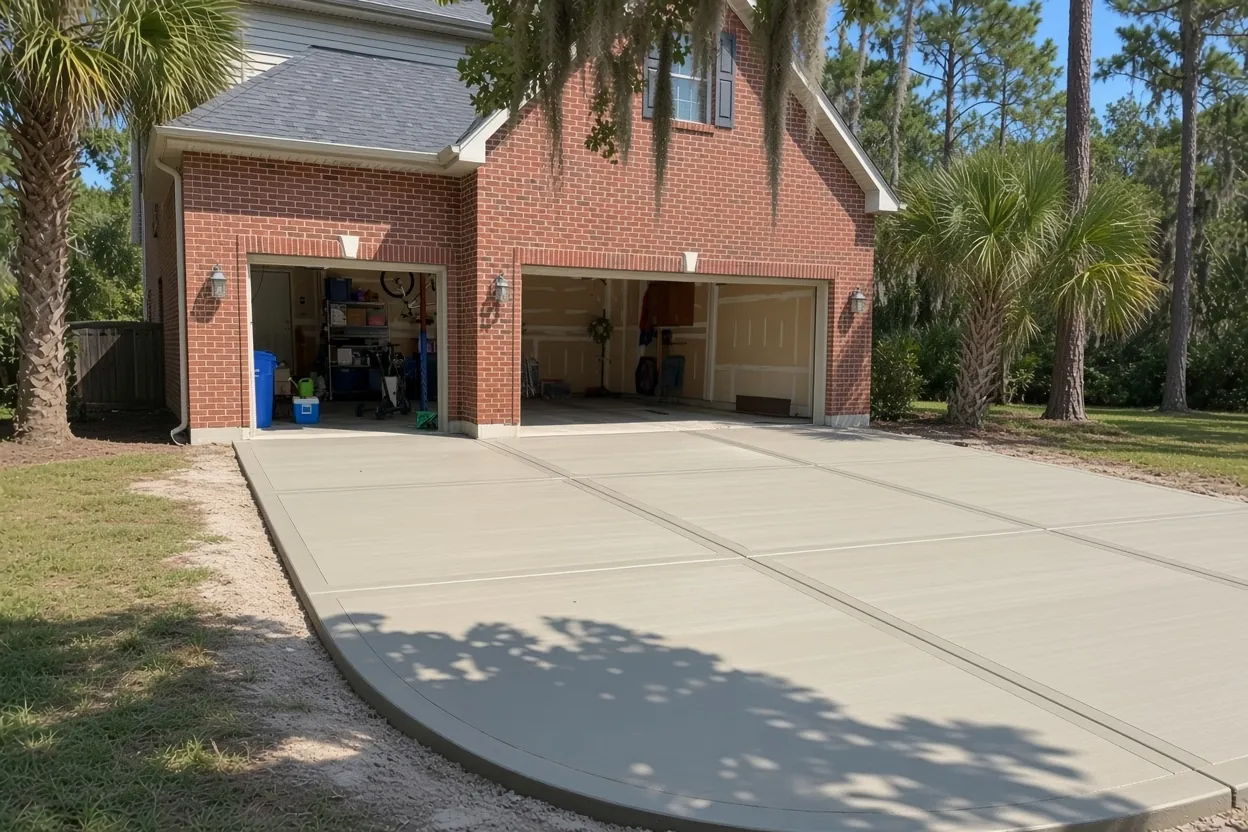
Outside the historic districts, the City's single-family driveway section (adopted by Ord. 5793 in 2019) gives you three shapes to pick from:
- Standard slab: 10 to 24 feet wide. The low end is a single lane. The top end is a full side-by-side two-car pad.
- Ribbon driveway: 7 to 10 feet from outer edge to outer edge, with each concrete tire track at least 2 feet wide and grass between.
- Circular: 10 to 14 feet wide, and only on a lot with at least 75 feet of street frontage.
Every driveway has to run at least 20 feet onto the lot (40 feet if your two required spaces are tandem in a single-car driveway), and a lot gets one curb cut unless it has a circular driveway or access to an improved alley. One more line matters on a replacement: the code lets an older driveway that doesn't meet these numbers be maintained and repaired, as long as it isn't made bigger.
Lots here are roomy by Lakeland standards. The median single-family parcel in the neighborhood is about 13,000 sq ft, and the upper quarter runs past 18,000. About 69% of the land is zoned RA-1. On a lot that size, a 24 foot two-car concrete driveway, or even a circular one, has room that a narrow 1920s lot in the historic blocks up the hill doesn't. Before you fall for a circle, measure your frontage. The Polk County Property Appraiser parcel map shows it. On the free visit we check the width, the length to the garage and the curb cut against the code. The written quote lists all three.
What It Costs
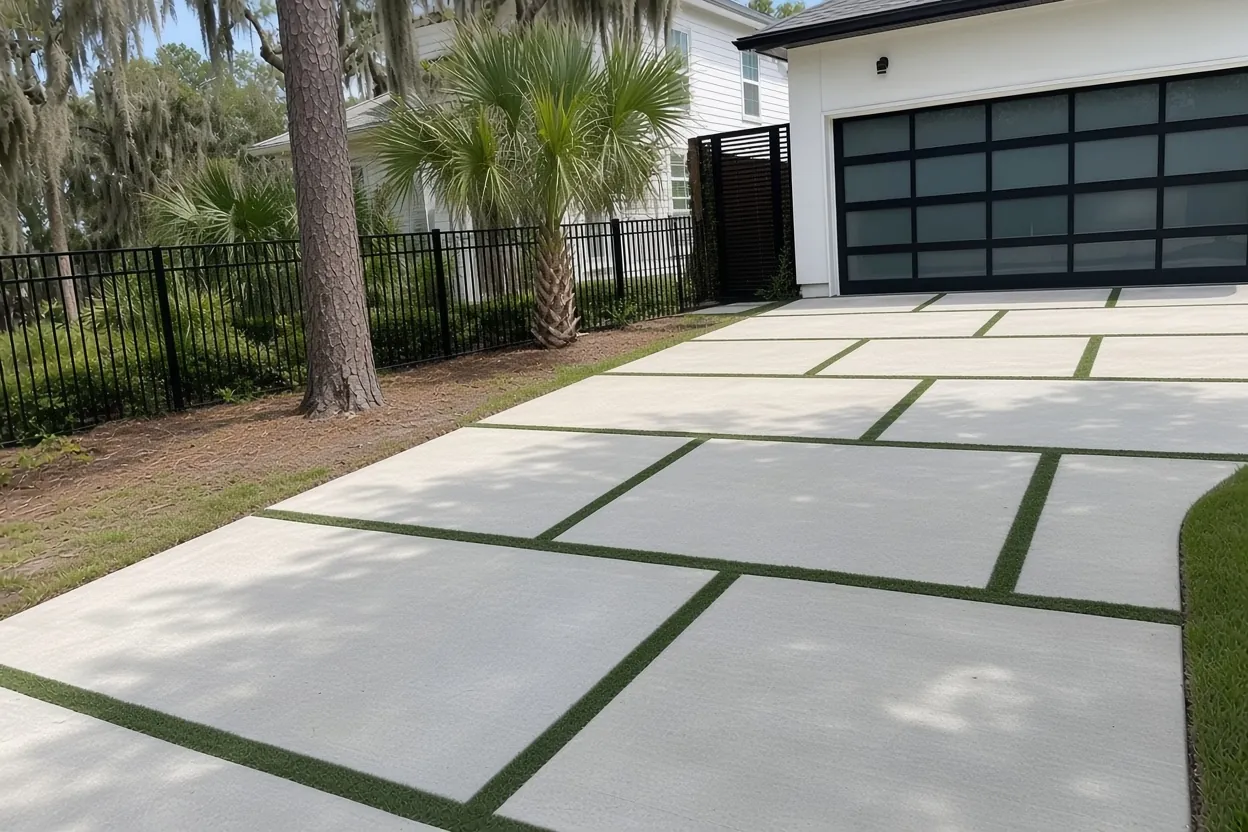
Here are our driveway ranges, applied to the lot sizes you see around the lake. The visit sets the final numbers.
| Driveway job | Per sq ft | Typical project | What moves the price here |
|---|---|---|---|
| Two-car slab, 4 to 5 in. broom finish (500 to 700 sq ft) | $8 to $14 | $5,000 to $10,000 | Thickness, run to the garage, apron at the curb |
| Long single-lane run, 12 by 60 ft (720 sq ft) | $8 to $14 | $5,760 to $10,080 | Length on deeper lots, compaction of the sand base |
| Ribbon driveway, two 2 ft strips 40 ft long (160 sq ft) | $8 to $14 | $1,280 to $2,240 | Forming two strips, grass restoration between them |
| Tear-out of an old slab | adds $2 to $4 | Depends on size | Thickness of the old slab, roots, haul-off |
The worked rows are concrete math at our per-foot rate, not a quote; apron work and small-job minimums can move them. You get a free written estimate after we see the site, within 48 hours of the visit.
Candler sand under the slab: thickness, steel and joints
The NRCS soil map puts about 85% of the neighborhood on Candler or Tavares sand, the deep ridge sands of this part of Polk County. The official Candler description calls it excessively drained. Rain soaks in fast, so the base rarely sits wet. Under a driveway, that's good news. The catch? Loose sand needs compacting before it can carry a truck tire. We hold the base to the standard the Florida residential code sets for fill under a house slab (R506.2.1): free of vegetation and foreign material, compacted for uniform support.
Here's the spec we price for a new concrete driveway that carries cars and pickups on that ground:
- Thickness: 4 inches minimum. Going to 5 inches adds roughly 20% to the concrete cost and nearly 50% to load capacity, per Concrete Network, so we suggest 5 where a work truck or trailer parks.
- Steel: wire mesh suits 4 to 5 inch slabs; rebar on about a 12 inch grid for 5 inches and up.
- Joints: saw cuts no more than 10 feet apart, a quarter of the slab depth.
- Edges: thickened 1 to 2 inches along the sides that take the most wheel traffic.
Not every spot fits that pattern. About 4% of the area maps as Sparr soil, which drains slowly, and about 2.7% is organic muck. If the excavation turns up black, spongy soil, it can be dug out and replaced with clean, compacted sand before any forms go down, and the quote shows that line separately.
City streets, six private lanes and one state road
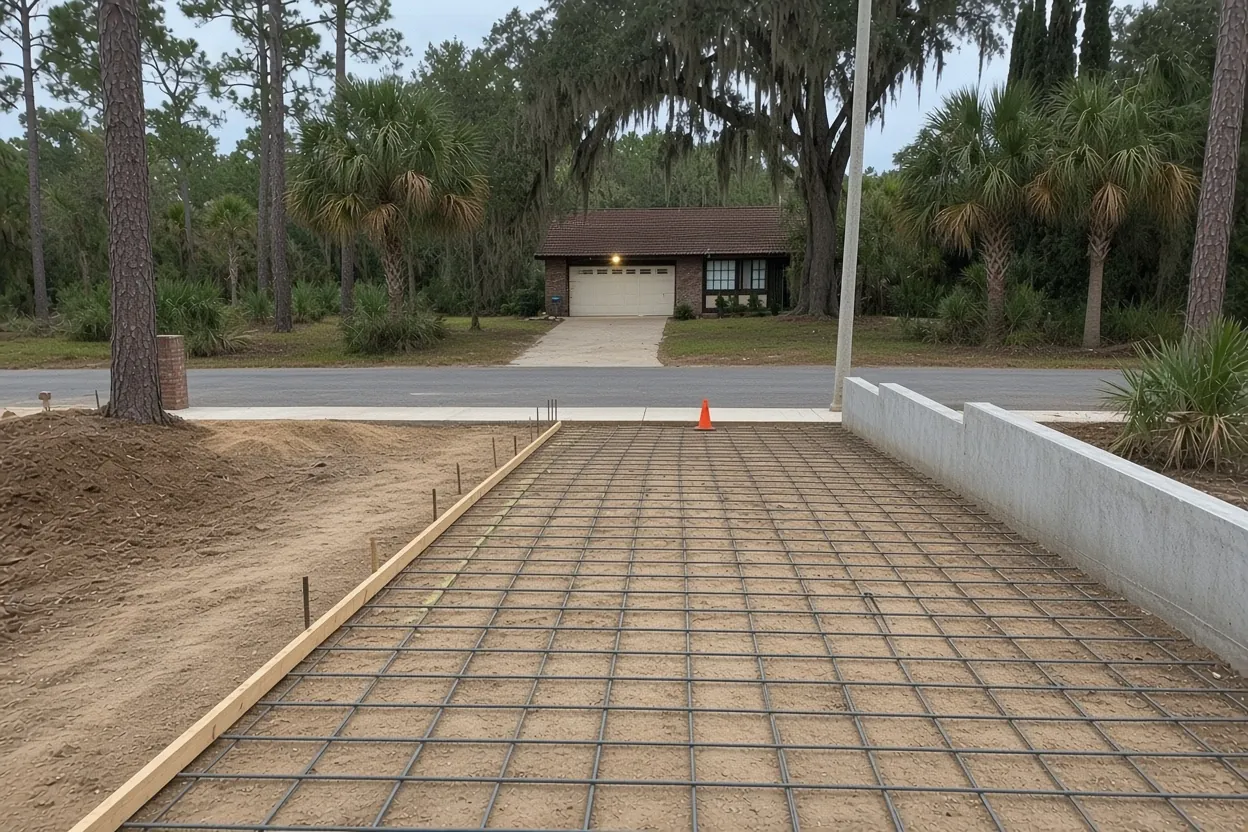
The street in front of your house decides who you deal with at the curb. The City's centerline map lists about 29.3 km of streets in the neighborhood as City-owned. On those, the Building Inspection Division processes a residential driveway and Public Works Engineering inspects it, the apron needs a Right-of-Way Use Permit before work starts, and the City wants a pre-construction notice at least 48 hours ahead. Apron work follows the City's Engineering Standards Manual, and the permit and inspection steps are on the Public Works permit and inspection page.
Six short streets in Lake Hollingsworth show up differently on that map: Collins Ln, Oaklawn Pl, Fairhaven Dr, Seville Pl, Greywicke and one more short street are coded private, not City-owned, about 1.4 km in all. Live on one? Tell us on the first call, so the apron question gets an answer from the City before the estimate is final.
On the west edge, S Florida Ave is coded as a state road, not a City street. If your driveway opens onto it, the state's transportation department may be involved as well as the City, so we raise it with you early. The whole sequence of City approvals, in order, is laid out in our Lakeland concrete permit guide.
How Your Job Goes
Street and parcel check
Before we come out, we confirm whether your street is coded City, private or state, and we pull your frontage and lot size.
Free site visit
We measure width, length to the garage and the curb cut, look for soft or dark soil, and note roots near the old slab.
Written estimate in 48 hours
Thickness, steel, joint spacing, tear-out and the apron are spelled out line by line.
Permits and notices
We line up the driveway permit, the right-of-way permit for the apron and the Notice of Commencement before we set a pour date.
Pour, cure, clean up
Morning pour, wet cure under cover, saw cuts on time, and a clean jobsite when we leave.
Replacing a 1950s driveway under the oaks
Polk County Property Appraiser records show the 1950s as the busiest decade here, with 397 of the neighborhood's single-family homes, and the median build year is 1955. Plats go back further: the biggest, H A Stahl's Cleveland Heights Unit No 1, was recorded in 1925 alongside the golf course. On a house from the 1950s, the slab you're looking at may be decades old, so a job here is likely to start as a driveway replacement, with a tear-out, rather than a first pour.
Then there's the shade. Tree canopy across the neighborhood averages 24.8% in the 2021 national land-cover data, and about 5.8% of the ground sits under 50% canopy or more. UF/IFAS warns that live oaks planted close to driveways can grow roots big enough to lift and crack the slab. On a tear-out, we look at what lifted the old slab before the new one goes in.
- Tear-out adds $2 to $4 per sq ft to our driveway rate.
- Roots under the old slab get flagged on the quote, along with any change in layout to stay clear of them.
- A tree in the strip by the street may be a City street tree. The code (Sec. 4.5.6) handles street trees separately from yard trees, so ask the City before cutting roots there.
Our driveway cost guide works the tear-out math by size if you want to run your own numbers first.
Notices, flood panels and the rainy-season calendar
Some rules for a driveway extension or replacement in Lake Hollingsworth come from the contract size or the lot, not from the concrete.
Florida law requires a Notice of Commencement recorded with the County Clerk before work starts on a direct contract over $2,500. A typical two-car concrete driveway crosses that line easily. A copy goes to the building department before the first inspection once the contract passes $5,000.
Next, the flood maps. FEMA puts about 97.8% of the neighborhood in Zone X, outside the mapped flood hazard, but 62 single-family parcels touch a Special Flood Hazard Area. That changes one thing for a driveway: Florida's HB 803 permit exemption for small non-structural work leaves out properties in a flood hazard area. Look up your parcel on the FEMA Flood Map Service Center if you're close to the lake.
Last comes the weather. The National Weather Service dates the West Central Florida rainy season from May 25 to October 10, with frequent showers and thunderstorms. We book summer pours for the morning, keep the slab covered and wet while it cures, and plan on a week before you park on it, whether it's a full replacement or a short driveway extension. Nothing ruins a good pour faster than cars on a green slab.
Common Questions
How wide can my new driveway be in Lake Hollingsworth?
Do I need a permit to replace a driveway on Cleveland Heights Blvd?
My house is on Oaklawn Pl. Is the street City-owned?
Is 4 inches thick enough on the sandy lots around the lake?
Mesh, rebar or fiber for a two-car slab here?
How long before I can park on a new driveway poured in July?
Sources
- Land Development Code, Sec. 4.11.4.6 Vehicle Use Area Design and Construction Standards for Single-Family and Two-Family Residential Uses (City of Lakeland (Municode))
- Engineering Permit Inspection Information (City of Lakeland Public Works Engineering)
- Engineering Standards (City of Lakeland Public Works)
- CANDLER Series (USDA-NRCS Official Soil Series Descriptions)
- Concrete Driveway Installation: 8 Essentials (Concrete Network)
- Florida Statutes 713.13 Notice of commencement (The Florida Senate)
- Florida Statutes 713.02 Types of lienors and amounts of liens (The Florida Senate)
- Florida Statutes 713.135 Notice of commencement and applicability of lien (The Florida Senate)
- Florida Thunderstorm Season / Rainy Season (NOAA National Weather Service Tampa Bay)