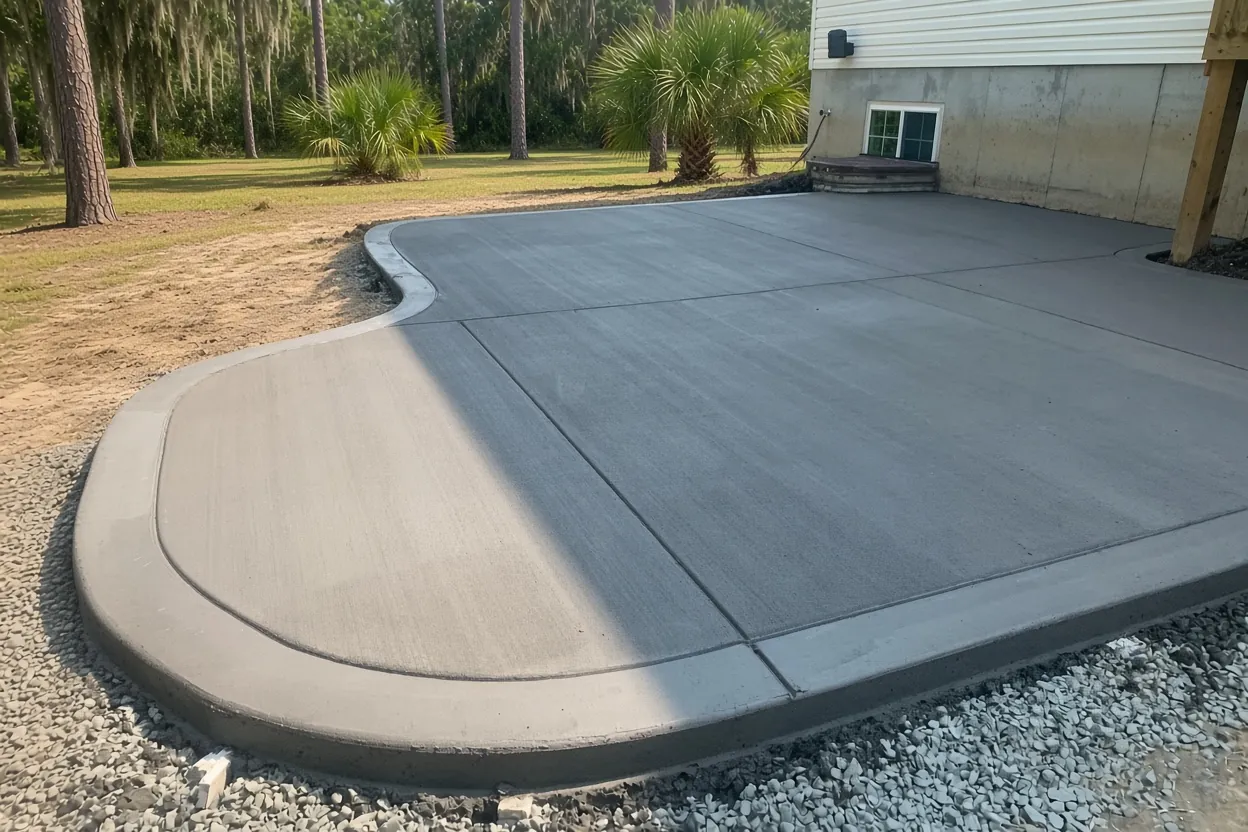
Off the protected-lakeshore list, still a lake lot
Lakeland's Land Development Code names eleven protected lakeshores in Sec. 6.4, with Hollingsworth, Morton, Bonny, Hunter and Wire among them. Lake Somerset isn't on that list, so the 50 foot lakeshore structure setback in Sec. 6.4.3.2(a) doesn't name it. The Property Appraiser codes 88 parcels here as residential lakefront. For those owners, that's a different starting point from a Lake Hollingsworth patio. There, the lake is on the list, and the owner asks the City whether a ground-level slab counts as a structure.
More room doesn't mean a free pass. The City still requires its own permits for shoreline projects. Where FDEP, the Army Corps and the Southwest Florida Water Management District have jurisdiction, the wetland rules in Sec. 6.4.2.2 point to them. Here's the simple version: a concrete patio that stays up in the yard is ordinary backyard work. If it reaches toward the water, ask the City first. Our patio service page covers the general build, and the Lake Somerset area page tells you more about the lake itself.
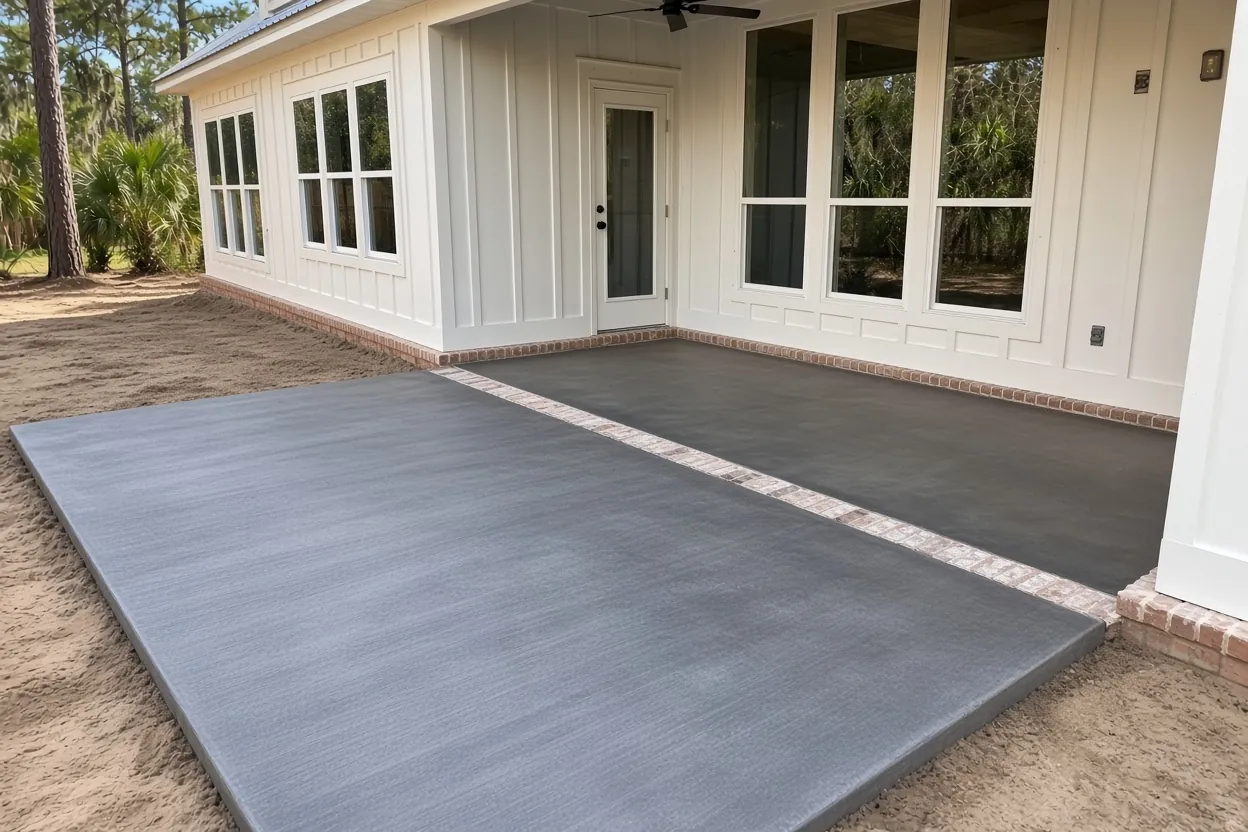
Under a Somerset backyard: wind-blown spoil or wet flatwoods
Two very different soils share this neighborhood, and a patio acts differently on each one. On the county's SSURGO map, Neilhurst sand covers about 55% of the polygon. The USDA describes it as sandy spoil from mining operations that the wind reworked, excessively drained and very rapidly permeable. Rain drains through it fast. The catch is that a patio still needs even support, and the residential code asks for fill under a slab to be compacted for uniform support (R506.2.1), so spoil sand gets compacted across the whole footprint, not just at the edges.
Pomona-Urban land covers another 13.7%, and Pomona is a poorly and very poorly drained flatwoods sand. Clayey Haplaquents add 8.2%. On that ground water can sit in a back yard after a summer storm. There the slab can be set a little above the lawn around it and pitched away from the back wall, with a plan for where runoff from the patio and the roof will land.
Want to know which soil sits under your yard? Look it up on the USDA Web Soil Survey. The county copy we work from is an older vintage, so if your yard holds water, take a quick look at your own lot.
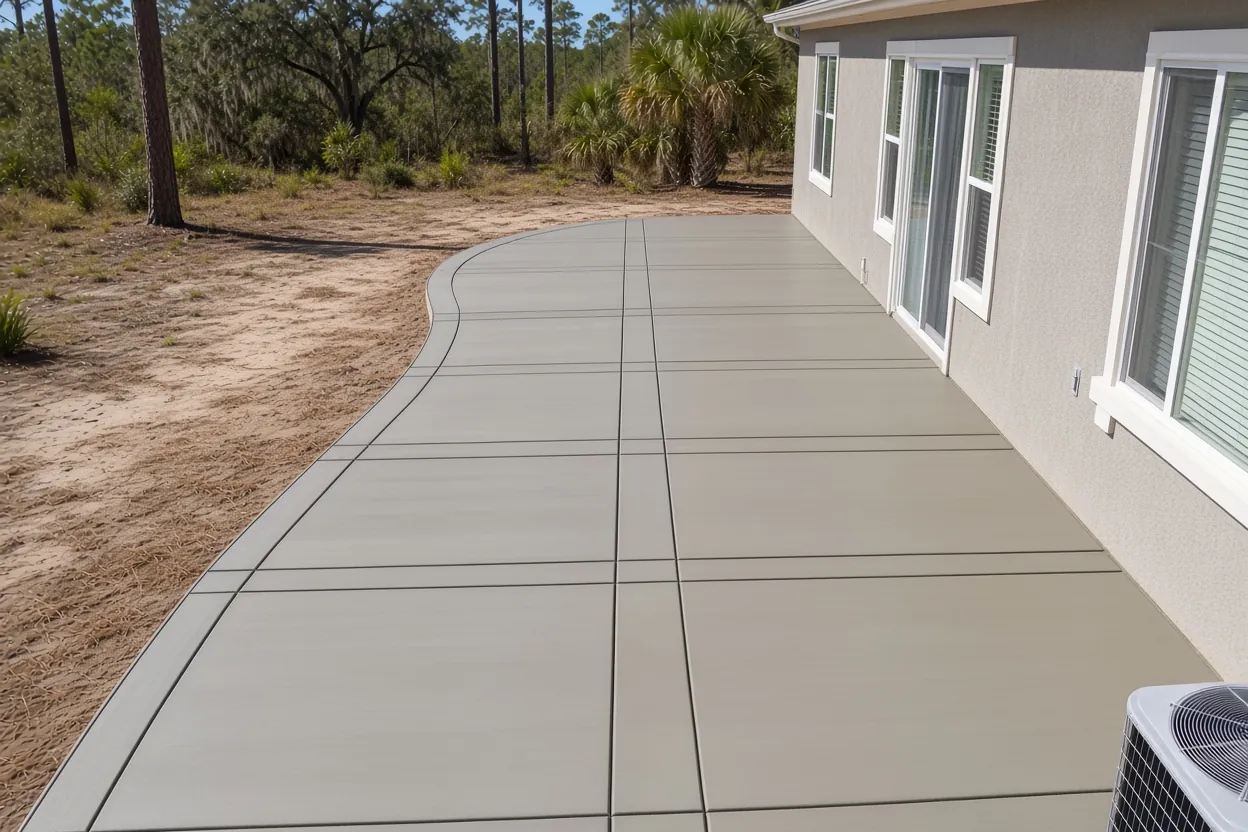
What It Costs
These are our plain and broom patio ranges, multiplied out for common sizes. In Lake Somerset, three things move the number: tear-out of an old pad, a soggy yard that needs fill, and a slab built for a future screen room.
| Patio size | Per sq ft | Typical project | What moves the price |
|---|---|---|---|
| 12 by 16 ft (192 sq ft) | $8 to $14 | $1,536 to $2,688 | Access to the backyard, old pad removal |
| 16 by 20 ft (320 sq ft) | $8 to $14 | $2,560 to $4,480 | Fill on wet Pomona ground, steps down |
| 20 by 20 ft (400 sq ft) | $8 to $14 | $3,200 to $5,600 | Edges for a future screen enclosure |
| Stamped patio | $14 to $24 | Priced separately | Pattern, color and sealer |
These are ranges only. You get a firm number in a free written estimate after we see the site.
Patio prices against the $2,500 notice and the $7,500 exemption
Concrete patios fall in an awkward money band. Our plain and broom range is $2,500 to $6,500. Two state rules sit right around those numbers.
The first is the Notice of Commencement. Florida Statutes 713.13 and 713.02(5) require one recorded with the County Clerk before work starts when the direct contract is over $2,500. Nearly all of our patio range sits above that line. A copy goes to the building department before the first inspection only when the contract tops $5,000.
The second is HB 803 (effective July 1, 2026), which has local governments exempt qualifying non-structural single-family work valued under $7,500 from permits. A concrete patio could fit under that cap. The exemption isn't automatic, though: you file a written request and get approval before starting. It also leaves out property in a flood hazard area. In Lake Somerset, 187 of 782 single-family parcels touch a FEMA special flood hazard area, with Zone AE base flood elevations of 111.2 and 111.7 feet. Look up your parcel on the FEMA Flood Map Service Center, then ask the City's Building Inspection Division what applies. Want more size examples? See our patio cost guide.
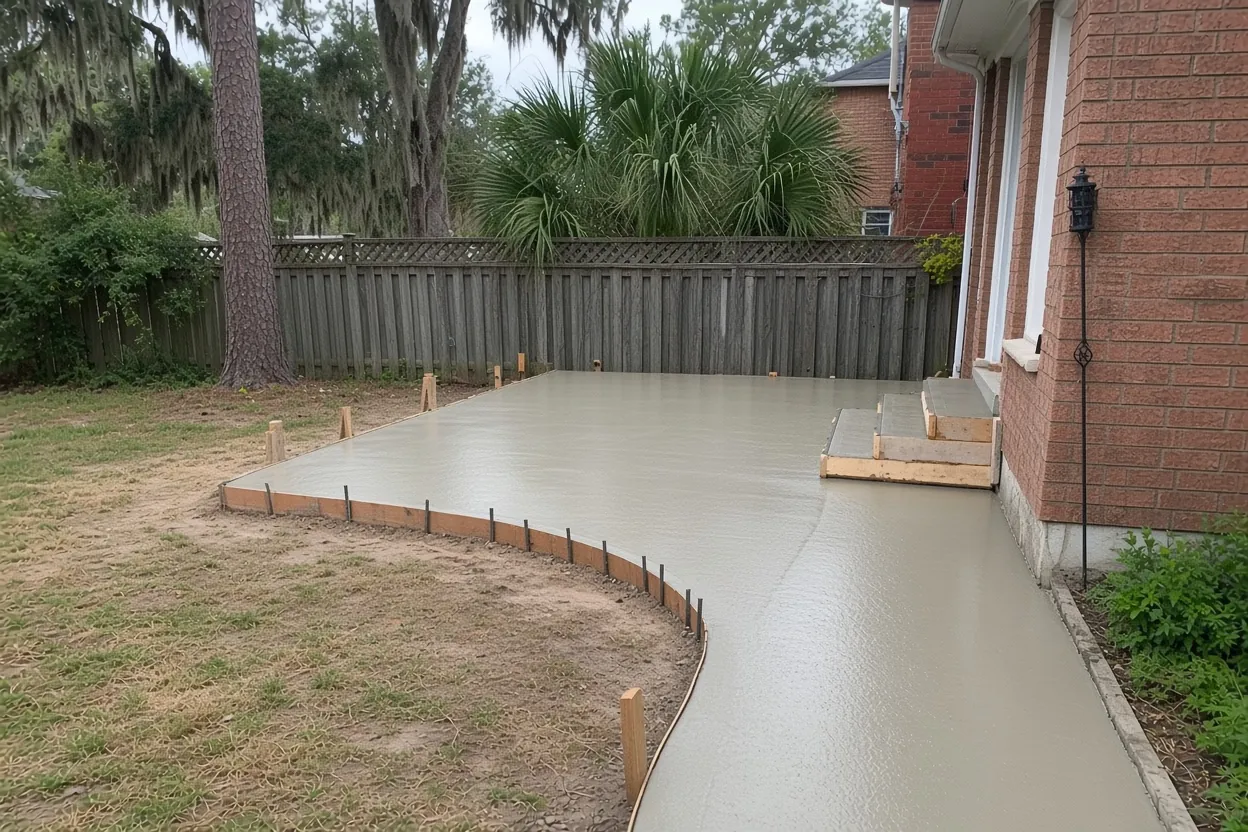
Only 14 percent canopy: shade, covers and screen rooms
Satellite tree-canopy data (NLCD 2021) puts Lake Somerset's mean canopy at 14.0%, and only 4.5% of the 30 meter cells reach 50% cover or more. The lake water drags that average down, but the point holds: much of this neighborhood is open to the sun, and a bare slab on the south or west side of a house soaks up the afternoon heat.
That's why shade comes before finish. If you might add a screen enclosure or a solid cover, tell us before the forms go in. The building that sits on the slab decides the permit and what the edges need to carry, so a future screen room changes today's spec. Florida's residential code (R506.2.3) doesn't require a vapor retarder under patios unlikely to be enclosed and heated later. A slab that may become a heated room gets priced differently. To spare bare feet, put the patio on the shaded side of the house where you can, keep the color light, and size it for an umbrella or a future cover.
One more code item applies to a slab against the house. When soil termite treatment is used on new construction, R318.1.6 calls for treatment under exterior concrete within 1 foot of the building's walls, done by the pest control company, not the concrete crew.
How Your Job Goes
Yard walk
We mark the outline, check the sun, the soil and where water sits, and ask whether a roof could go up later.
Written quote
Size, thickness, reinforcement, joints and any tear-out, all spelled out and sent within 48 hours.
Prep and form
The old pad comes out, the sand gets compacted, and forms go in with fall away from the house.
Pour, cure, clean up
We pour outside the worst heat, start curing right away and leave the yard clean.
Slab spec behind a mid-century Lakeland ranch
Property Appraiser data shows 266 single-family homes here built in the 1960s and 123 in the 1950s. Compare that with 102 from the 1990s and 90 from the 2000s, the decades when Waterford and Turtle Rock were platted. Behind an older ranch on Edgewood Park or Cleveland Heights Manor lots, a new concrete patio may replace an original back slab or a cracked pad. That tear-out is priced on its own line.
A backyard patio slab can be 4 inches over compacted sand (the residential code minimum for slab floors is 3.5 inches, R506.1), with welded wire or fiber. The choice comes down to crack control, not strength. NRMCA says synthetic fibers at 1 to 2 lb per cubic yard reduce plastic shrinkage cracks, but they can't be used to thin the slab or stretch the joint spacing. Industry guidance for a 4-inch slab puts saw-cut joints no more than 10 feet apart, and lining them up with the house corners keeps the panels close to square.
Summer pours get their own plan. NRMCA's hot-weather guidance says to skip the hottest part of the day, never add water at the site beyond the mix design, and start curing as soon as finishing ends, for at least 3 days. White-pigmented curing compound reflects heat, which helps on an open Somerset lot. Doing a new front slab at the same time? See our Lake Somerset driveway page.
Patio estimate checklist for a Lake Somerset yard
- A rough size in feet, or the furniture you want on it.
- Whether a screen room or roof could ever go over it.
- Your survey, especially if you're on one of the 88 lakefront parcels.
- The side of the house that gets the afternoon sun.
- Any spot where water stands after rain.
- Your parcel's flood zone on FEMA's map.
Then book the free estimate or call (863) 400-2934.
Common Questions
What does a 12x16 concrete patio cost in Lake Somerset?
Does the 50 foot lakeshore setback apply to a patio on Lake Somerset?
Can my Lake Somerset patio use the HB 803 permit exemption?
Can you pour a patio slab in Lake Somerset now for a screen enclosure later?
How do I keep a Lake Somerset patio from getting too hot?
Will my patio need a Notice of Commencement in Lake Somerset?
Sources
- Land Development Code, Sec. 6.4 Lake and Natural Habitat Protection (City of Lakeland (Municode))
- Lakeshore Residents (City of Lakeland Lakes and Stormwater)
- Official Series Description: POMONA (USDA-NRCS (NCSS OSD Registry))
- Official Series Description: NEILHURST (USDA-NRCS (NCSS OSD Registry))
- NLCD 2021 USFS Tree Canopy Cover (Multi-Resolution Land Characteristics Consortium)
- National Flood Hazard Layer, Flood Hazard Zones (FEMA)
- 2023 Florida Building Code, Residential, Chapter 5 Floors (UpCodes (ICC text))
- CIP 12 Hot Weather Concreting (NRMCA)
- CIP 24 Synthetic Fibers for Concrete (NRMCA)
- Florida Building Code Residential Section R318 Protection Against Termites (Charlotte County, FL)