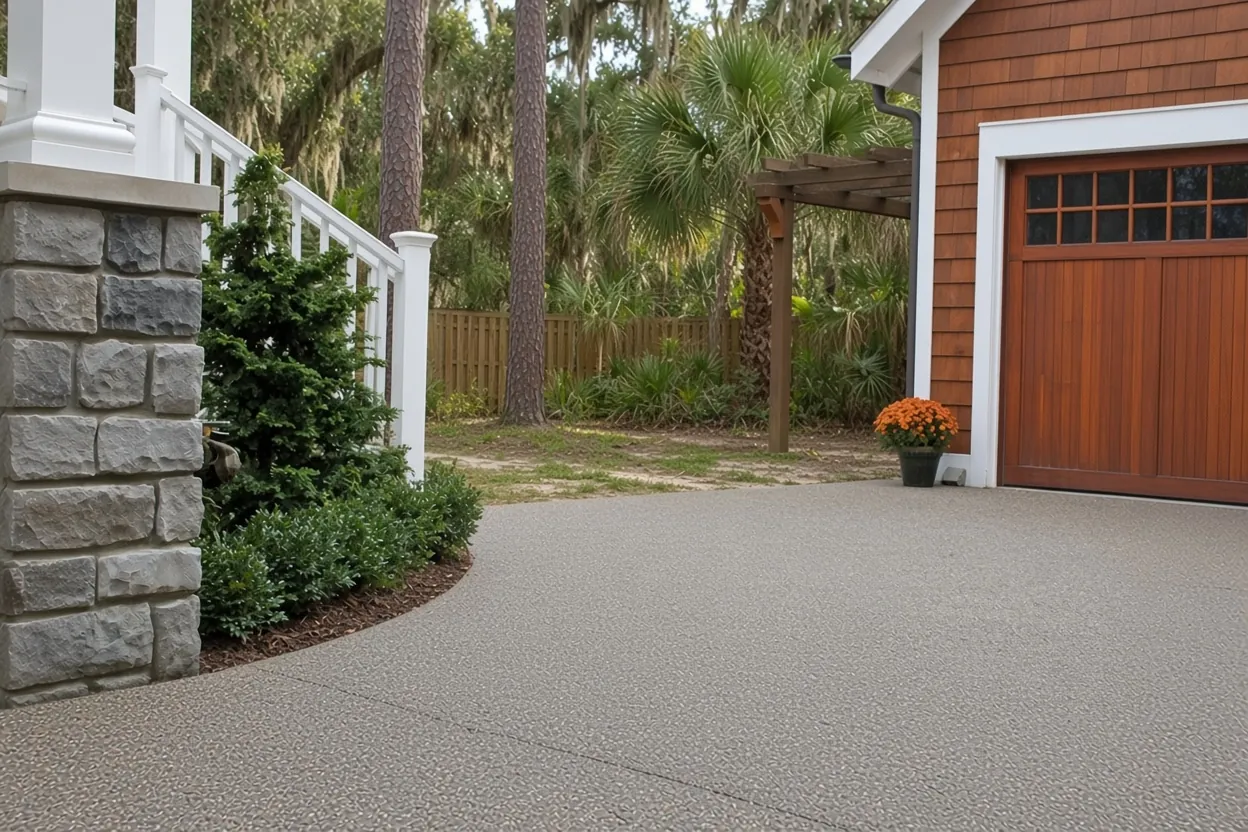
Mine-spoil sand under a Lake Somerset driveway
Most of Lake Somerset is mapped as Neilhurst sand. The county's soil map puts Neilhurst and Neilhurst-Urban land on about 55% of the neighborhood, and the USDA series description says it formed in "homogeneous sandy spoil from mining operations reworked by wind." It's deep, excessively drained and very rapidly permeable.
For a concrete driveway, that's good news in one way: rain leaves the subgrade fast. Support is the catch. Loose, wind-sorted sand needs to be compacted in lifts before the forms go in. The Florida residential code's fill rule for slab floors, free of vegetation and foreign material and compacted for uniform support, is a fair benchmark for a driveway too. When an old slab comes out, we can probe the base, and a soft spot gets fixed before the pour, not after a crack shows up. Our driveway service page walks through the full build, and the Lake Somerset neighborhood page covers the lake side of the lot.
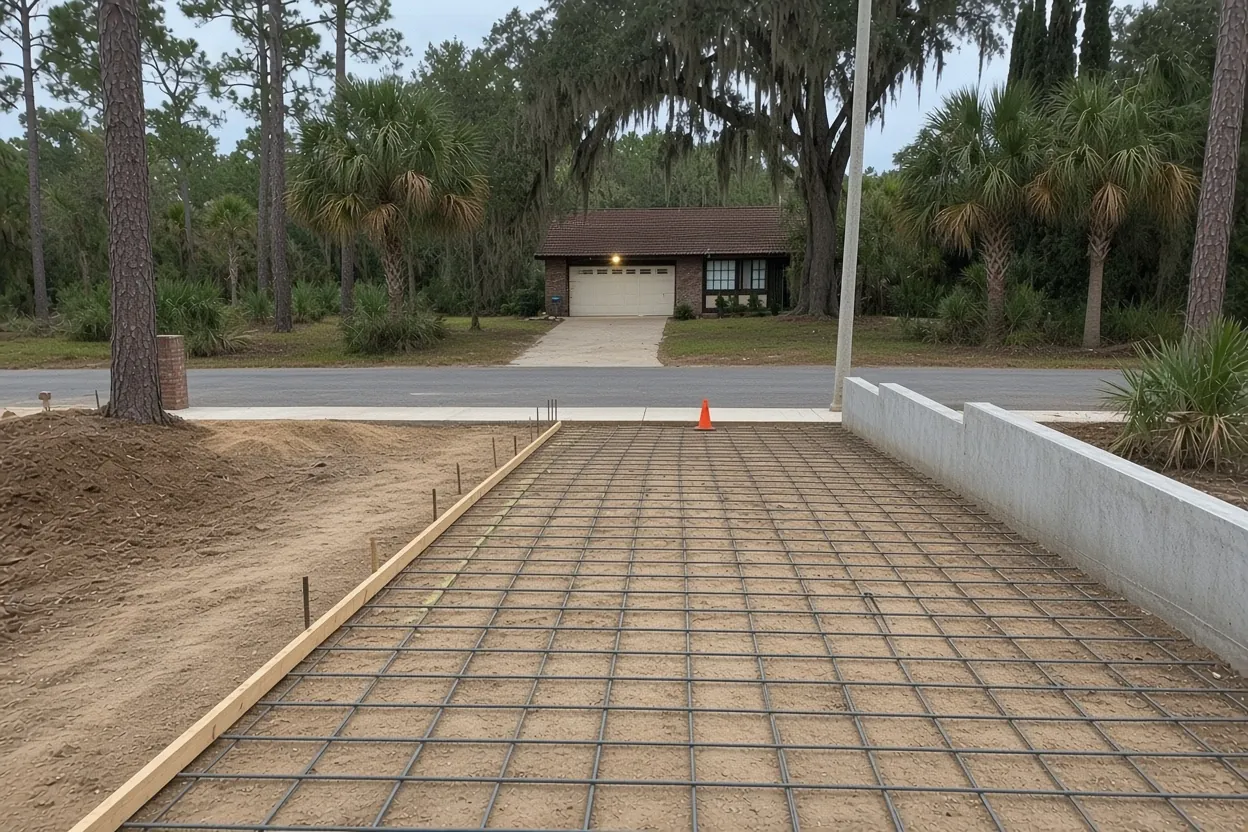
Flood maps, a $7,500 exemption and the notice you sign
About 19% of the Lake Somerset polygon sits in a FEMA special flood hazard area, and that share counts the lake water itself. On land, 187 of the 782 single-family parcels touch a hazard zone. The mapped Zone AE pockets carry base flood elevations of 111.2 and 111.7 feet, on FIRM panels 12105C0315G, 0320G, 0480G and 0485G, all effective December 22, 2016.
So why does that matter for a driveway? Florida's HB 803 tells local governments to exempt some single-family work valued under $7,500 from permits, but the exemption skips properties in a flood hazard area and still needs a written request approved before work starts. A full two-car replacement at $5,000 to $10,000 may not fit under the cap anyway, and in the City of Lakeland residential driveways go through the Building Inspection Division with Public Works Engineering doing the inspection. Pull your address up on the FEMA Flood Map Service Center before you plan around an exemption.
Paperwork on price: Florida Statutes 713.13 and 713.02(5) have the owner, or the owner's authorized agent, record a Notice of Commencement with the County Clerk when the direct contract is over $2,500. Over $5,000, a copy also goes to the building department before the first inspection. A two-car job in our $5,000 to $10,000 range crosses both lines, so expect to sign one.
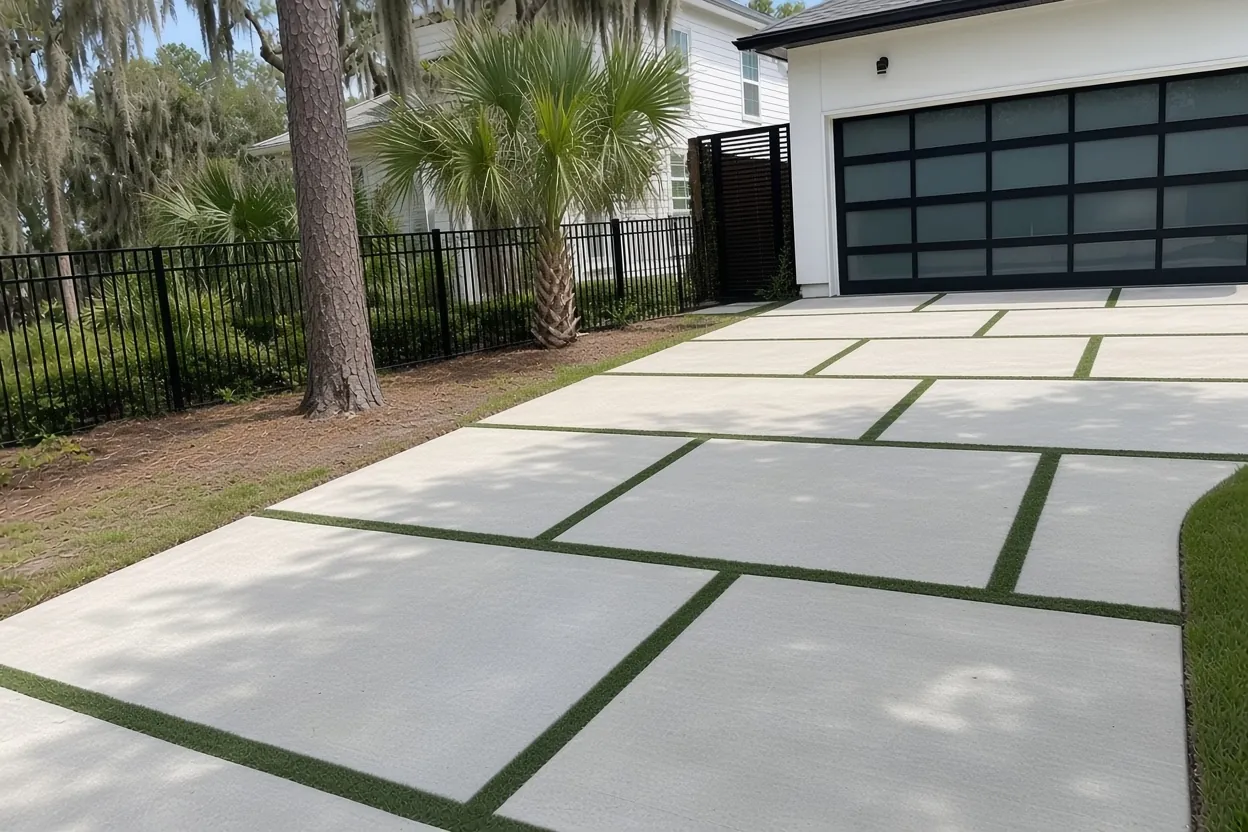
What It Costs
Here are our driveway ranges for Lake Somerset. What moves a quote here is tear-out, a 5 inch slab, an apron on a City street and soft sand that needs new fill.
| Job | Per sq ft | Typical project | What moves the price |
|---|---|---|---|
| Two-car broom finish driveway | $8 to $14 | $5,000 to $10,000 | About 500 to 700 sq ft at 4 to 5 in. |
| Single concrete driveway at the 10 by 20 ft code minimum | $8 to $14 | $1,600 to $2,800 | 200 sq ft; apron and tear-out extra |
| Tear-out of an old slab | adds $2 to $4 | Depends on size | Old thickness, buried steel, haul-off |
| Widening or parking pad | $8 to $14 | By the square foot | Matching the old slab, the one curb cut rule |
These are ranges only. After we see the site and measure the frontage, your price comes as a free written estimate.
Ten to 24 feet: Sec. 4.11.4.6 widths for a non-historic street
Lakeland's Land Development Code sets residential driveway sizes in Sec. 4.11.4.6, adopted by Ord. 5793. The City's historic district map shows no district inside Lake Somerset, so the standard widths apply: a single concrete driveway can be 10 to 24 feet wide. A ribbon driveway, two concrete strips with grass between, runs 7 to 10 feet overall with 2 foot strips. Any driveway has to be at least 20 feet long, and a lot gets one curb cut unless it has access to an improved alley or the driveway is circular.
A circular driveway needs at least 75 feet of street frontage. With the median single-family lot here at about 9,620 sq ft (half the lots fall between roughly 7,500 and 12,020), measure your frontage before you plan a horseshoe. Got a narrower lot? Widening the driveway you have keeps the one curb cut and still makes room for a second car.
Historic districts play by different numbers, 8 to 10 feet wide. Lake lots differ too: compare our Lake Hollingsworth driveway page, where the lake is one of the City's protected lakeshores, or read the Land Development Code yourself before we meet.
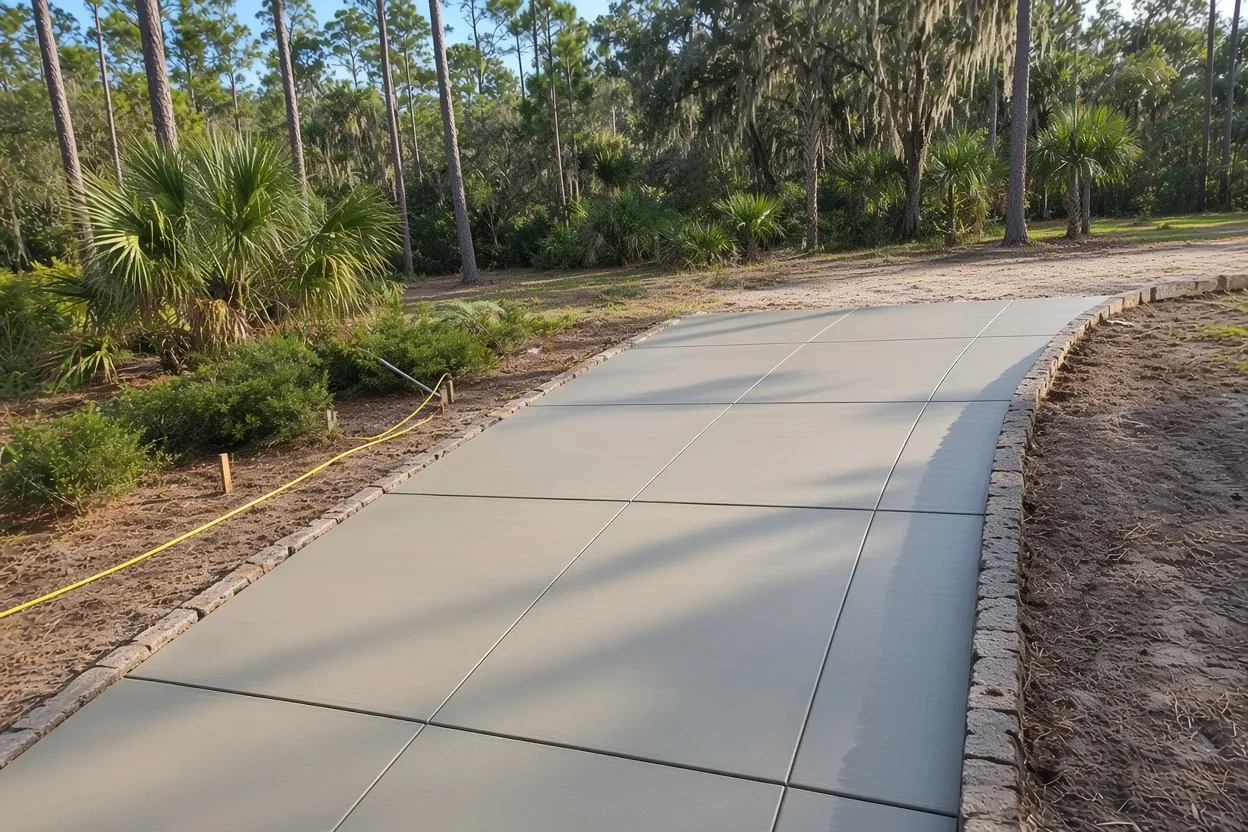
City-coded and privately coded streets in the neighborhood
Lake Somerset has about 14.4 km of City streets, 1.3 km of private ones and a short State piece tied to the Polk Parkway. How we handle the front end of your driveway depends on that split.
On a City street such as New Jersey Road, Glendale St, Woodlake Dr, Ashling Dr, Turtle Rock Dr, Waterford Dr, Lagoon Rd or Lismore Dr, the apron between your property line and the pavement sits in City right-of-way. Work there needs a Right-of-Way Use Permit from Public Works Engineering, the apron has to meet the City's Engineering Standards Manual, and the City wants a pre-construction notification at least 48 hours before work begins. We put the apron on its own line in the quote so you can see what that piece costs.
Kilmer Dr, Shorewood Dr, Pl and Ct, Williamsburg Sq, Windjammer Dr, Shelley Pl and Kipling Ln are coded private, not City-owned, in the City's street centerline data. If your home fronts one of them, ask the City's Building Inspection Division how the apron paperwork works for your lot before we schedule, and tell us what they say so the quote matches it. The full order of approvals is laid out in our Lakeland concrete permit guide.
How Your Job Goes
Measure the front
We check the frontage, the current width, who owns the street and where water stands. Where the old base looks soft, we can probe it.
Price it on paper
Tear-out, slab, apron and any fill each get their own line, and the written quote reaches you within 48 hours.
Paperwork and notice
Permit, right-of-way piece and the recorded Notice of Commencement are lined up before the 48 hour pre-construction call.
Pour and keep off
We compact, form, place steel and pour, then start curing right away and leave the jobsite clean. Cars stay off it for at least 7 days.
Pulling out a 1960s slab: tear-out, depth and steel
More than half the houses here are mid-century. Polk County Property Appraiser records show 266 of the single-family homes went up in the 1960s and 123 in the 1950s, on plats like Edgewood Park Unit 1 and Cleveland Heights Manor (both 1959) and Pine Acres (1960). Waterford (1991) and Turtle Rock (2004) are the newer pockets. If your driveway is the slab poured with the house and it is cracked through, tear-out adds $2 to $4 per sq ft to our price.
You decide on paper what goes back in:
- Thickness. Four inches is the floor for a residential concrete driveway. Going to 5 inches adds roughly 20% to concrete cost and nearly 50% to load capacity, per Concrete Network, which is the move if a boat trailer or work truck lives on it.
- Edges. Thickened edges, 1 to 2 inches deeper for the outer 4 to 8 inches, stiffen the place tires roll off.
- Steel. Wire mesh suits 4 to 5 inch slabs. Rebar on about a 12 inch grid goes in at 5 inches and up. Fiber cuts early shrinkage cracks, but it isn't structural reinforcement.
- Joints. Saw cuts no more than 10 feet apart, one quarter of the slab depth, plus isolation joints at the garage floor and any walk.
For strength, ask for a 4,000 psi mix at 28 days, the figure the Illinois Ready Mixed Concrete Association uses for homeowner driveways. Our driveway cost guide prices each of these upgrades.
Pomona flatwoods and clayey fill near the water
Not every Somerset lot sits on dry mine sand. About 13.7% of the area maps as Pomona-Urban land, and the USDA calls Pomona poorly and very poorly drained flatwoods sand. Another 8.2% is clayey Haplaquents and about 1.1% is Arents with a clayey substratum, both signs of placed or wet ground.
That kind of ground changes the driveway plan. Show us where water stands after a storm. The slab can be pitched to shed toward the lawn and away from the garage door, and any layer that won't compact can be dug out and replaced with clean fill, priced on its own line. The soil map is an older SSURGO copy, so treat it as a starting point and check your own lot on the USDA Web Soil Survey if the yard holds water.
Timing counts too. The National Weather Service runs the West Central Florida rainy season from May 25 to October 10. In those months we keep plastic on site, and a pour can move by a day rather than finish a wet slab. Thinking about a back slab too? Our Lake Somerset patio page covers that job.
Common Questions
Is the sandy ground around Lake Somerset good for a concrete driveway?
Do I need a permit to replace a driveway in Lake Somerset?
How wide can a new driveway be on a Lake Somerset lot?
My house is on Shorewood Drive. Does a private street change the driveway job?
How thick should a Lake Somerset driveway be for a boat or work truck?
How soon can we park on a new driveway in Lake Somerset?
Sources
- Soils (NRCS SSURGO map units) (Polk County GIS)
- Official Series Description: NEILHURST (USDA-NRCS (NCSS OSD Registry))
- National Flood Hazard Layer, Flood Hazard Zones (FEMA)
- Land Development Code, Sec. 4.11.4.6 (City of Lakeland (Municode))
- Engineering Permit Inspection Information (City of Lakeland Public Works Engineering)
- iMS Centerlines (street ownership) (City of Lakeland GIS)
- Concrete Driveway Installation: 8 Essentials (Concrete Network)
- Work Exempt from Permits (HB 803) (Hillsborough County Development Services)
- CIP 11 - Curing In-Place Concrete (National Ready Mixed Concrete Association)
- Florida Statutes 713.13 Notice of Commencement (Florida Legislature)