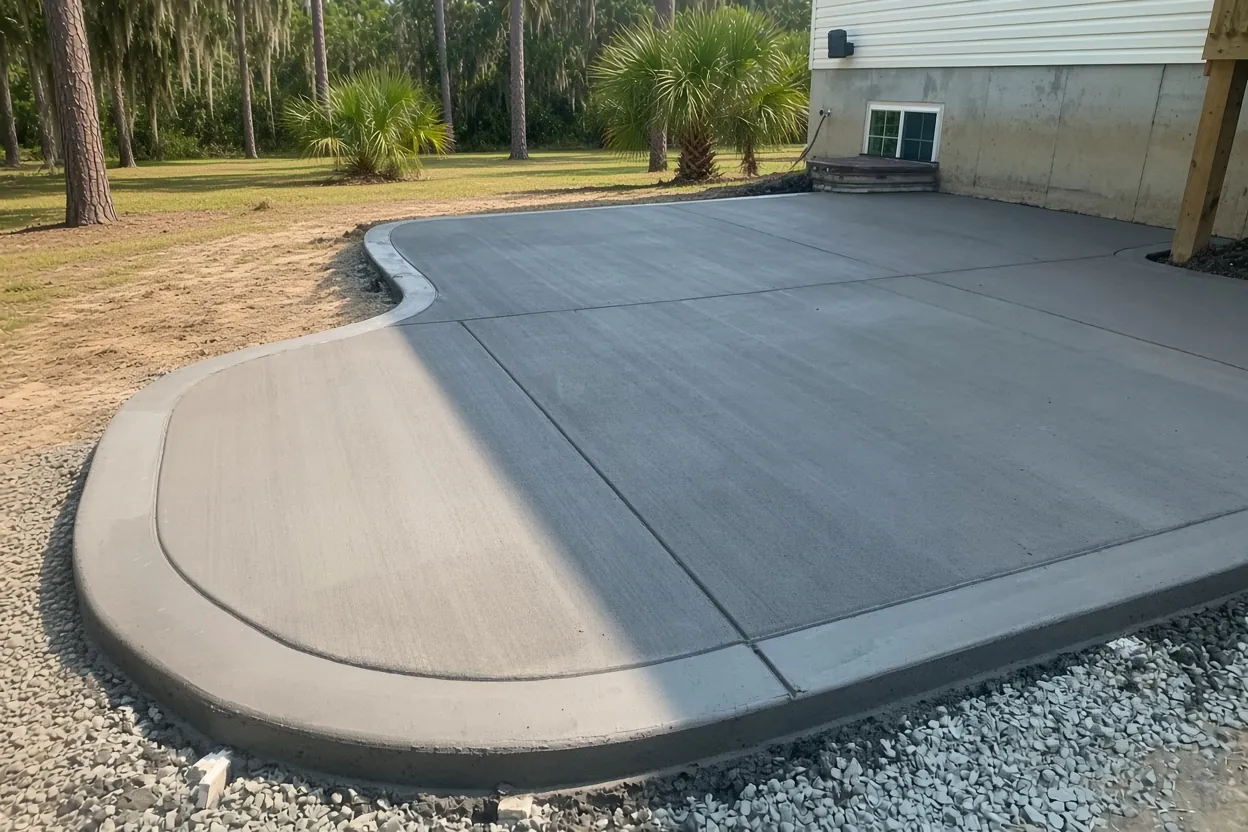
Pricing a Hallam backyard patio by the square foot
For a plain or broom finish, our concrete patio range is $8 to $14 per sq ft. Take a 12 by 16 slab: that's 192 sq ft, so the concrete alone comes to around $1,536 to $2,688. Extras sit on top, like fill, tearing out an old slab or a long wheelbarrow run to the back yard. Our typical project range assumes about 250 to 450 sq ft and runs $2,500 to $6,500. Stamped or colored work gets its own price.
So what moves a Hallam number? Access around the house, how much loose sand we have to firm up, and whether the slab will carry a screen room someday. The concrete patio service page walks through the job citywide, and our patio cost guide runs the math on more sizes.
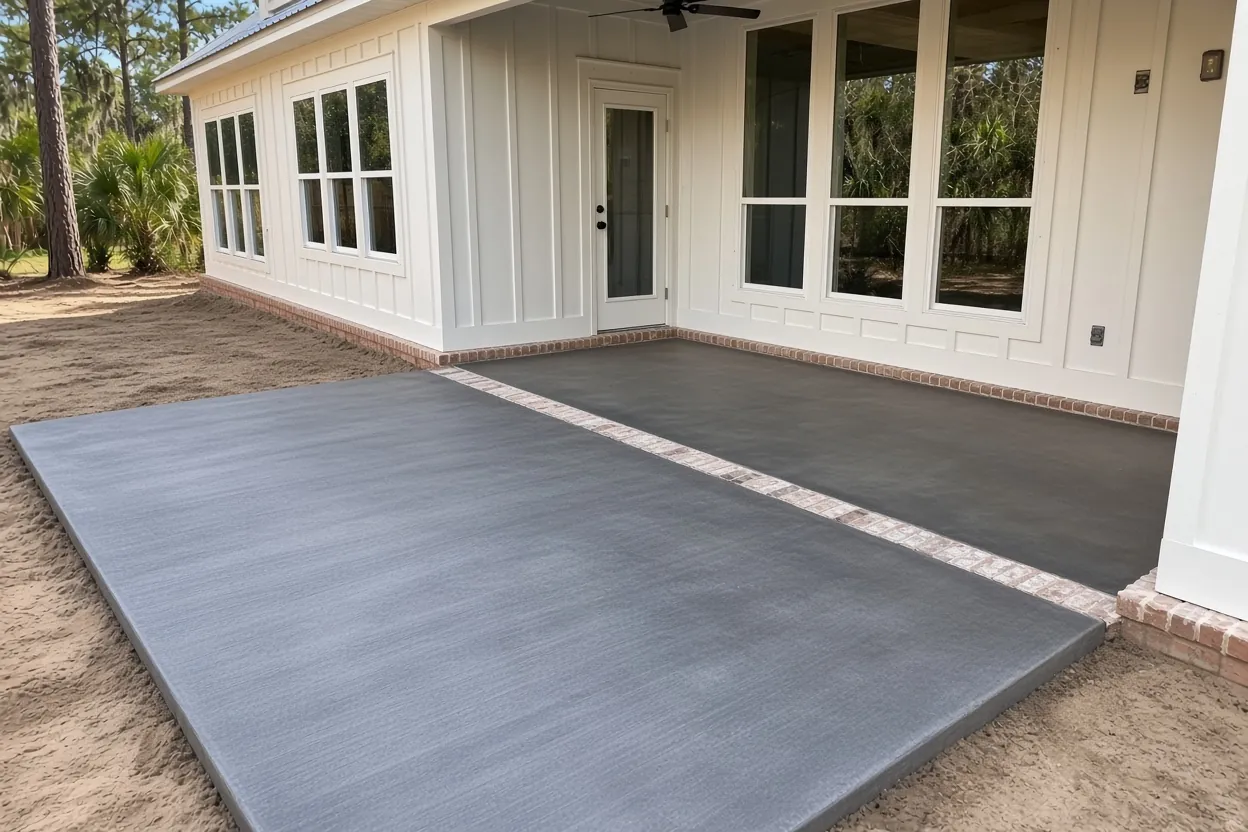
Screen room later? Settle the plastic sheet question before the pour
The Florida Building Code, Residential R506.2.3, calls for a 6-mil vapor retarder between a slab and its base, with laps of at least 6 inches. Patios get a pass, but only when they aren't likely to be enclosed and heated later. Think you might turn the patio into a heated room someday? Tell us at the walk-through so we can plan for it now.
Here's the trade-off. NRMCA's guidance on vapor retarders says concrete placed right on plastic cracks from plastic shrinkage more easily and can hold up finishing. Its hot-weather sheet adds that slabs on a retarder need extra care during finishing and curing. On a Hallam patio that will stay open to the air, we leave the plastic out. If a room is coming, we put it in and adjust the pour.
Thickness works the same way. Code sets 3 1/2 inches as the minimum for a slab-on-ground floor, and your written quote states the thickness we'd pour. Slabs on ground also need contraction joints unless code-listed fibers or welded wire handle crack control.
What It Costs
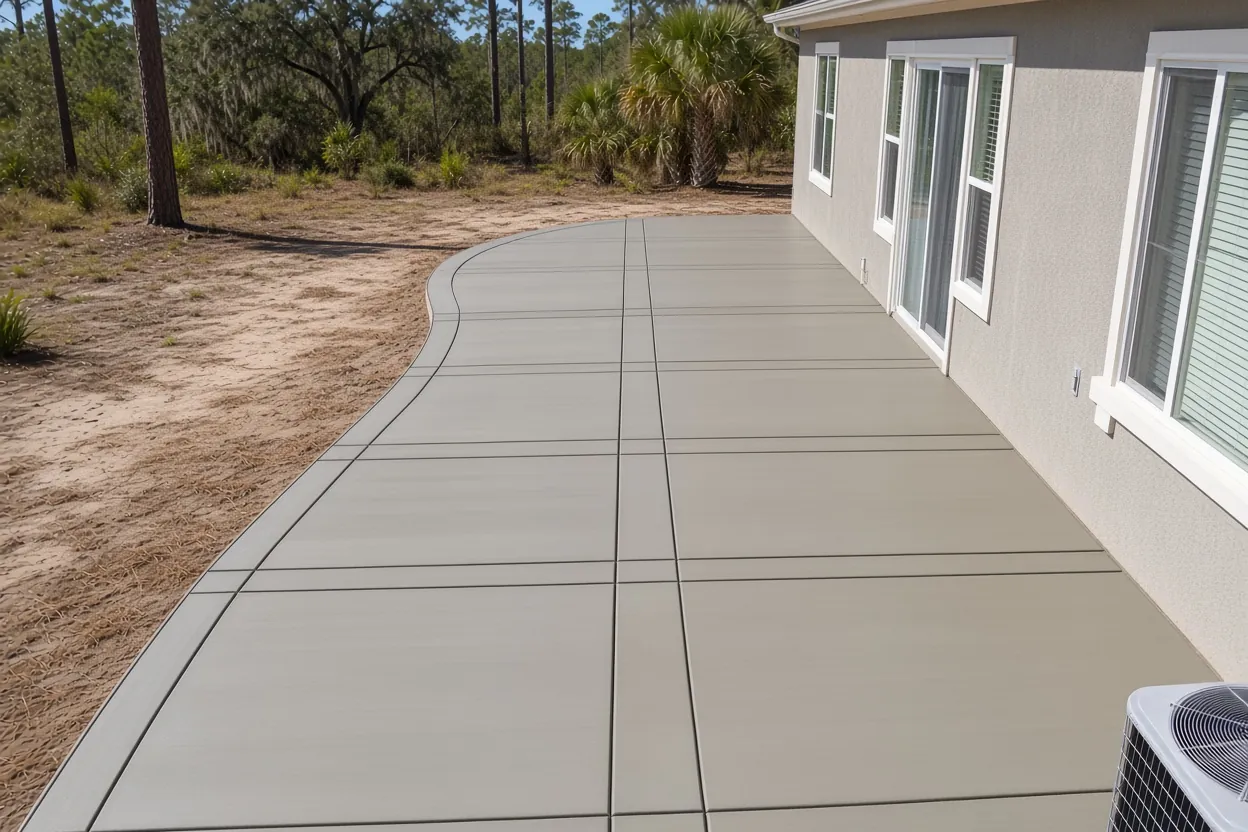
Plain or broom-finish patios run $8 to $14 per sq ft with us. Stamped and colored work gets its own price.
| Job | Per sq ft | Typical project | What moves the price in Hallam |
|---|---|---|---|
| Backyard patio, broom finish (about 250 to 450 sq ft) | $8 to $14 | $2,500 to $6,500 | Access to the back yard, sand base work, slope toward a pond |
| 12 by 16 patio (192 sq ft) | $8 to $14 | $1,536 to $2,688 for the slab | Fill, tear-out of an old slab, wheelbarrow distance |
| Slab for a future screen room | $8 to $14 | Priced after the site visit | Vapor retarder, thickness, edge detail |
| Patio extension | $8 to $14 | Priced after the site visit | Tie-in to the old slab, joint layout |
These are ranges, not a quote. Once we see the yard, you get a free written estimate.
Lake Pollock and pond-edge back yards
Lake Pollock sits inside Hallam. The Polk County Water Atlas lists it as a 16-acre private lake in the Peace River-Saddle Creek watershed. Federal wetland maps show freshwater ponds over about 9% of the neighborhood, so some lots here back onto water.
On eleven protected lakeshores, Lakeland's code keeps structures 50 feet back from the ordinary high water line. That list includes Lake Hollingsworth, Lake Morton, Lake Parker and Lake Bonny. Lake Pollock isn't on it. The City says shoreline projects on its lakes need City permits, and state, regional and federal wetland agencies can weigh in too. Does a ground-level patio even count as a structure under the setback rule? That's the City's call, so ask before you plan a slab right at the bank.
When the lot slopes, we pitch the patio so rain sheets onto the lawn instead of running off a slab edge into the pond. The concrete should also stop well short of soft ground near the water.
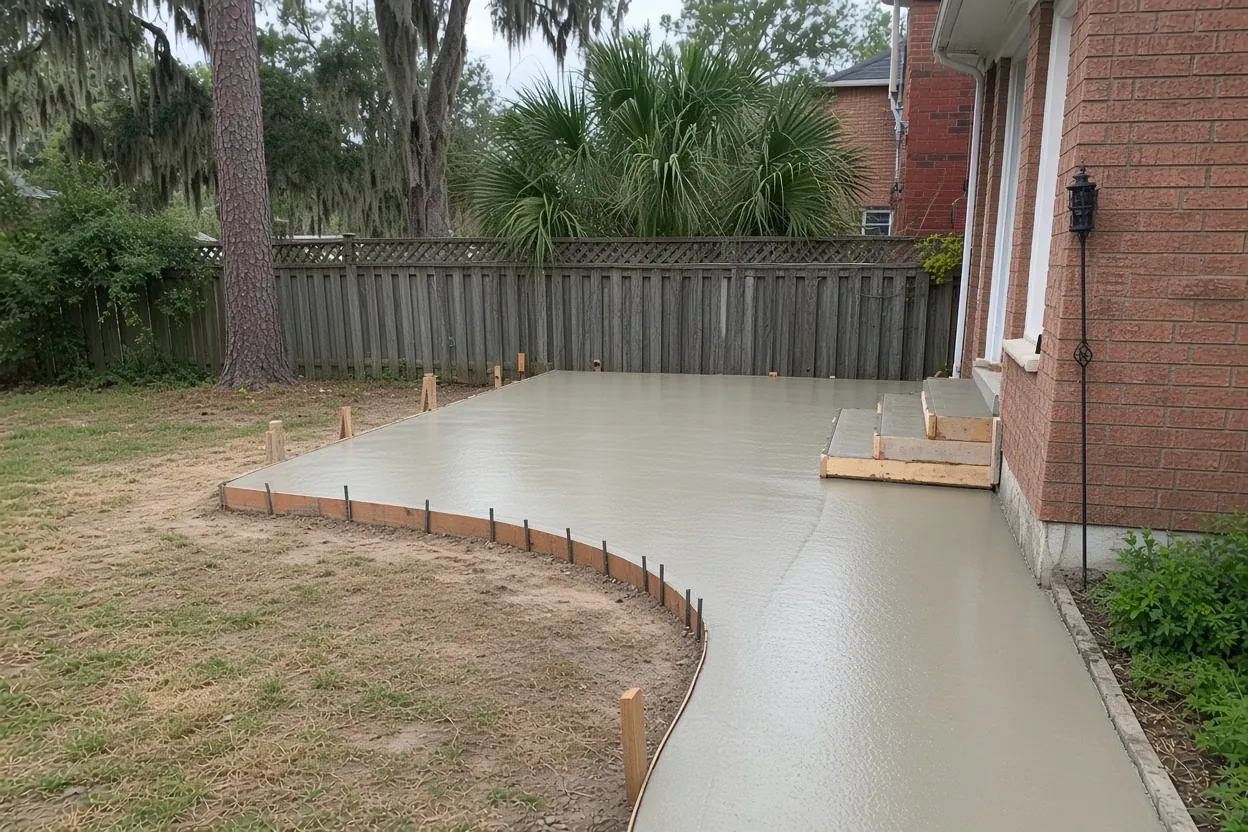
Patio permits, the $7,500 exemption and the notice threshold
Under Florida's HB 803, a patio lands in an odd spot. Since July 1, 2026, local governments have to exempt qualifying work under $7,500 on single-family homes from permits, and our typical patio range of $2,500 to $6,500 falls under that cap. The catch is that the exemption isn't automatic. You request it in writing and get approval first. Structural work doesn't qualify, you can't split a bigger job to fit under the cap, and any property in a flood hazard area is out.
About 10.4% of Hallam is FEMA Zone AE and 2.1% is Zone A, and those zones take in the lake and pond surfaces. Look up your address on the FEMA Flood Map Service Center. In Zone X, the exemption request may be worth filing, and the building official decides. In AE or A, plan on the City permit.
There's a second rule. Florida Statutes 713.13 and 713.02(5) require a Notice of Commencement recorded with the County Clerk before work starts on a direct contract over $2,500. A patio priced above $2,500 crosses that line, so plan the recording into the schedule. Over $5,000, a copy also goes to the building department before the first inspection.
How Your Job Goes
Yard walk
We check access, slope, any old slab, and where the shade falls.
Written quote
You get size, thickness, plastic or no plastic, and the permit path in writing within 48 hours.
Paperwork
The City permit or an exemption request, plus the Notice of Commencement on jobs over $2,500.
Pour and cure
Compacted base, a morning pour, curing for at least 3 days and a clean yard when we leave.
Low tree canopy means you plan the shade
National land-cover data puts Hallam's average tree canopy at about 21.7%. Put plainly, close to four-fifths of the ground has no tree cover overhead. The National Weather Service describes summer highs in the upper 80s to mid 90s with dew points above 70 F, and concrete in full afternoon sun gets hot underfoot.
We can't promise you a cooler surface. Layout still helps a lot. Set the seating where the house, a pergola or a covered section throws shade during the hours you sit outside, and save the sunny part for the grill and the path to the yard. A light broom finish grips when it's wet, which counts near a pool deck or a hose bib.
Planning a pool? We can price the deck on the same walk-through.
Summer pour day on a Hallam patio
Plastic shrinkage cracks are the shallow parallel ones that show up a foot or three apart. They form when the surface dries faster than bleed water can rise. NRMCA names wind over 5 mph, low humidity and high air or concrete temperature as the causes. In a sunny Hallam back yard, shade or wind breaks can go up if the day calls for it, with fog spray or an evaporation retarder between finishing passes, and start curing as soon as finishing ends. Curing runs at least 3 days under wet burlap, plastic or a membrane compound; white pigmented compounds reflect heat.
We dampen the sand base without leaving puddles, and we never add water at the truck beyond the mix design. When we're done, the forms and scraps leave with us so your yard is clean. For the front of the house, see our Hallam driveway page. The Hallam neighborhood page covers the area from Highlands Grove Elementary to the Polk Parkway, and across Hallam Drive you'll find patios in Lake Miriam.
Common Questions
How much is a 12 by 16 foot patio behind a Hallam house?
Should my Hallam patio be built for a screen room I might add later?
What keeps a Hallam patio cooler on summer afternoons?
Can I pour a patio close to Lake Pollock?
Does a small Hallam patio still need a permit under HB 803?
Will my Hallam patio need a Notice of Commencement?
Sources
- 2023 Florida Building Code, Residential, Chapter 5 Floors (R506) (UpCodes / ICC)
- CIP 29: Vapor Retarders Under Slabs on Grade (National Ready Mixed Concrete Association)
- CIP 5: Plastic Shrinkage Cracking (National Ready Mixed Concrete Association)
- Lake Pollock (Polk County Water Atlas (USF Water Institute))
- City of Lakeland Land Development Code, Sec. 6.4 Lake and Natural Habitat Protection (City of Lakeland (Municode))
- Lakeshore Residents (City of Lakeland Lakes and Stormwater)
- NLCD 2021 USFS Tree Canopy Cover (CONUS) (Multi-Resolution Land Characteristics Consortium (USFS))
- Florida Thunderstorm Season / Rainy Season (NOAA National Weather Service Tampa Bay)
- Florida Statutes 713.02, Types of lienors and amount of liens (The Florida Legislature (Online Sunshine))
- Florida Statutes 713.135, Notice of commencement and applicability of lien (The Florida Legislature (Online Sunshine))
- National Flood Hazard Layer, Flood Hazard Zones (FEMA)