Backyard soil behind Lake Miriam homes, from Fort Meade to Sparr
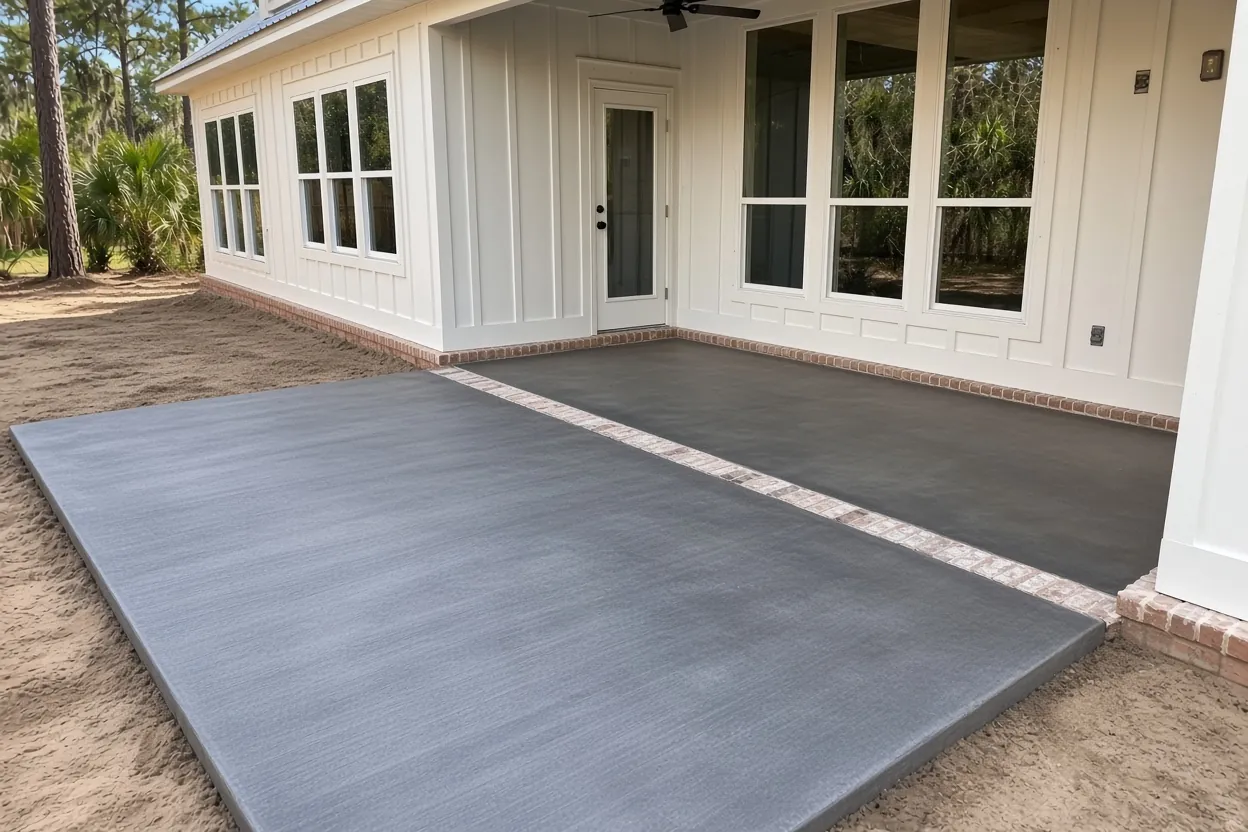
The USDA soil map behind most Lake Miriam houses shows Fort Meade-Urban land complex, about 62% of the neighborhood, with another 18.1% Apopka fine sand. Both drain well. For a patio slab that's good news, since rain moves down through the sand instead of sitting under the concrete. The trade-off? Loose, dry sand needs compacting, so the pad area gets compacted before the forms go up.
A few back yards sit on something different. Tavares fine sand, about 3.5% of the area, is only moderately well drained, and Sparr, about 3.4%, is somewhat poorly drained. Does your yard hold water after a summer storm? Tell us, so the low spot gets looked at on the walk-through and the slab grade can be set to match. Our concrete patios page covers the general build, and the Lake Miriam neighborhood page covers every other job we take on here.
Shade, afternoon sun and a slab you can stand on in July
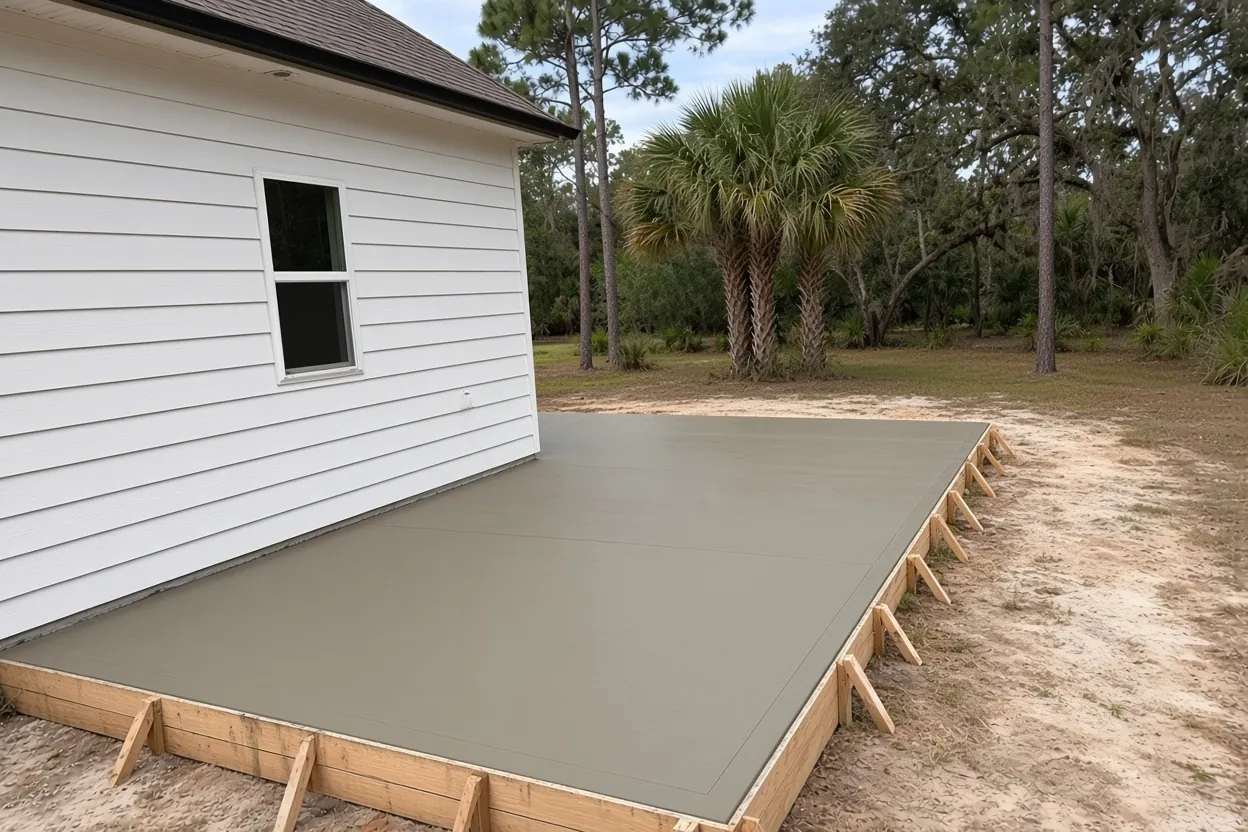
Federal tree-canopy data averages about 22.3% canopy across Lake Miriam, and the City describes the neighborhood as full of mature trees. Nothing keeps a patio comfortable more simply than that shade. Where an oak already throws afternoon shade, a slab under its edge stays cooler than one in open sun. Where the yard is open to the west, a smaller slab plus a future cover may serve you better than a big one baking all afternoon.
Then there are the roots. UF/IFAS notes that live oaks can spread 60 to 120 feet wide, and that live oaks planted too close to paving can grow roots that lift and crack it. That's why the patio gets laid out with the tree in mind. Pull the edge back, change the shape, or, if the tree has to go, the City's Tree Removal Permit comes first.
Think about bare feet when you pick a finish. A light broom finish leaves texture underfoot instead of a smooth trowel surface. If you want a patterned look, stamped concrete runs $14 to $24 per sq ft, and our stamped concrete vs pavers guide compares the two for Florida heat and rain. We can also price a pool deck in the same visit if one is on your list.
What It Costs
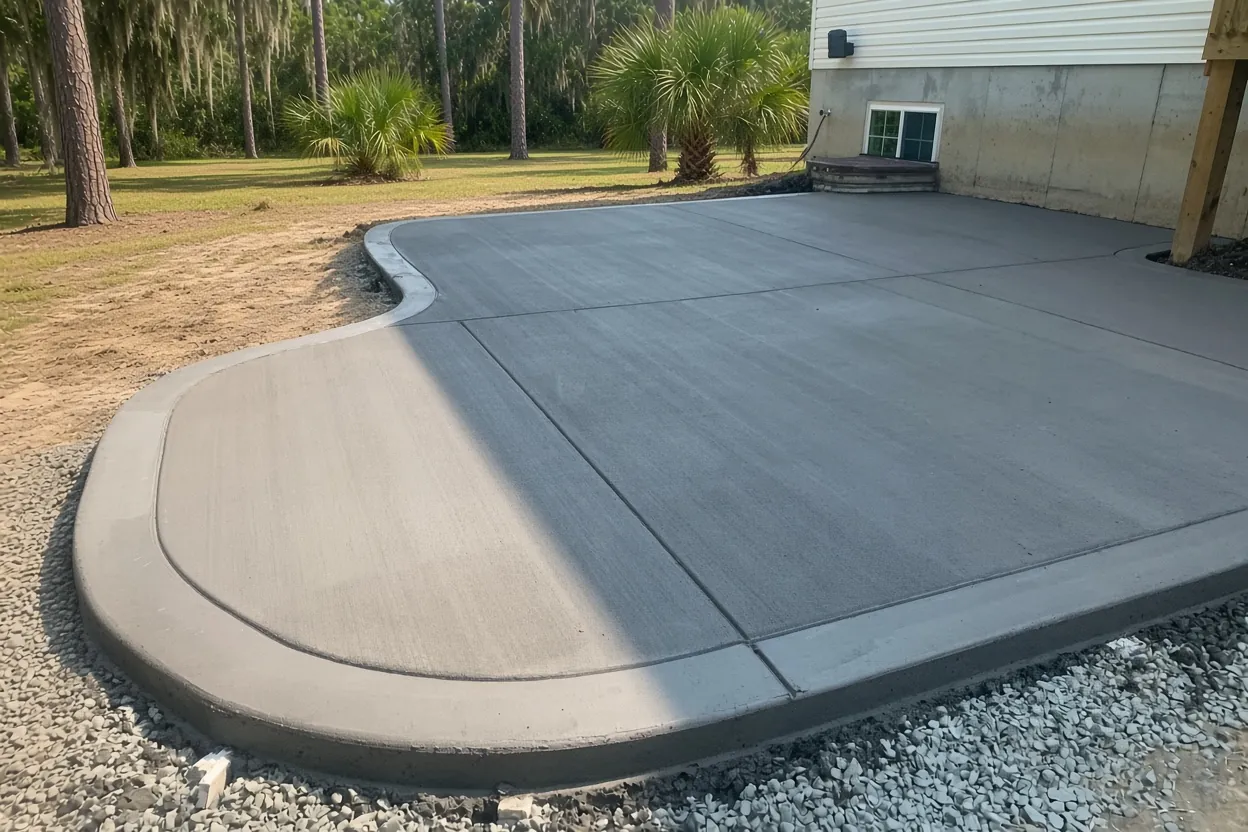
Here are our patio ranges for Lake Miriam back yards. Size, breaking out an old stoop or slab, and working around roots move the number the most.
| Patio | Per sq ft | Typical project | What moves the price |
|---|---|---|---|
| 12 by 16 ft patio (192 sq ft) | $8 to $14 | $1,536 to $2,688 | Access to the back yard, old stoop removal |
| 14 by 20 ft patio (280 sq ft) | $8 to $14 | $2,240 to $3,920 | Shape, steps down from the door, fiber and joints |
| Larger patio or lanai extension | $8 to $14 | $2,500 to $6,500 | Tie-in to an existing slab, roots, thickened spots for a hot tub |
| Stamped patio | $14 to $24 | $5,000 to $16,000 | Pattern, color and sealer |
These are ranges, not quotes. Once we see the site, you get an exact number in a free written estimate. Any City permit fee is separate.
Patio slab spec: thickness, joints, fiber and the plastic sheet question
The Florida Building Code, Residential R506 sets a 3 1/2 inch minimum for slab-on-ground floors. A patio isn't a floor, so your written quote states its thickness outright, and a spot that will carry a hot tub or a heavy grill island can be thickened.
Joints decide where a slab cracks. R506 calls for contraction joints, or crack control from synthetic fibers at 0.75 to 3.0 lb per cubic yard, or 6x6 welded wire placed in the middle to upper third of the slab. On a backyard patio, saw-cut joints can be paired with fiber, which NRMCA says reduces plastic shrinkage cracks but doesn't replace joints or steel.
You might wonder about plastic under the slab. R506.2.3 does not require a vapor retarder under patios and other flatwork that is not likely to be enclosed and heated later. NRMCA adds that pouring straight onto plastic raises the risk of plastic shrinkage cracking and finishing delays. An open patio goes right on compacted sand. If you plan to turn the slab into a heated, air-conditioned room down the road, say so now, because that changes the spec before the pour.
Pouring against a 1960s or 1970s house in Montclair, Sherwood or Lamplighter
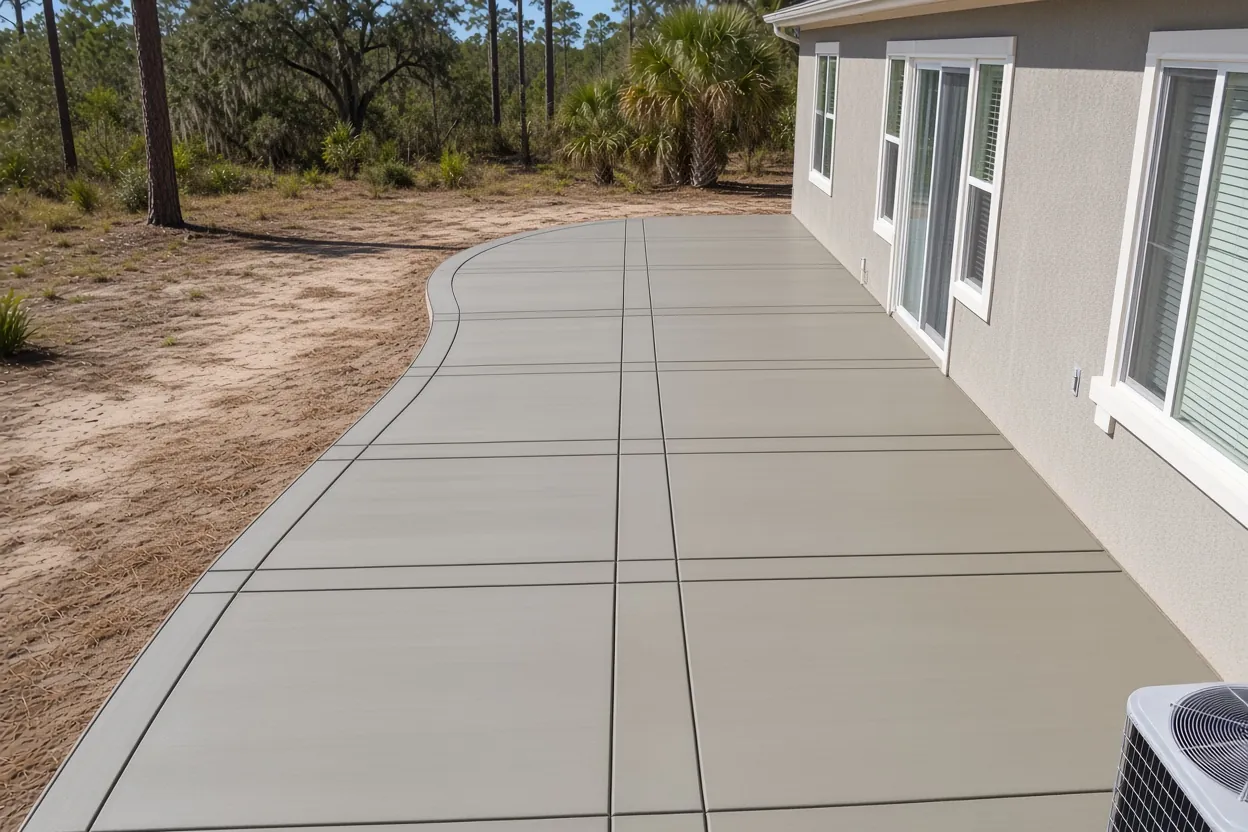
Lake Miriam got platted in waves. Apart from two small Farview plats from the 1920s, Montclair came first in 1964, Sherwood in 1967, Monteray Heights, Valley Hill, Tierra Alta and Kings Point in 1971, Granger Lor Estates in 1972, Lamplighter in 1976 and Live Oak Heights and Catamarta in 1978. The median build year sits around 1974. Have an original back stoop or small slab behind the house? The new patio has to tie into it or replace it.
An isolation joint keeps the new concrete separate from the house and from any old slab, so each one can move on its own. If the old stoop is cracked or tilted, we can break it out and pour one continuous patio instead of patching around it.
When a slab sits against the house, termite treatment comes up. Under FBC R318, when a builder uses soil treatment on new construction, exterior concrete within 1 foot of the house walls also gets treated. On an older house, ask your pest control company whether your current termite plan needs anything before we pour against the wall. A sliding door or lanai door also sets the finished height, so we measure from the threshold down and keep the slab low enough that water runs off, not in. Our Lakeland patio cost guide runs totals by size.
How Your Job Goes
Walk the back yard
We look at the soil, the low spots, the trees, the door threshold and any old slab that has to come out.
Written quote in 48 hours
Size, finish, tear-out and any thickened areas each get a line.
Permit or exemption
We confirm with the City whether your slab needs a permit or fits the under-$7,500 exemption request.
Compact, form and pour
We compact the sand, set forms to the grade we agreed on and, in summer, aim for an early pour.
Cure and hand it back
Curing starts right after finishing. We clean up and let you know when the furniture can go back.
City permit, the $7,500 exemption and paperwork for a patio here
Lake Miriam is inside Lakeland city limits. Its edges run along Hallam Drive to the north and Cleveland Heights Boulevard to the west, and Florida Avenue and the Polk Parkway are close by. Much of it was county land until March 1, 2001, so the City's Building Inspection Division is the office to ask about your patio, even if older records for your house sit with Polk County. Give them your address and a simple sketch, then ask whether your slab needs a permit.
Florida's HB 803, effective July 1, 2026, lets qualifying non-structural work on a single-family home valued under $7,500 skip a permit. A plain patio can come in under that number. FEMA maps the whole neighborhood polygon as Zone X, outside the special flood hazard area, so the flood exclusion shouldn't block you here. Confirm your address on FEMA's map anyway. The exemption still needs a written request and approval before work starts, and the building official decides what qualifies.
Bigger jobs add one more step. A patio contract above $2,500 triggers Florida's Notice of Commencement, which the owner or the owner's authorized agent records with the County Clerk ahead of the first day of work. Past $5,000, the City's building department gets its own copy before the first inspection. We list each of these on the written quote so nothing surprises you.
Common Questions
Behind a Lake Miriam house, what would a 12x16 patio slab run?
Can my Lake Miriam patio be poured now and screened in later?
How do I keep a backyard patio in Lake Miriam from getting too hot?
Will tree roots crack a new patio in my Lake Miriam back yard?
Is a patio in Lake Miriam permitted by the City or by Polk County?
How long before I can put furniture on a new Lake Miriam patio?
Sources
- 2023 Florida Building Code, Residential, Chapter 5 Floors (R506) (UpCodes / ICC)
- Find Your Neighborhood: Lake Miriam (archived) (City of Lakeland)
- Soils layer (NRCS SSURGO map units) (Polk County GIS)
- National Flood Hazard Layer, Flood Hazard Zones (FEMA)
- Recorded subdivisions layer (Polk County Property Appraiser)
- Live Oaks (UF/IFAS Gardening Solutions)
- CIP 29: Vapor Retarders Under Slabs on Grade (NRMCA)
- CIP 11: Curing In-Place Concrete (NRMCA)
- CIP 24 - Synthetic Fibers for Concrete (National Ready Mixed Concrete Association)