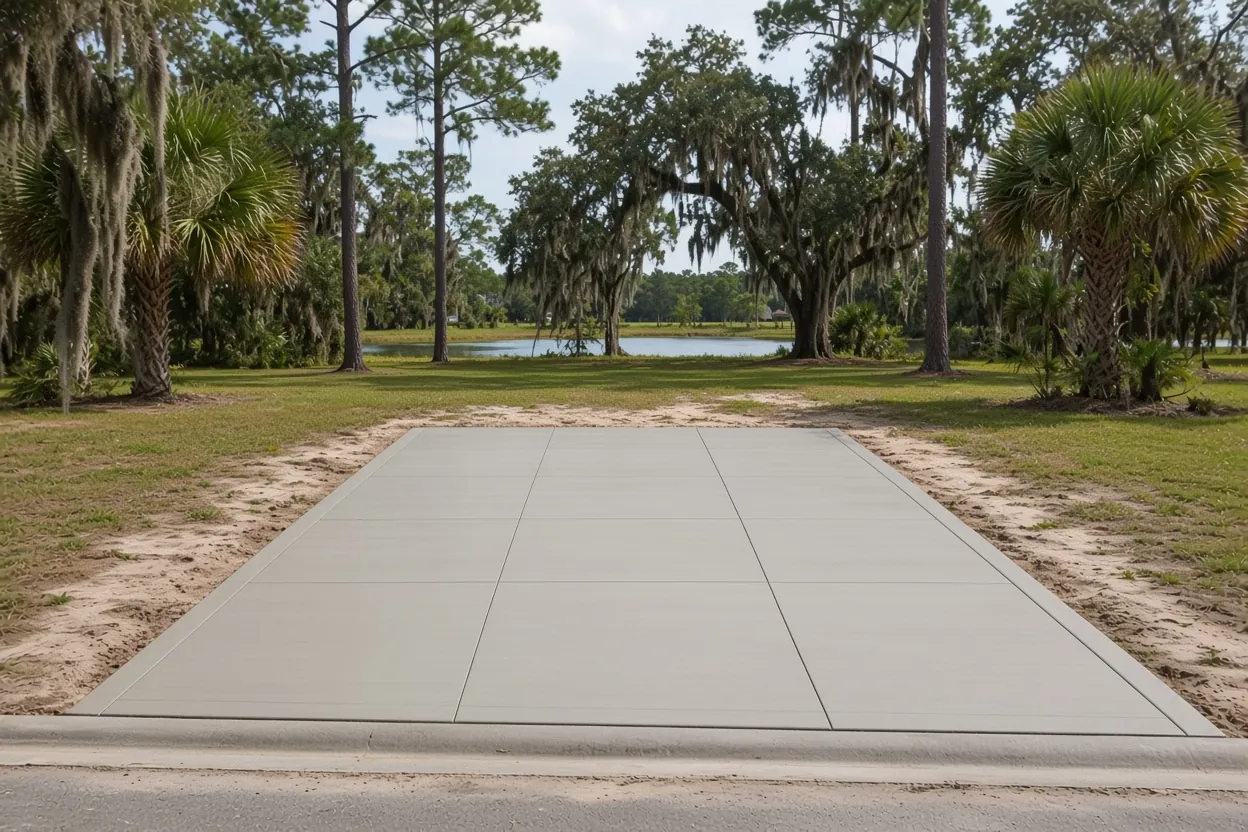
Lake Bonny at a glance
A 203-acre public lake with a 3-foot mean depth, and the Shore Acres plat that takes its name.
Slope toward a shallow lake under a state nutrient TMDL, older slabs on thin base, and open, breezy yards on pour day.
Permit office: City of Lakeland Building Inspection; Lakes and Stormwater for shoreline work · official page Shoreline projects on city lakes need City permits; other agencies may also require them.
A shallow public lake with fifty years of water samples
The Polk County Water Atlas lists Lake Bonny as a 203-acre public lake in the Peace River-Saddle Creek watershed, holding about 389.9 million gallons. Its mean depth is 3 feet and its deepest point is 11. The Atlas shows 15 water-quality and 4 hydrologic sampling locations, with the earliest sample dated 1975. The state verified it as impaired for nutrients, and the Florida Department of Environmental Protection set a nutrient TMDL for Lake Bonny in 2016, which sets in-lake targets for nitrogen and phosphorus.
None of that changes how thick your concrete is. It changes where the water off it goes. A broad, shallow lake that people have tested for half a century is a poor place to send driveway wash, sealer overspray or a bare-dirt edge that sheds sand every storm. So as a concrete contractor at Lake Bonny in Lakeland, we plan the fall of a driveway or patio before we plan its size. The rest of our Lakeland service area gets the same site visit; lake lots just get a longer look at the grade.
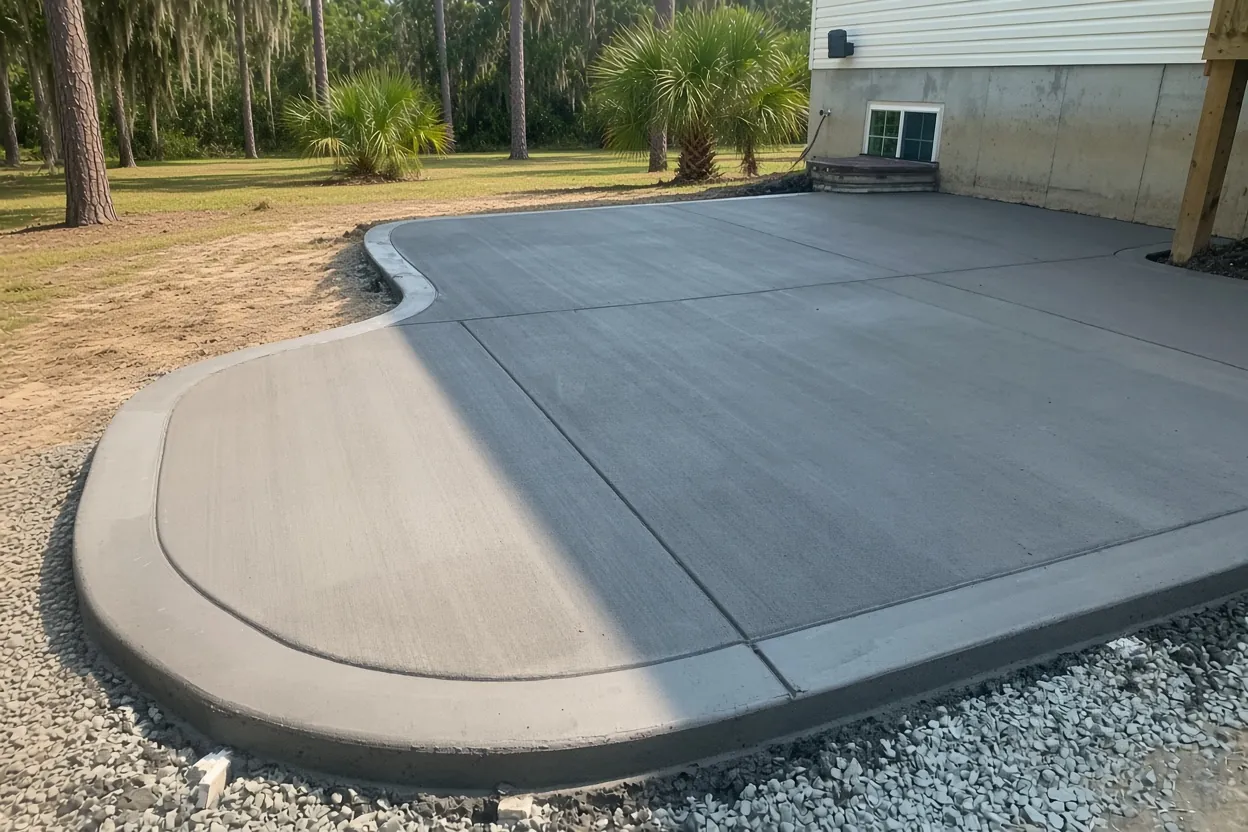
Pitching a slab so rinse water soaks into lawn, not the lake
Every slab needs some slope or it puddles. On a lake lot the question is which way. Here is what we look at on the walk-through, and what you can check before we arrive:
- Watch a hard rain. Note where water runs across the yard today and where it stands for an hour afterward. That path is where new concrete will send it, only faster.
- Find the downspouts. A gutter that empties onto a new patio adds roof water to what that patio has to shed.
- Leave a planted strip. A band of lawn or beds between the slab's low edge and the water gives runoff somewhere to soak in before it reaches the lake.
- Turn the pitch sideways if you can. A patio facing the water can fall toward a side yard or a planted swale instead of straight at the shoreline.
- Plan the washdown. If you pressure wash or reseal later, rinse toward the lawn side.
We put the direction of fall on the written quote, so you see where water goes before a form is set. If a patio needs a short curb or a deeper edge to hold its line on a slope, that shows up as its own line too.
What It Costs
Our standard Lakeland ranges. On Lake Bonny lots, tear-out of an old slab, base repair and drainage details are what move a job within them.
| Job | Per sq ft | Typical project | What moves the price |
|---|---|---|---|
| Concrete driveway | $8 to $14 | $5,000 to $10,000 | 4 to 5 in. broom finish, typical 2-car; tear-out adds $2 to $4 per sq ft |
| Concrete patio | $8 to $14 | $2,500 to $6,500 | About 250 to 450 sq ft; pitch away from the water, curbs on a slope |
| Sidewalk or walkway | $8 to $14 | $1,500 to $4,500 | 4 in., 3 to 5 ft wide; short runs hit a job minimum |
| Stamped and decorative | $14 to $24 | $5,000 to $16,000 | Pattern, integral or release color, sealer |
| Slab or shed pad | $7 to $12 | $2,000 to $7,500 | 4 in. reinforced; thicker or monolithic costs more |
Free written estimate after we see the site. Lake-side drainage work and old-slab removal are listed as separate lines.
Lakeshore work starts with Lakes and Stormwater
A driveway out by the street is an ordinary city permit. Anything that reaches the water is not. The city's lakeshore residents page says permits are required for shoreline projects on its lakes and that other local, state and federal agencies may also require permits. Talk to Lakes and Stormwater before you design a walk to the dock or a patio at the water line, and bring their answer to the estimate.
Look up your lot on FEMA's flood map too. It matters for the paperwork, because the state's small-job permit exemption doesn't apply to property in a flood hazard area. Our Lakeland concrete permit guide has a section on lake lots and shoreline concrete, plus the right-of-way and inspection steps for the apron.
Once you know the line you can't cross, the rest is layout. One layout that works: keep the patio back from the shore and run a narrower concrete walkway toward the water, which keeps more ground open and less concrete in the permit conversation.
Old slabs in the Lake Bonny Addition
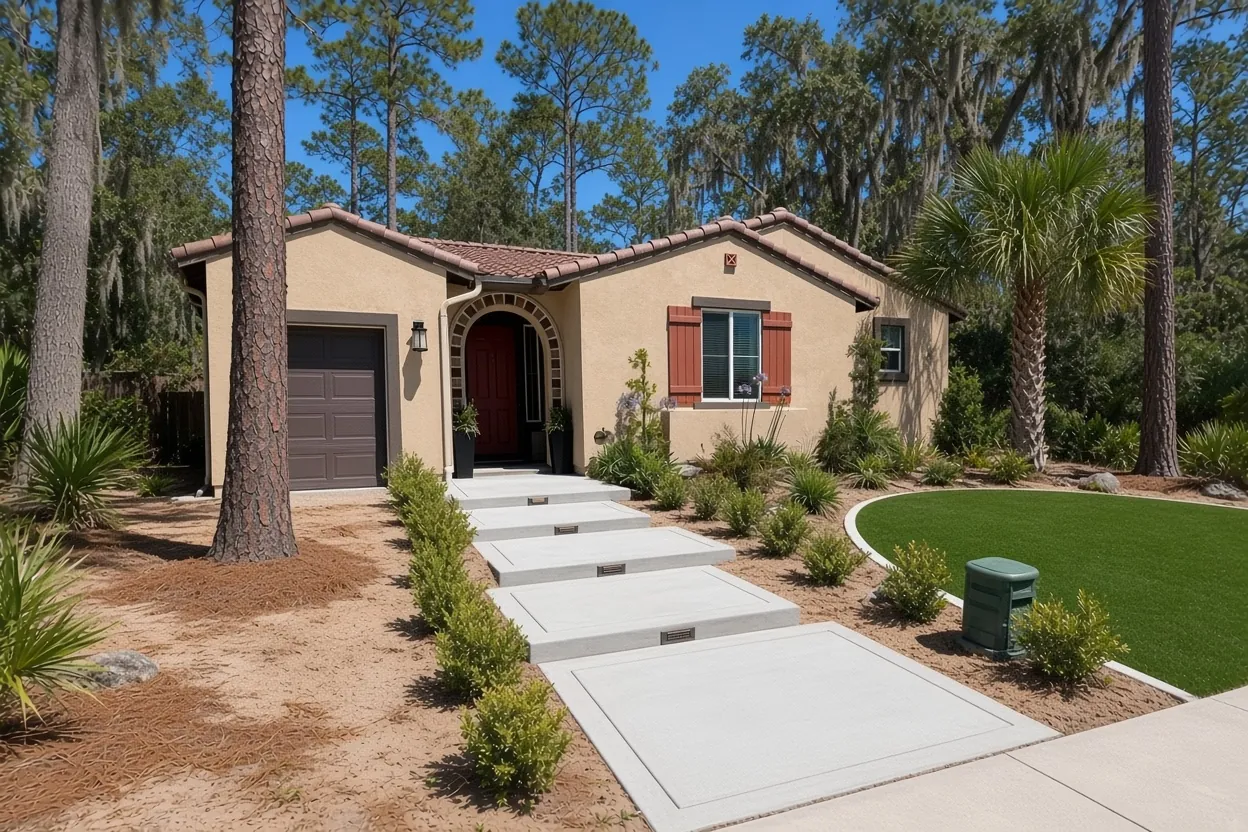
The neighborhood on the lake carries its name on paper: Shore Acres is platted as the Shore Acres Lake Bonny Addition, plat book 15, page 8, in ZIP 33801. A brokerage page citing the Florida Department of Revenue 2025 roll reports a median build year of 1952 there. That is the broker's figure, not the city's. If your house is that age, the driveway and walks may be too.
An old slab raises two questions before price. First, patch or replace? A slab with one clean crack can be cut and patched. One that has settled, rocks underfoot or has lifted at a root is one we quote as a replacement, and tear-out adds $2 to $4 per sq ft to the new pour. Second, what's under it? Nobody can see the base under an old slab, so we probe the subgrade once the old slab is up and compact it before anything new goes down.
If a big oak caused the lift, removing it for construction goes through the city's Tree Removal Permit application. We would rather curve the new edge or add a joint at the root than cost you the shade. The driveway cost guide shows how tear-out and base work show up on a quote.
How Your Job Goes
Grade walk
We walk the lot, trace where water runs today and measure the slab.
Written price with the fall marked
The quote shows size, thickness, finish and which way the slab drains.
Shoreline and permit check
We line up the city permit and confirm any shoreline question is settled before a pour date.
Pour and cure
Base compacted, forms set, concrete placed and finished, then covered right away.
Wind off the open water on pour day
A yard that opens onto 203 acres of water can catch more wind than one tucked between houses. That matters while concrete is fresh. NRMCA's guide to plastic shrinkage cracking says wind over 5 miles an hour, low humidity and high temperatures can dry the surface faster than bleed water rises, which leaves shallow, roughly parallel cracks.
So on a breezy day by Lake Bonny we set the pour early, keep a fog spray or curing cover close, and start the cure the moment finishing ends. If the wind is up and the forecast says it will stay up, we move the date rather than fight it. For the season and timing rules that apply all over town, see our patio page.
Nearby lake neighborhoods have their own quirks: Lakeshore on Lake Parker, concrete work around Lake Bentley, and the historic blocks of South Lake Morton and Historic Lake Morton, where new paving goes through review first.
Common Questions
Why does it matter that Lake Bonny is listed as impaired?
Can a patio run all the way to the water on a Lake Bonny lot?
Is Shore Acres the same as the Lake Bonny Addition?
How do I check whether my Lake Bonny lot is in a flood zone?
What does tearing out an old driveway add near Lake Bonny?
Does wind off the lake change the pour?
Sources
- Lake Bonny (Lakeland) (USF Water Institute / Polk County Water Atlas)
- Lakeshore Residents (City of Lakeland Lakes and Stormwater)
- Shore Acres Lake Bonny Add PB 15 PG 8 (Move With Momentum (brokerage))
- Lakeland's Urban Forest (City of Lakeland Parks and Recreation)
- CIP 5 - Plastic Shrinkage Cracking (National Ready Mixed Concrete Association)
- Nutrient TMDL for Lake Bonny (WBID 1497E) (Florida Department of Environmental Protection)