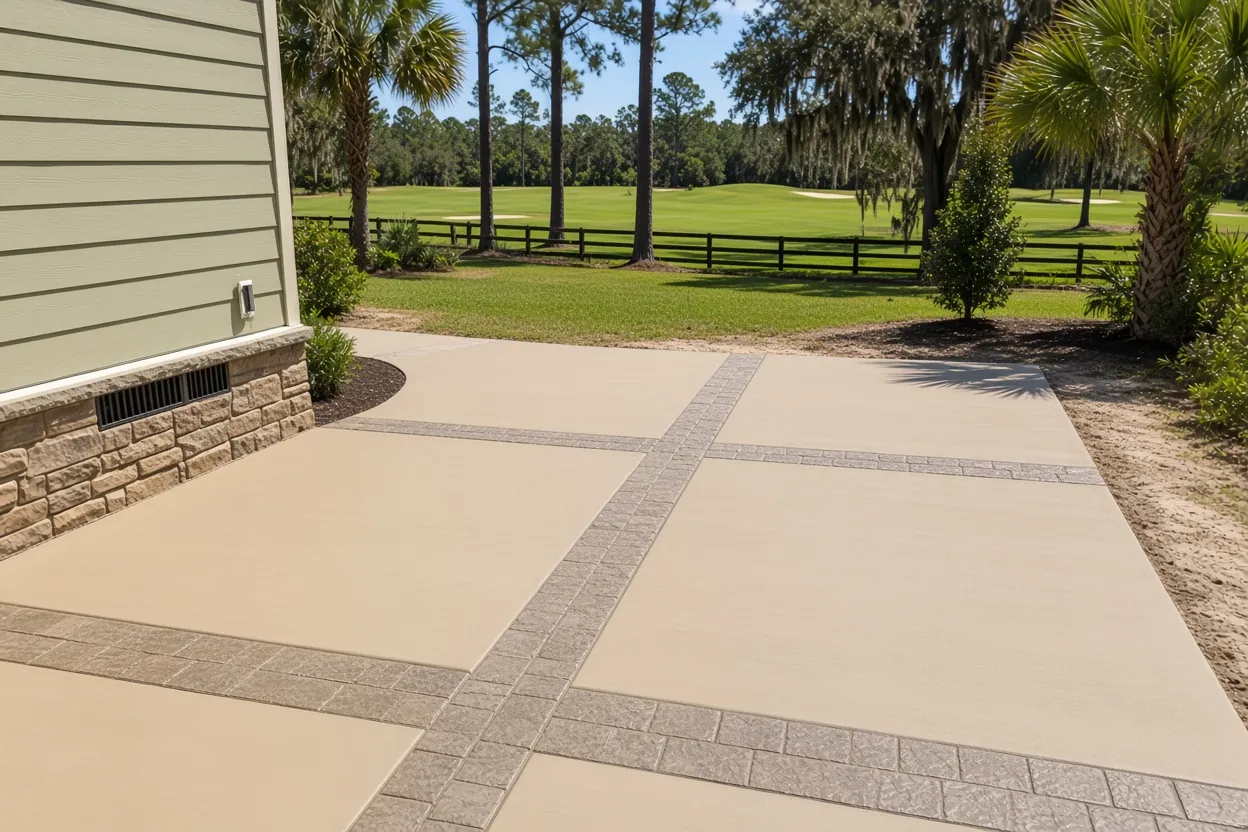
Cleveland Heights at a glance
Built around H.A. Stahl's 1925 course, now 27 city-run holes at 2900 Buckingham Ave on the Lake Hollingsworth side of town.
Rear lot lines against a city-run course, street-side-only access to back patios, and runoff that can cross between yard and fairway.
Permit office: City of Lakeland Building Inspection Division · official page City permits apply around the course; Public Works Engineering inspects driveway aprons in the right-of-way.
A 1925 golf community the city still runs
Cleveland Heights grew up around a golf course that opened in 1925 as the centerpiece of developer H.A. Stahl's exclusive golf course community, named for his Ohio hometown. The Florida Department of State's historic golf trail release says the course was described as "as long and difficult as most of the northern links," designed by Toomey and Flynn under William Flynn's supervision. The city took it over by the late 1930s and added a third nine in the early 1980s. Today it plays as 27 holes, three nines in 18-hole combinations, run by the city's Parks and Recreation Department.
The course sits at 2900 Buckingham Ave, and the U.S. Census geocoder places that address inside Lakeland city limits, so for homes around it the city is the permit office. Check your own address the same way if you're not sure. As a concrete contractor in Cleveland Heights we pour back patios, driveways, walks and slabs here. Paperwork for any of them is laid out in our Lakeland concrete permit guide.
When the back yard ends at a fairway
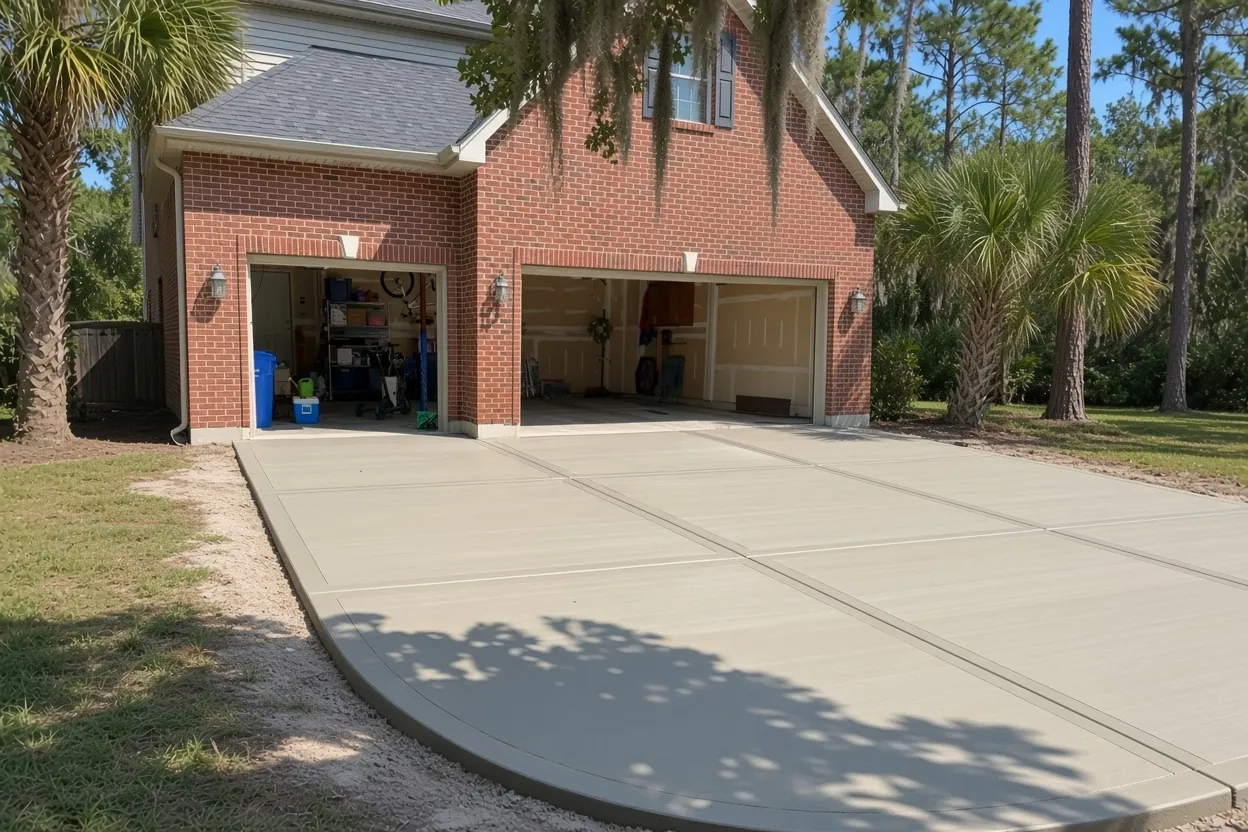
A patio or screen-room slab at the back of a course lot is the job we plan most carefully here, because the course past your rear line is run by the city's Parks and Recreation Department, not by a neighbor you can ask over the fence. A few things to settle before we form anything:
- Find your rear line. Pull out your survey, or the plat from closing. The slab, its forms and any dug-out soil all stay on your side.
- Ask about setbacks. How close a patio can sit to a rear lot line is a zoning question to settle with the city when the permit is applied for, not something to guess from where the grass changes.
- Plan access from the street. The fairway is a city facility, so we don't count on parking a ready-mix truck or a pile of base rock there. The route in comes from your street side.
- Look at the grade both ways. If the fairway sits higher than your yard, its runoff may already cross your lot. If it sits lower, your new slab could push water onto it.
We mark the slab's footprint and direction of fall on the written quote so you can check it against the survey. Where a slab needs a thickened edge or a short curb to hold its line on a slope, we price that as its own line.
What It Costs
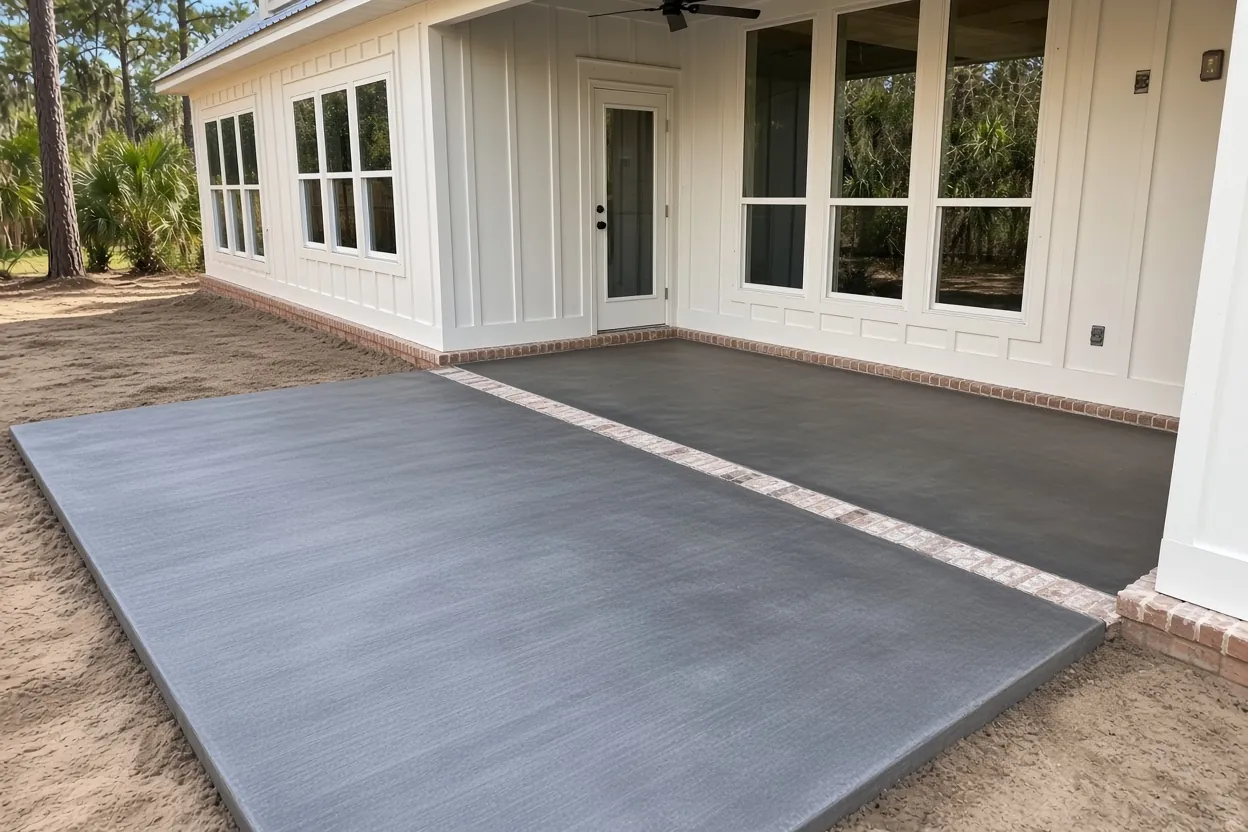
Our standard Lakeland ranges. Around the Cleveland Heights course, access to the back yard, the slope toward the fairway and tear-out of old slabs set where a job lands.
| Job | Per sq ft | Typical project | What moves the price |
|---|---|---|---|
| Concrete patio | $8 to $14 | $2,500 to $6,500 | About 250 to 450 sq ft; pump or wheelbarrow access, edge on a slope |
| Concrete driveway | $8 to $14 | $5,000 to $10,000 | 4 to 5 in. broom finish, typical 2-car; tear-out adds $2 to $4 per sq ft |
| Sidewalk or walkway | $8 to $14 | $1,500 to $4,500 | 4 in., 3 to 5 ft wide; short runs hit a job minimum |
| Stamped and decorative | $14 to $24 | $5,000 to $16,000 | Pattern, integral or release color, sealer |
| Slab or screen-room base | $7 to $12 | $2,000 to $7,500 | 4 in. reinforced; thicker or monolithic costs more |
Free written estimate after we see the site. Pumping, long wheelbarrow runs and removal of old concrete are listed as separate lines.
Getting concrete from the street to a course-side patio
If the back yard faces the fairway, the street is on the far side of the house. That makes access the second question on a Cleveland Heights patio. Measure the clear width of your side yard, gate to gate, and note anything in the way: an A/C pad, a fence post, sprinkler heads, a low branch.
When a ready-mix truck can back close to the forms, concrete goes straight down the chute. When it can't, the concrete has to be pumped over or wheeled through the side yard, and either one shows up on the quote. A wide gate and a short run keep a pour simpler. A narrow side yard isn't a deal breaker, it just changes the plan and the price.
Protecting the lawn on the way in is part of the job. We lay out the path, mark the irrigation heads you show us, and keep the route the same from base prep through finishing. If the patio will carry a screen enclosure later, tell us now. A slab that may be enclosed and heated someday is treated differently under the code than open flatwork, and our slab page explains what changes.
Driveways and walks on the street side of a Cleveland Heights lot
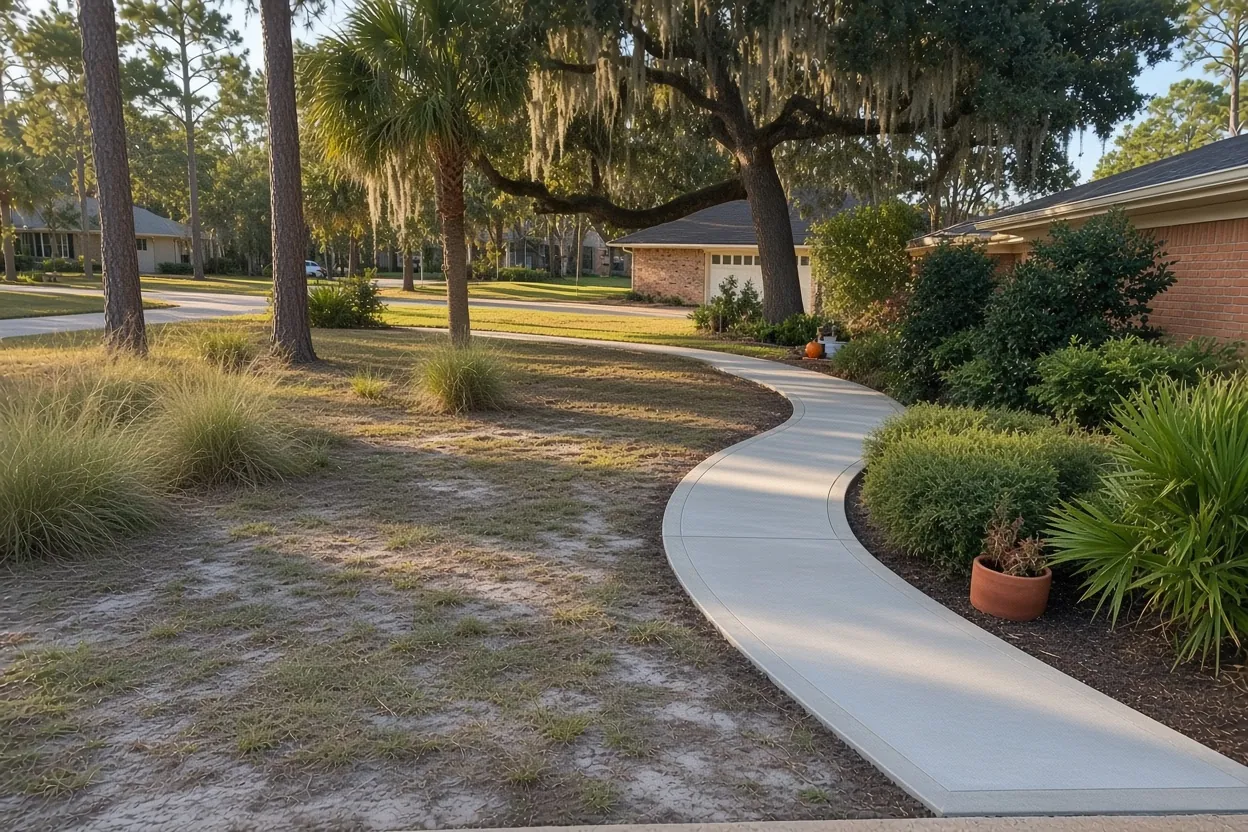
Out front, the work looks like the rest of the city's older neighborhoods. The apron where your driveway meets the street is city right-of-way. Per the city's engineering permit page, residential driveways are processed by Building Inspection and inspected by Public Works Engineering, all of it has to meet the Engineering Standards Manual, and other work in the right-of-way needs a Right-of-Way Use Permit. For a slab that's sunk or cracked across, we recommend full replacement of that panel rather than a patch, and tear-out adds $2 to $4 per sq ft.
If a big oak root lifted the old driveway, it will lift the new one too unless something changes. We route the new edge, add a joint, or both. Cleveland Heights isn't one of the city's seven local historic districts, so new paving here doesn't need a Certificate of Review. The South and East Lake Morton districts lie north of Lake Hollingsworth, though, and our historic driveway guide shows how to check.
Neighbors on this side of town include Lake Hollingsworth, Historic Beacon Hill, Lake Somerset, and Grasslands and Oakbridge, both built on reclaimed mine land. If you want a decorative finish out front, see stamped concrete, and for a front walk, our sidewalk work.
How Your Job Goes
Walk the rear line
We measure the slab area, look at your survey and the grade toward the course, and check the side-yard route.
Written quote with access noted
The price shows size, thickness, finish, direction of fall and how the concrete gets to the back.
Permits
City permit for the work, plus a right-of-way permit if the apron is part of the job.
Pour and protect
Base compacted, forms set, concrete placed and finished, then cured and kept off-limits until it's ready.
Common Questions
Can my patio go right up to the rear lot line on the golf course?
Who runs the Cleveland Heights Golf Course?
Can a concrete truck reach a patio on the course side of my house?
Will course runoff end up on my new patio?
Is Cleveland Heights inside Lakeland city limits?
What does a back patio on a course lot cost?
Sources
- Cleveland Heights Golf Course featured as Florida Historic Golf Trail (Florida Department of State)
- Cleveland Heights Golf Club (Polk County Golf)
- Parks (City of Lakeland Parks, Recreation and Cultural Arts)
- Census Geocoder: 2900 Buckingham Ave (U.S. Census Bureau)
- Engineering Permit Inspection Information (City of Lakeland Public Works Engineering)
- 2023 Florida Building Code, Residential, Section R506 (UpCodes / ICC)