Historic Lake Morton at a glance
Permit office: City of Lakeland Historic Preservation, then Building Inspection · official page New or replaced paving is a Minor Review item filed in iMS. Anything poured in an alley or at the street apron also needs a Right-of-Way Use Permit.
Deep lots between Lime and Lemon, narrow lots almost everywhere else
Historic Lake Morton covers the South and East Lake Morton districts, the blocks south and east of Lake Morton, north of Lake Hollingsworth and west of Ingraham Avenue. The city calls them Lakeland's first-generation suburbs. Building started around 1906, but most houses went up in the 1920 to 1926 boom, mostly Bungalow and Mediterranean Revival.
Lot shape drives the big concrete decisions here. The blocks were laid out on a grid with alleys, and lots are generally narrow with houses set close to the street. The exception the city calls out is in East Lake Morton, where several lots between E. Lime Street and E. Lemon Street run up to 200 feet deep. A deep lot means a long driveway to a rear garage, or room for a slab out back. A narrow lot means a tight side driveway and a truck that may have to come in from the alley.
We start every Historic Lake Morton job by reading which of those two lots you have. If you're closer to the Florida Southern campus, our South Lake Morton page covers those blocks.
The alley behind your house: access, rear pads and the right-of-way
The city's historic guidelines describe alleys as narrow public rights of way that split residential blocks lengthwise, with over 37,000 linear feet of them, about 7 miles, across four of the historic districts. Historically they were the back of the house: parking, garages and trash pickup.
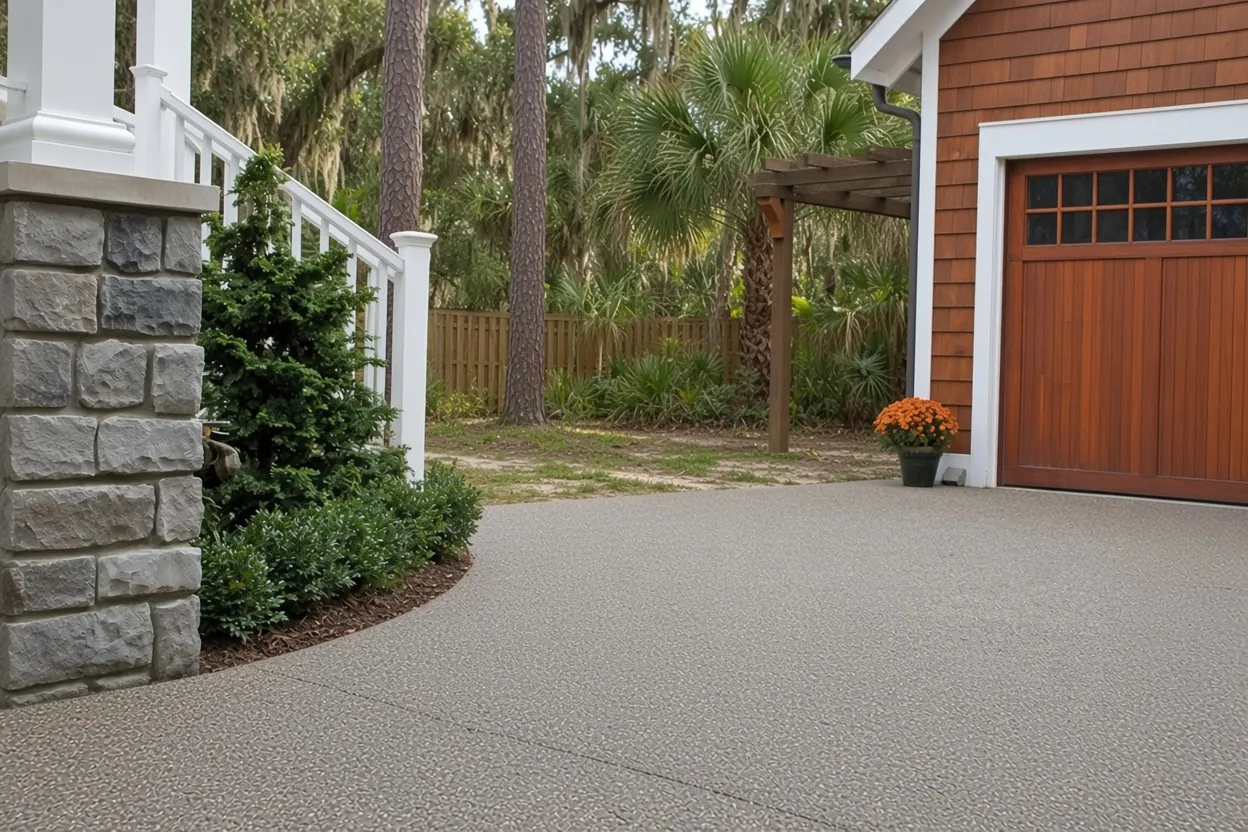
That history helps a Historic Lake Morton homeowner who wants off-street parking. The guidelines discourage extra driveway width for front-yard parking, but a parking pad at the rear, reached from the alley, fits the old pattern. Two rules follow. The pad is still permanent paving, so it goes through Minor Review like a driveway. And the strip where it meets the alley is city right-of-way, so that piece needs a Right-of-Way Use Permit from Public Works Engineering before work starts.
Alleys also change pour day. Some are wide enough to stage a truck or run a pump hose, others aren't, and overhead lines or a neighbor's fence can block the chute. We look at the alley during the free visit, not just the street side. The full permit order, from review to inspection, is laid out in our Lakeland concrete permit guide.
What It Costs
Our ranges for Historic Lake Morton work. On these lots, run length and access move the price more than anything else.
| Job | Per sq ft | Typical project | What moves the price here |
|---|---|---|---|
| Concrete driveway, side or ribbon | $8 to $14 | $5,000 to $10,000 | Run length on deep lots, ribbon vs solid, tear-out adds $2 to $4 per sq ft |
| Rear parking pad off the alley | $8 to $14 | $3,200 to $5,600 for a 20 x 20 ft pad | Alley access for the truck, apron in the right-of-way |
| Front walk replacement | $8 to $14 | $1,500 to $4,500 | Tie-ins at porch and street, short runs hit a job minimum |
| Patio on a sloped yard | $8 to $14 | $2,500 to $6,500 | Fall away from the house, root work |
| Slab for a rear garage or shed | $7 to $12 | $2,000 to $7,500 | Structure on top, thickness, how the truck reaches the back |
These are ranges, not a quote. We give a free written estimate after we see the lot, the alley and the street.
Porte cocheres, rear garages and a driveway the length of the lot
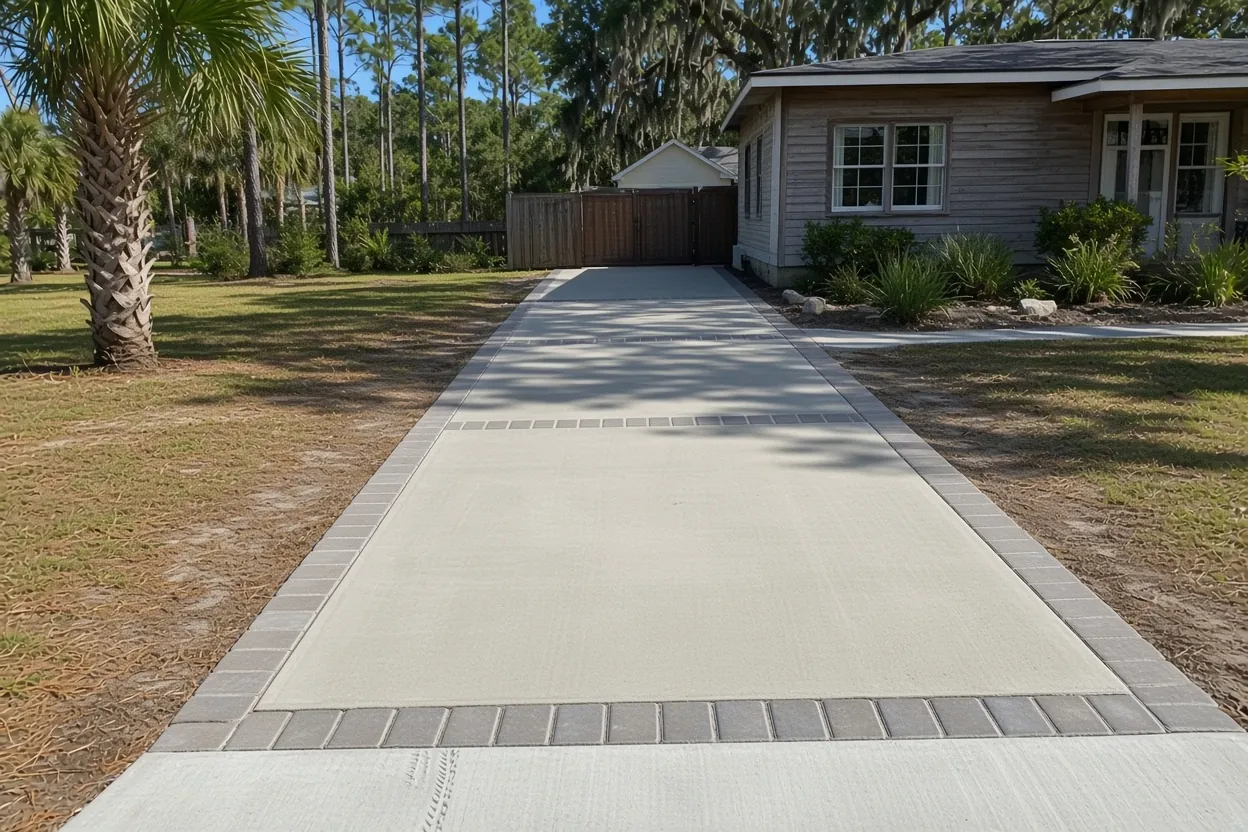
Porte cocheres and detached garages are common in these districts. The guidelines describe the pattern: a garage at the rear, reached by a driveway along one side of the lot or from the alley. Driveways usually run no wider than ten feet, and wider ones are listed as not acceptable. Tandem parking for up to two cars along the side of the house is accepted, and the guidelines note that some historic driveways used a ribbon layout, two strips of concrete or brick under the wheels.
On a 200 foot lot the length is what costs money. A ten foot driveway that runs 150 feet back is 1,500 sq ft. At our $8 to $14 per sq ft rate that comes to roughly $12,000 at the low end and $21,000 at the top, well past a typical two-car job. That's why, on the deep lots, we also price a ribbon driveway or a shorter solid run that ends at a rear pad. A job that size also needs a recorded Notice of Commencement (required over $2,500), and past $5,000 a copy goes to the city before the first inspection.
Our historic district driveway guide covers materials, curb cuts and the brick street rules in full, and the concrete driveway page covers thickness and reinforcement for the slab itself.
Rolling ground near the lake and where the water goes
The city's district narrative points to rolling topography, a mature tree canopy and the odd angled street or lake shore as part of what makes these blocks unusual for a Florida city. For concrete in Historic Lake Morton, rolling ground means a driveway or walk that climbs or drops, and a patio that has to shed water on a slope.
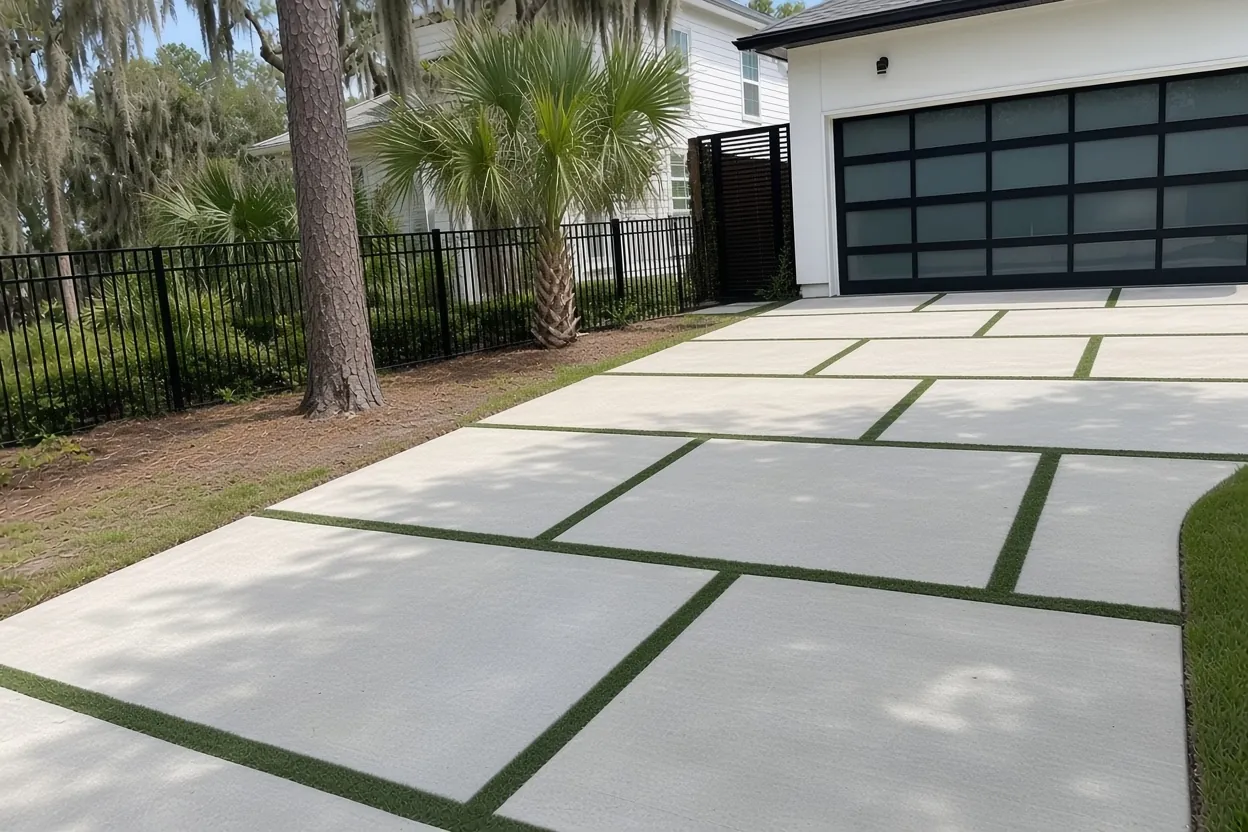
On a sloped lot we set the fall of a patio or rear pad so water runs away from the house and off the slab onto grass, not into a neighbor's yard or down the alley. A long side driveway that drops toward the street needs its joints and edges planned so runoff doesn't cut the sand out from under the low end. Florida soils run sandy, so we compact the base before forms go in.
Mature oaks are the other constant. The guidelines list cutting large shade trees as not acceptable, and removing any tree takes a city Tree Removal Permit. So we plan the walk or driveway around big roots first and only talk about the tree if there's no other line.
How Your Job Goes
Lot and alley walk
At the free visit we measure the side yard, the run to the garage and the alley, not just the front.
Written quote
You get layout, thickness, finish and the approvals in writing, with ribbon and solid options priced side by side when you ask.
Review step
Our visit measurements cover what the Minor Review site plan has to show. The building permit follows approval.
Pour from the side that reaches
We stage from the street or the alley, whichever reaches the forms without blocking neighbors.
Cure, then cars
We keep the slab covered and damp while it cures and tell you when foot traffic and then cars can go on it.
Front walks, the Palmetto Street corridor and Garden District blocks
Historic walks here were concrete or brick with a smooth surface, and the guidelines put front walks at about three to four feet wide. Loose stone isn't an accepted walk material. A replacement walk has to meet the porch steps at one end and the public sidewalk at the other, so we measure both before quoting. See our walkway page for joints and thickness.
Two parts of the district behave a little differently. East Palmetto Street between Lake Morton Drive and Michigan Avenue is a neighborhood commercial corridor with the Lakeland Public Library and the Polk Museum of Art, so a pour near it means planning where the truck parks. And the Garden District is a special overlay on part of East Lake Morton that allows land uses the base zoning doesn't, and the city calls it prime for mid-rise, multi-family and mixed-use redevelopment. It sits inside the historic district, so paving there still goes through Minor Review. If your parcel is in the overlay, tell us at the visit.
What to measure on an East or South Lake Morton lot
- Lot depth, if you're between E. Lime and E. Lemon, and how far back the garage or pad would sit.
- Width of the side yard where the driveway runs, and the clear height under a porte cochere.
- Alley width behind the house, plus any gates, wires or fences along it.
- The existing walk: width, and whether it meets brick or concrete at the street.
- Big oaks within reach of the work.
- Photos of the front and rear, so we can start the review site plan.
Send them with your call to (863) 400-2934 or through the contact page.
Common Questions
My East Lake Morton lot runs 200 feet deep. Is a driveway all the way to a rear garage worth it?
Can the concrete truck come in through the alley behind my house?
Can I add a parking pad off the alley instead of widening the front driveway?
Does the new driveway have to run through my porte cochere?
My house is in the Garden District overlay. Is the paving review any different?
Our yard slopes toward Lake Morton. How do you keep water off a new patio?
Sources
- Historic District Narratives (City of Lakeland)
- Design Guidelines for Historic Properties (City of Lakeland)
- Design Review (City of Lakeland Historic Preservation)
- Engineering Permit Inspection Information (City of Lakeland Public Works Engineering)
- Forms & Checklists (City of Lakeland Building Inspection)
- Lakeland's Urban Forest (City of Lakeland Parks & Recreation)
- Lakeshore Residents (City of Lakeland Lakes and Stormwater)