What Lakeland's driveway code lets you build on a Lake Miriam lot
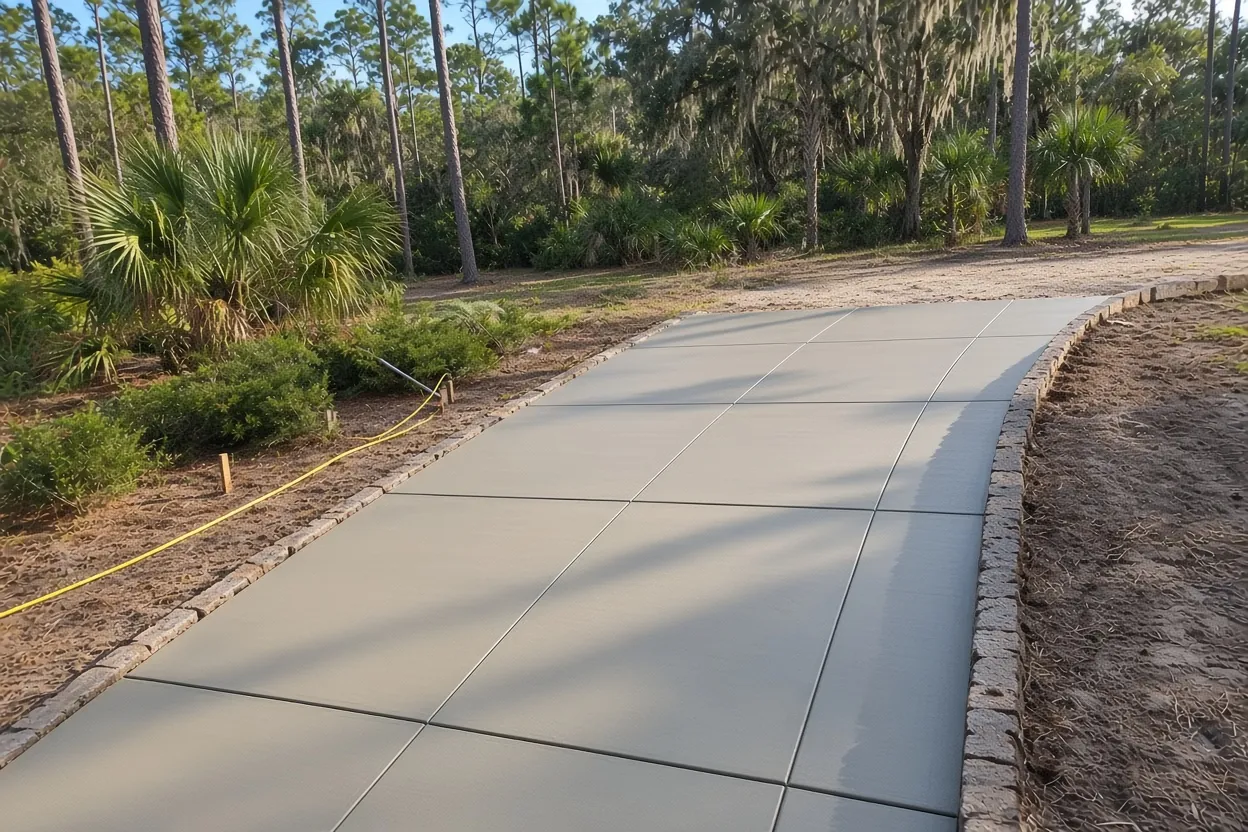
Before we price a new concrete driveway in Lake Miriam, we lay it out against Section 4.11.4.6 of the City's Land Development Code, adopted by Ordinance 5793. Outside the historic districts, a standard driveway can be 10 to 24 feet wide. A ribbon driveway runs 7 to 10 feet from outer edge to outer edge, with each tire strip at least 2 feet wide. A circular driveway needs at least 75 feet of lot frontage, and the slab has to reach at least 20 feet onto the lot.
You get one curb cut per lot, with exceptions only for circular driveways, side-by-side duplexes and lots with an improved alley. Want a second entrance for a boat? Unless you qualify for a circular layout, plan on widening the one you have instead. Our concrete driveways page covers the slab itself, and the Lake Miriam neighborhood page covers the rest of the work we do here.
Widening a 1970s slab for a third car or a trailer
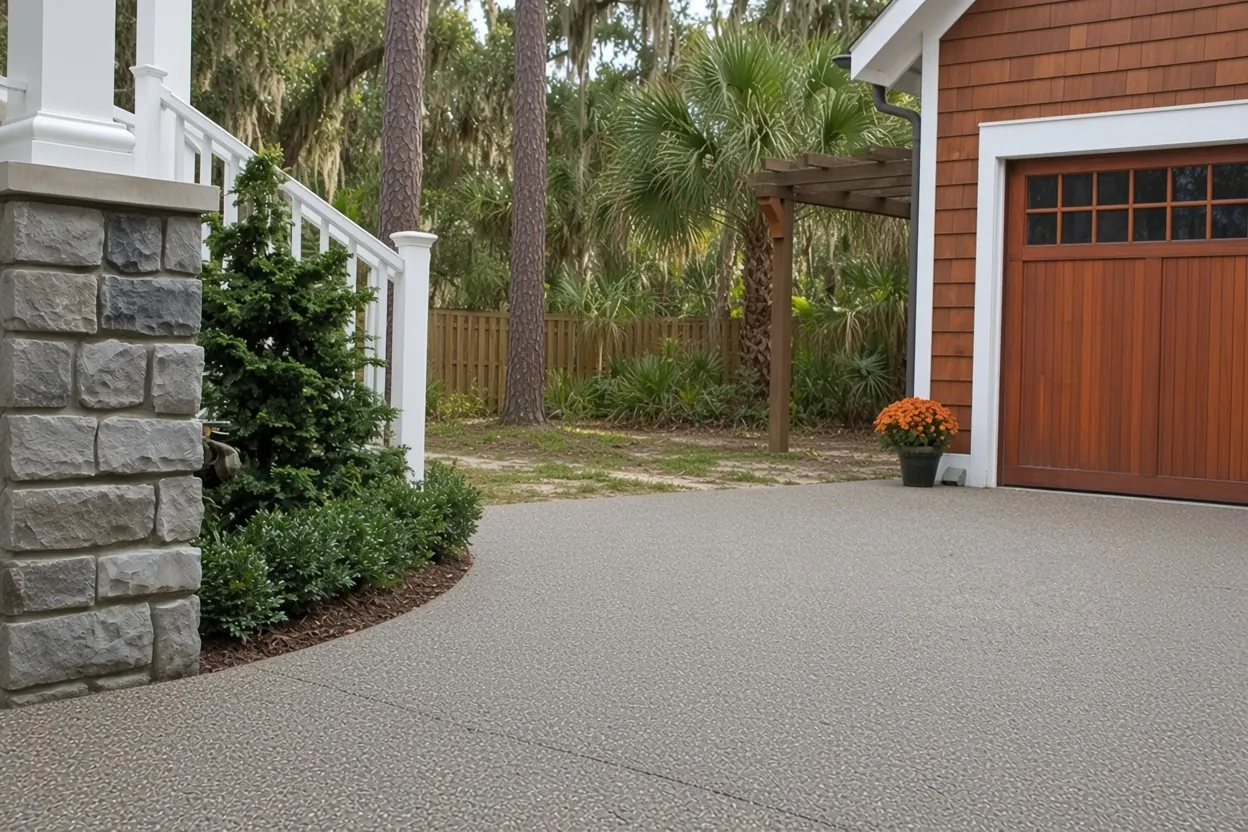
Property appraiser records show 633 of the single-family homes here with 1970s improvement dates, out of about 998 counted. Reva Heights alone has 166 houses on plats recorded from 1968 to 1977, and Summit Chase has 69 on its 1978 plat. Is the original slab sound but too narrow for what you park now? Adding width can cost far less than starting over.
Here's the math. A 10 by 20 foot strip is 200 sq ft, so $1,600 to $2,800 at our $8 to $14 per sq ft range. The widened driveway still has to stay at or under 24 feet wide, though the apron at the street can flare up to 3 feet past that on each side. The part in the right-of-way has to sit at least 3 feet off your side lot line.
Don't expect old and new concrete to match exactly in color. An isolation joint goes where the new strip meets the old slab so the two move on their own. If the original panels are cracked through or sunk at the garage, widening just adds new concrete to a failing slab. In that case a full replacement makes more sense, and tear-out adds $2 to $4 per sq ft. Our Lakeland driveway cost guide lays out totals by size.
What It Costs
Here are our ranges for driveway work in Lake Miriam. On these 1960s to 1980s lots, tearing out the original slab and any widening move the total the most.
| Job | Per sq ft | Typical project | What moves the price |
|---|---|---|---|
| Full driveway replacement | $8 to $14 | $5,000 to $10,000 | Two-car, 4 to 5 in. broom finish; tear-out adds $2 to $4 per sq ft |
| Driveway widening strip | $8 to $14 | $1,600 to $2,800 for a 10 by 20 ft strip | Saw-cutting the old edge, isolation joint, apron flare |
| New 20 by 30 ft driveway | $8 to $14 | $4,800 to $8,400 | Thickness, mesh or rebar, apron in the right-of-way |
| Stamped driveway | $14 to $24 | $5,000 to $16,000 | Pattern, color and sealer |
These are ranges, not quotes. Once we see the site, you get an exact number in a free written estimate. City permit fees are separate.
Four inches or five on Fort Meade sand, plus mesh and saw cuts
About 62% of Lake Miriam maps as Fort Meade-Urban land complex. The USDA series description calls Fort Meade very deep, well drained and rapidly permeable. That helps, since rain soaks through instead of sitting under the slab. Loose sand still needs compacting before the forms go in. Small pockets of Sparr soil, about 3.4% of the area, are mapped as somewhat poorly drained, so a yard that holds water after rain is worth pointing out at the walk-through.
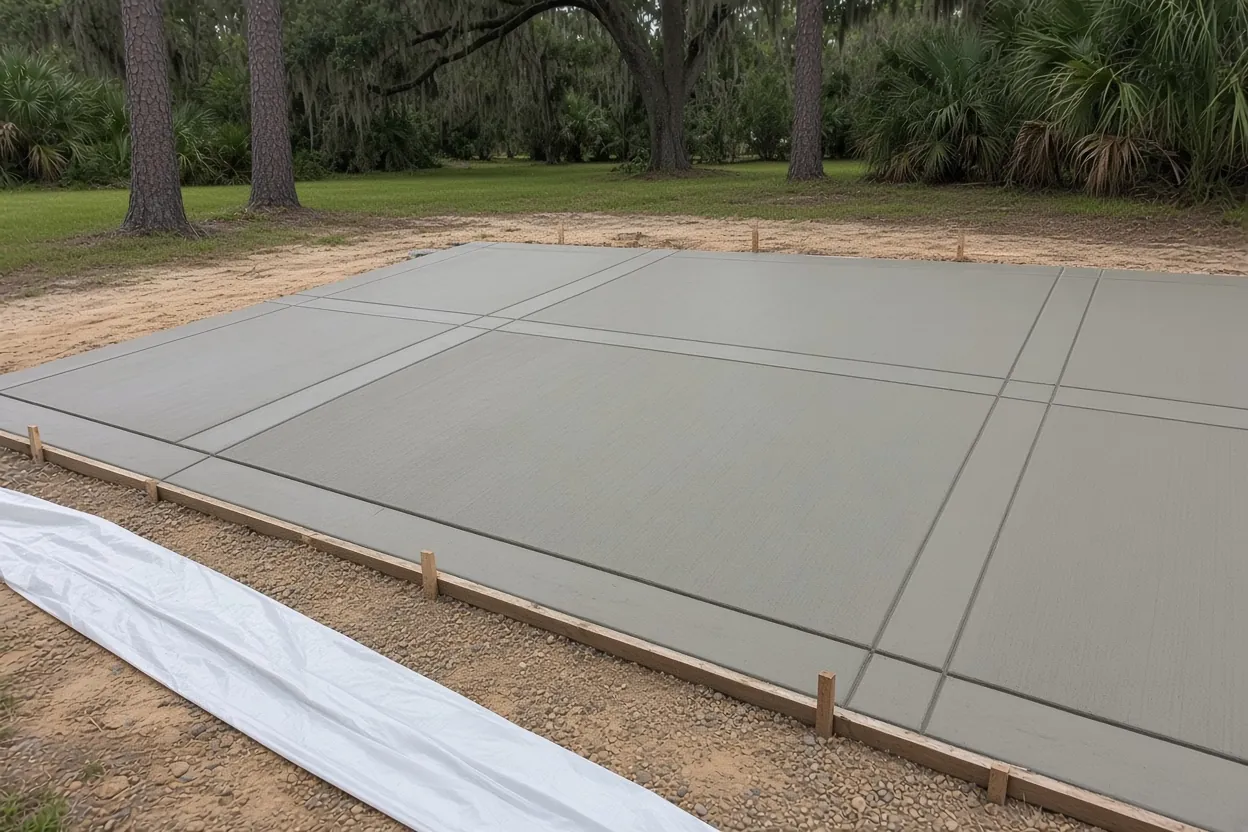
The Illinois Ready Mixed Concrete Association sets a homeowner minimum of 4 inches and 4,000 psi at 28 days. Four inches covers cars. Got a pickup, a camper or a boat trailer living on the slab? Then ask us to price 5. Concrete Network puts that extra inch at about 20% more concrete for nearly 50% more load capacity. The same guide puts wire mesh in 4 and 5 inch slabs, and rebar on about a 12 inch grid at 5 inches and up.
Control joints go no more than 10 feet apart and a quarter of the slab deep, per IRMCA and Concrete Network. Isolation joints separate the driveway from the garage floor, the front walk and the street. Synthetic fiber helps with early surface cracking, but NRMCA says it can't replace steel or let joints spread farther apart.
Permits for the slab and the apron in Lake Miriam
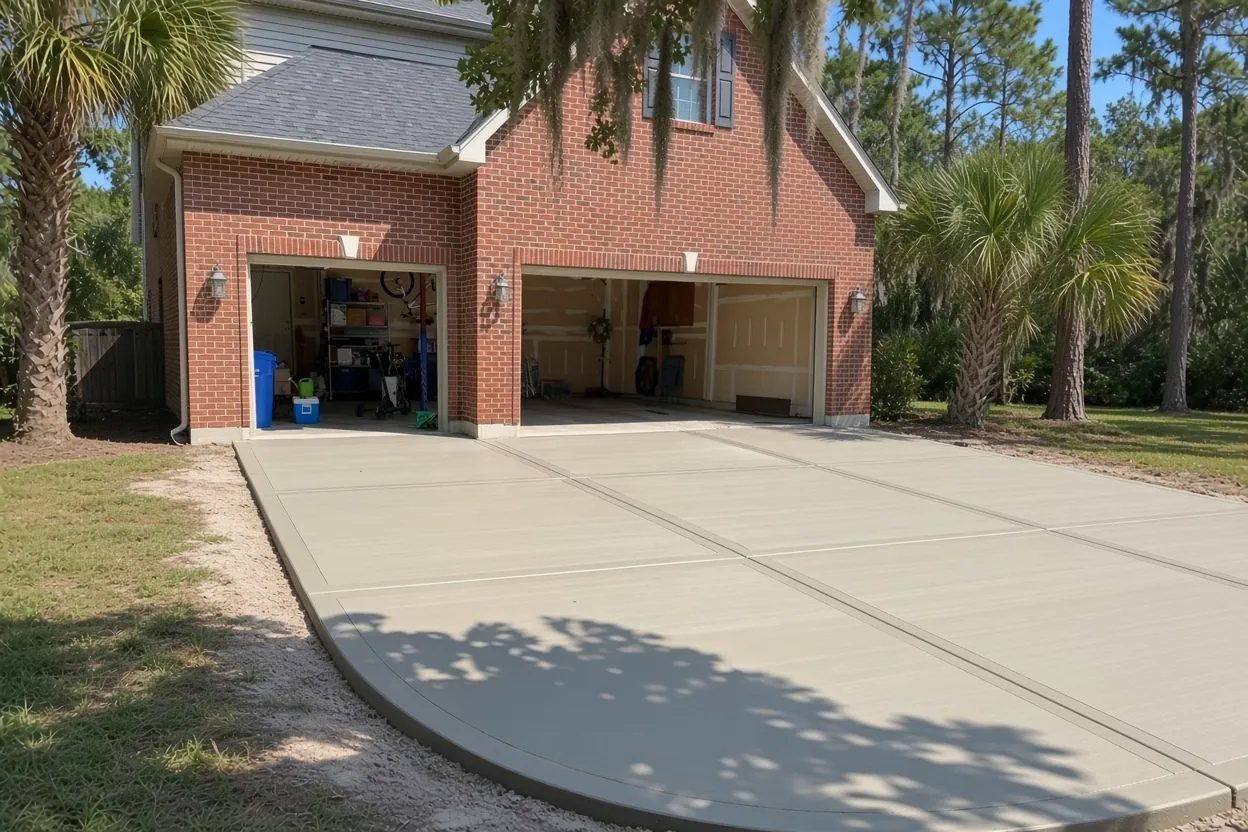
Lake Miriam sits inside Lakeland city limits between Hallam Drive, Lake Miriam Drive and Cleveland Heights Boulevard, with what the City calls easy access to Florida Avenue and the Polk Parkway. Much of it was unincorporated county land until March 1, 2001. A driveway here runs through the City's Building Inspection Division, and Public Works Engineering inspects it. The City asks for a pre-construction notice at least 48 hours before work starts. Any work in the City right-of-way, including the apron where it crosses that right-of-way, needs a Right-of-Way Use Permit from Public Works Engineering first, built to the City's Engineering Standards Manual.
City GIS codes most streets here as City-owned, including Dakeman Road, Deter Road, Devonshire Lane and Burgundy Place. Chalfont Lane, High Point Drive, Jones Trail and Sheryl Street are coded private, not City-owned. Live on one of those four? Tell us at the walk-through, and we'll sort out the apron paperwork before we quote it.
There's one more step under Florida law. On a direct contract over $2,500, the owner or the owner's authorized agent has to record a Notice of Commencement with the County Clerk before work begins. Over $5,000, a copy also goes to the building department before the first inspection. A two-car replacement in our $5,000 to $10,000 range clears both. Our Lakeland concrete permit guide walks through each form. If your house was permitted before 2001, its older records may sit with Polk County.
How Your Job Goes
Measure against the code
We check your lot's frontage, width and the one-curb-cut rule, and we note whether your street is City-owned or coded private.
Written quote in 48 hours
Tear-out, base, slab, reinforcement and apron each get their own line.
Permits and notice
Building Inspection permit, the Right-of-Way Use Permit when the apron meets a City street, and the 48-hour pre-construction notice.
Break out, compact, pour
We remove the old slab, compact the sand, set mesh or rebar and pour. In summer, we aim for an early start.
Cure and clean up
Curing starts right after finishing. Cars stay off for a week. We leave the yard clean.
Pour day, seven days off it and the sealer at a month
The National Weather Service puts the West Central Florida rainy season at May 25 to October 10. July through early September is its peak for heavy rain, and rainy-season highs run in the upper 80s to mid 90s. In those months we aim for early pours, with plastic on hand in case a shower pops up.
Heat speeds up the set. NRMCA's hot-weather guidance says to dampen the subgrade without leaving puddles, never add extra water to the mix on site, start finishing when the sheen leaves and start curing right after. It calls for at least 3 days of curing with wet burlap, plastic or a membrane compound, and Concrete Network warns that concrete not cured right away can lose up to half its strength.
After that, the slab just sits. Keep cars off it for at least 7 days. IRMCA suggests a sealer about 30 days after the pour and every 2 years after that, which helps the surface block water and stains. When the forms come off, we haul off the old concrete and leave the site clean.
Common Questions
How wide can I make a driveway in Lake Miriam?
Can I put a circular driveway in front of my Lake Miriam house?
How thick should a driveway be on the sandy soil in Lake Miriam?
Do I need a permit to replace a driveway on Dakeman Road or Deter Road?
I live on High Point Drive or Jones Trail. Does that change my driveway job?
When can I park on a new driveway poured in Lake Miriam's rainy season?
Sources
- Land Development Code, Sec. 4.11.4.6 Vehicle Use Area Design and Construction Standards (Ord. 5793) (City of Lakeland via Municode)
- Find Your Neighborhood: Lake Miriam (archived) (City of Lakeland)
- Engineering Permit Inspection Information (City of Lakeland Public Works Engineering)
- FORT_MEADE Official Soil Series Description (USDA-NRCS (OSDRegistry))
- Driveways (homeowner technical resource) (Illinois Ready Mixed Concrete Association)
- Concrete Driveway Installation: 8 Essentials (Concrete Network)
- CIP 12: Hot Weather Concreting (NRMCA)
- Florida Statutes 713.13 Notice of Commencement (Florida Legislature)
- CIP 24 - Synthetic Fibers for Concrete (National Ready Mixed Concrete Association)
- Rainy Season (National Weather Service Tampa Bay)